
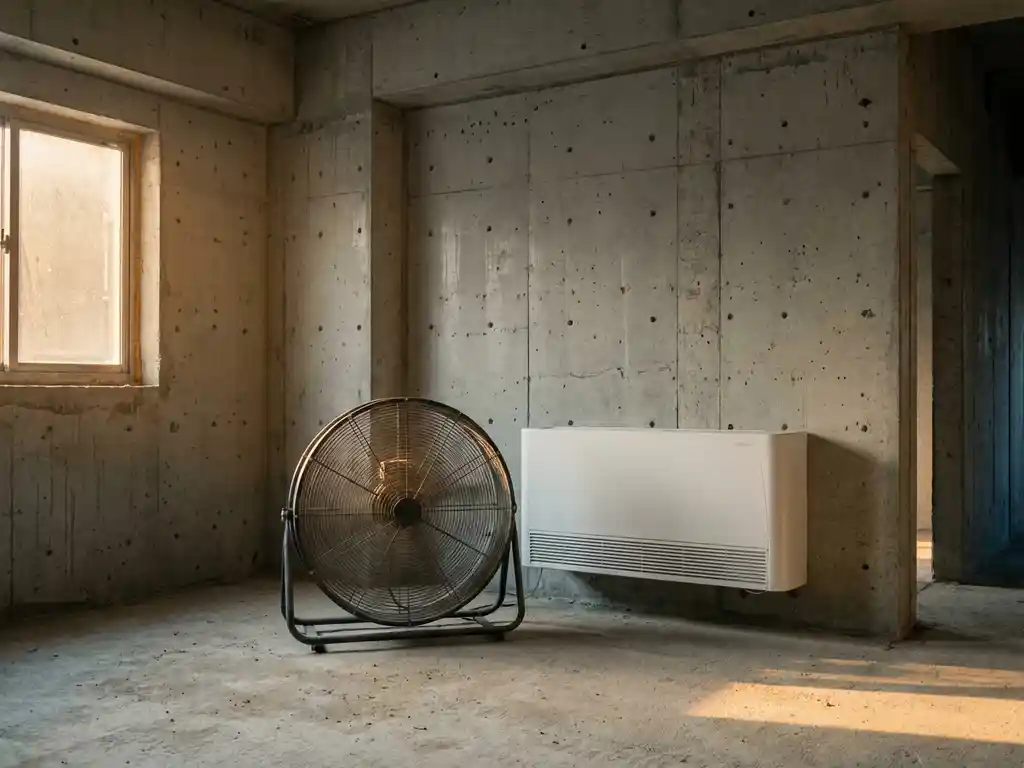
A fan consumes significantly less power than an air conditioner. While an average fan uses between 20 and 70 watts, an air conditioner easily draws 700 to 2.500 watts. On a hot summer day, the power consumption of an air conditioner can therefore be ten to twenty times higher than that of a fan. Below, you will find a clear answer to each question, so you know exactly which choice best suits your situation.
How many watts does a fan consume per day?
An average standing or table fan consumes between 20 and 70 watts per hour, depending on the model and setting. With eight hours of use per day, this amounts to a daily consumption of 0,16 to 0,56 kilowatt-hours (kWh). On an annual basis, during an average summer, that amounts to very little on your energy bill.
Ceiling fans are slightly higher, but generally remain below 100 watts. Industrial fans can consume more, but for home use, consumption is relatively low. Even if you run the fan all day on the highest setting, most models stay well below 1 kWh per day. That makes a fan one of the most economical ways to cool your home.
How much power does an air conditioner use on a hot day?
An average home split air conditioner consumes between 700 and 2.500 watts per hour, depending on the power and setting. With eight hours of use on a hot day, that quickly amounts to 5,6 to 20 kWh per day. That is a substantial difference compared to a fan.
Modern air conditioners with a high energy label (A+++ or higher) are more efficient than older models. The COP value, the ratio of cooling delivered to electricity consumed, determines how energy-efficient an air conditioner actually is. An air conditioner with a COP of 4 delivers four kilowatt-hours of cooling for every kilowatt-hour of electricity. Nevertheless, the total consumption on hot days remains significantly higher than with a fan.
Do you want to know which type of air conditioner suits your space? Via the air conditioning selection guide You will quickly find the right model based on your situation.
What is the difference in electricity costs between an air conditioner and a fan?
The difference in electricity costs between an air conditioner and a fan is significant. At an electricity price of approximately €0,30 per kWh, a fan costs you between 5 and 17 euro cents on a hot day. On that same day, an air conditioner easily costs €1,70 to €6. Over an entire summer, this can add up to tens or even hundreds of euros extra.
Suppose you use the air conditioner fifty days every summer, eight hours a day. With an average consumption of 10 kWh per day and an electricity price of €0,30, you pay €150 per summer in electricity costs for the air conditioner alone. In the same scenario, a fan costs you only €5 to €7 per summer. The difference is therefore not marginal, but substantial.
Does a fan really cool, or does it just feel that way?
A fan does not lower the air temperature in a room. What you feel is the windchill effect: the moving air accelerates the evaporation of moisture on your skin, cooling your body. As soon as you leave the room or turn off the fan, the temperature is exactly the same as before.
This is an important distinction. An air conditioner lowers the actual temperature in the room by expelling heat to the outside. A fan does not do that. On extremely hot days, when the temperature rises above 35 degrees, a fan falls short because the ambient air itself is too warm to provide effective cooling. In that case, the fan is actually blowing warm air over you.
For moderately warm days, when it is between 25 and 30 degrees outside, a fan works well as a supplement to other measures such as closing curtains during the day and ventilating during the cooler morning and evening hours.
When is an air conditioner worthwhile despite the higher consumption?
An air conditioner is worthwhile when the temperature in your home consistently exceeds 28 to 30 degrees and a fan no longer offers noticeable relief. This also applies to people who are sensitive to heat, such as the elderly, young children, or people with certain health conditions.
In addition, air conditioning is beneficial in situations where you need to be able to work productively from home. Heat has a demonstrably negative effect on concentration and performance. If you work from home and the temperature consistently rises to unpleasant levels, the comfort and productivity gains quickly outweigh the higher electricity costs.
Even if you live in a region where summers are getting hotter or if you have a bedroom that is difficult to ventilate, an air conditioner can be a good long-term investment. Especially if you choose an energy-efficient model with a high energy label.
How do you save electricity if you use an air conditioner anyway?
If you use an air conditioner, there are several ways to limit power consumption without sacrificing comfort. The most important tip: set the air conditioner to a temperature of 24 to 26 degrees instead of lower. Every degree cooler increases energy consumption by approximately 6 percent.
- Use the timer: Only run the air conditioner when you are at home or actually using the room.
- Close windows and doors: Keep the cooled air inside and prevent warm outside air from flowing in.
- Combine with sun protection: Close curtains or blinds during the day to block direct sunlight, so the air conditioner doesn't have to work as hard.
- Clean the filters regularly: Dirty filters result in higher energy consumption and reduced cooling capacity.
- Use sleep mode: Most modern air conditioners have a night mode that automatically reduces consumption.
- Choose an air conditioner with inverter technology: These models continuously adjust the power to the demand, which is more economical than air conditioners that constantly switch fully on and off.
Do you want to know what an installation will cost you? Then use the pricing tool to get a quick indication.
How De Betonboorder helps with installing an air conditioner
Installing an air conditioner sounds simple, but in practice, there is more to it than you think. For a split air conditioner, a hole must be drilled through the facade or wall for the pipes. That is exactly where our expertise comes into play.
- We drill precise holes through concrete, masonry, and other materials, without causing unnecessary damage to the surroundings.
- We work with high-quality diamond core drills for a sleek and clean result.
- Our professionals are available throughout the Netherlands and leave the workplace tidy.
- In many cases, we can schedule a professional within two days.
Do you want to have your air conditioner installed and do you need a professional for the drilling work? Contact us and we respond within 24 hours.
Related Articles
- What kind of tools are used to saw a stairwell opening?
- Is my loft ladder too steep and dangerous to continue using?
- Do I need to have the stairwell finished as well, or can I do that myself?
- How are ventilation holes drilled in the crawl space?
- How do I inspect my crawl space for moisture damage myself?
- What is the difference between natural and mechanical crawl space ventilation?
- Olimpia Splendid Unico vs Innova: fixed air conditioner without outdoor unit compared
- How do you cool a poorly insulated home in the summer?
- Innova ELEC series compared: 12HP vs 15HP vs 18HP
- Can an air conditioner work in extreme heat?
- What are the requirements for a steel beam when removing a load-bearing wall?
- How long is a structural calculation valid?