
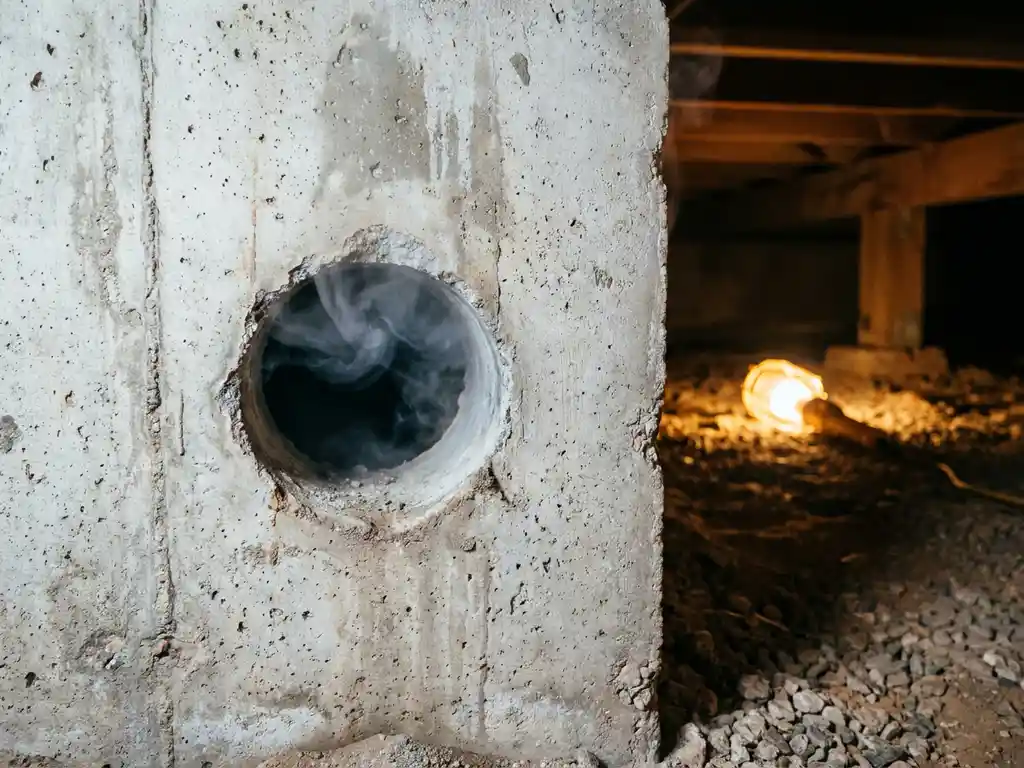
The difference between natural and mechanical crawl space ventilation lies in the way air is refreshed. With natural ventilation, air flows passively through vents and openings in the crawl space. With mechanical ventilation, an electrically driven fan actively circulates the air. Which system works best depends on your home type, the severity of moisture problems, and the structural situation. In this article, we answer the most frequently asked questions about crawl space ventilation so that you can make an informed choice.
How exactly does natural crawl space ventilation work?
Natural crawl space ventilation works by installing ventilation openings or grilles in the exterior walls surrounding the crawl space. Air flows in and out through these openings based on temperature differences and wind pressure, without the need for energy or equipment. This is the simplest and most traditional method of ventilation.
The effectiveness of this system depends heavily on the position and number of vents, the wind direction, and the outside temperature. On windless, damp days, natural ventilation performs less well. Ideally, vents are placed on opposite sides of the crawl space to create a continuous airflow that removes moisture before it can cause mold or wood rot.
A disadvantage of this system is that it actually draws in cold outside air in the winter, which can lower the floor temperature and increase the home's energy consumption. Nevertheless, it is a workable basic solution for many homes, especially if the crawl space is properly covered with foil and there are no serious moisture problems.
How does mechanical crawl space ventilation work?
Mechanical crawl space ventilation uses an electrically driven fan that actively draws air out of or blows air into the crawl space. This creates a controlled and constant airflow, regardless of the outside weather conditions. The extracted humid air is replaced by drier outside air through one or more supply openings.
There are two variants: systems that extract air from the crawl space (negative pressure) and systems that blow air in (positive pressure). With extraction, moist air is actively transported to the outside. With blowing in, dry air is forced into the space, forcing moist air out through cracks and vents. In practice, extraction is the most commonly used method.
Modern mechanical systems are often equipped with a hygrostat, a sensor that measures humidity and automatically switches the fan on or off based on the measured values. This makes the system energy-efficient and effective, without you having to monitor it yourself.
What are the advantages and disadvantages of both systems?
Both systems have specific strengths and weaknesses. The right choice depends on your situation, but an honest overview will quickly help point you in the right direction.
Advantages and disadvantages of natural ventilation
- Benefit: No energy costs, because no electricity is needed.
- Benefit: Little to no maintenance required
- Benefit: Low installation costs
- Downside: Dependent on wind and temperature, so less reliable
- Downside: Insufficient in case of severe moisture problems
- Downside: Cold air in winter can reduce the insulation value.
Advantages and disadvantages of mechanical ventilation
- Benefit: Constant and reliable air ventilation, regardless of the weather
- Benefit: Effective for severe moisture problems or poorly ventilated crawl spaces
- Benefit: Automatic control via hygrostat possible
- Downside: Higher purchase and installation costs
- Downside: Consumes electricity
- Downside: Requires periodic maintenance of the fan
When is mechanical ventilation better than natural ventilation?
Mechanical crawl space ventilation is better than natural ventilation in cases of persistent moisture problems, unpleasant odors, visible mold growth, or a crawl space that cannot be sufficiently ventilated naturally due to its structural condition. In those cases, a passive system simply offers insufficient capacity.
Specific situations where mechanical ventilation is preferred:
- The crawl space adjoins only one or two exterior walls, resulting in insufficient passage for natural airflow.
- There is a low crawl space height, where air circulation barely gets going.
- Your home is located in an area with a high groundwater level or heavy rainfall.
- There are already complaints of a musty smell in the home or condensation on the ground floor.
- Previous attempts with grilles have not solved the moisture problem.
In new-build homes and well-ventilated situations, natural ventilation can suffice perfectly. In existing buildings with a problematic crawl space, mechanical ventilation is almost always the better and more sustainable solution.
How much does it cost to install crawl space ventilation?
The costs for installing crawl space ventilation vary depending on the type of system, the size of the crawl space, and the required work. Natural ventilation via vents is cheaper than a mechanical system, but offers less guarantee of a good result for moisture problems.
When installing ventilation openings in concrete or masonry exterior walls, concrete drilling is required to create the correct penetrations. The total cost depends on the number of openings to be drilled, the thickness of the wall, and the accessibility of the work location. For an accurate quote, it is advisable to request a quotation tailored to your specific situation.
How De Betonboorder helps with crawl space ventilation
Good crawl space ventilation starts with the right penetrations in the exterior walls of your home. We handle the drilling of ventilation openings from start to finish, quickly and professionally, so you don't have to worry about the technical execution. Whether you want to have a single grille installed or a complete mechanical system connected, we ensure the right penetrations in the right place.
What we do for you:
- Drilling ventilation openings in concrete, brick, and other materials
- Working with high-quality diamond drill bits for minimal collateral damage
- Execution by experienced professionals throughout the Netherlands
- The workplace is left neat and tidy.
- In many cases, a professional is on site within two days.
Would you like to know what we can do for your crawl space? Contact us and we will respond within 24 hours with a suitable proposal.
Related Articles
- Can my concrete floor accommodate an opening for a stairwell?
- What if my floor is too thin for a stairwell?
- Having air conditioning installed: how does the installation proceed step by step?
- Can air conditioning worsen allergies?
- Can an air conditioner run on solar energy?
- What is the best air conditioner?
- How long do you have to wait after air-conditioned transport?
- How does an air conditioning heat pump work?
- Which plug do you use in a hollow wall?
- Why is my drill slipping on a tile?
- How do I know if I can drill myself or need a professional?
- How much does a structural calculation for load-bearing wall removal cost?