
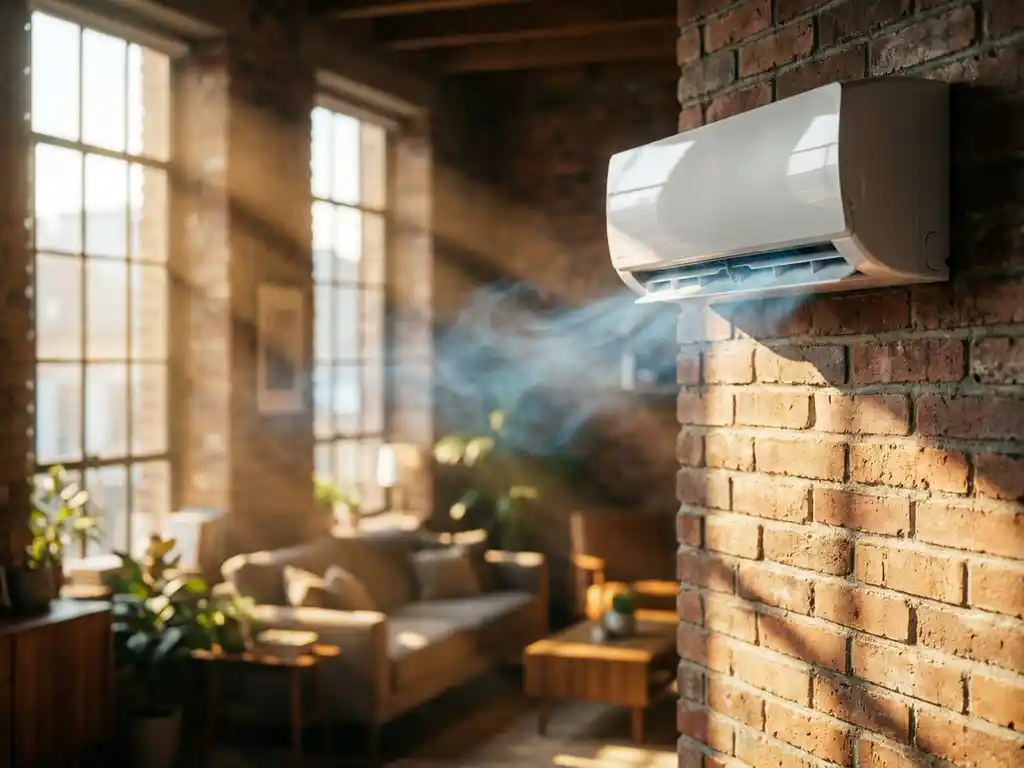
An air conditioner can certainly function in extreme heat above 35 degrees, but performance decreases significantly as the outside temperature rises. Most modern air conditioners are designed to operate down to temperatures of 40-43 degrees Celsius, where cooling capacity gradually decreases and energy consumption increases. At temperatures above 35 degrees, your air conditioner has to work harder to achieve the same level of comfort.
Why does your air conditioner lose power during extreme heat days?
When the outside temperature exceeds 35 degrees, your air conditioner has to expend increasingly more energy to dissipate heat into the even hotter outside air. This process becomes exponentially more difficult: while your air conditioner might deliver 100% of its nominal capacity at an outside temperature of 25 degrees, this can drop to 70-80% at 38 degrees. The result is that your living room no longer reaches the desired 21 degrees, but hovers around 24-26 degrees, while your energy bill rises significantly due to the increased power consumption.
The solution lies in choosing an air conditioner with sufficient reserve capacity and optimizing your home insulation. Ensure your air conditioner has at least 20-30% more cooling capacity than theoretically required for your space, so that there is a buffer for extreme temperatures.
How do you prevent your air conditioning from becoming overloaded during heatwaves?
Overloading your air conditioner during heatwaves can lead to costly repairs and complete failure at the moment you need the system most. Signs of overloading include running constantly without a temperature drop, strange noises, or the safety mechanism tripping frequently. An overloaded air conditioner consumes up to 40% more power while cooling less, and its lifespan can be shortened by years due to the constant stress on the components.
Prevention begins with creating shade around the outdoor unit, regularly cleaning filters, and avoiding heat sources in cooled rooms. Do not set your thermostat lower than 6-8 degrees below the outside temperature and use fans to improve air circulation.
Can an air conditioner work in extreme heat above 35 degrees?
Yes, an air conditioner can function in extreme heat above 35 degrees, but with significant limitations. Most air conditioners are technically designed to operate up to temperatures of 40-43 degrees Celsius. However, their effectiveness decreases drastically as the outside temperature rises.
At temperatures above 35 degrees, air conditioners face the following challenges:
- Reduced cooling capacity: The cooling capacity may decrease by 20-30%
- Increased energy consumption: The air conditioner has to work harder and consumes more power.
- Longer cooling time: It takes longer to reach the desired temperature.
- Risk of overload: Components may become overloaded with prolonged use
Modern inverter air conditioners generally perform better at extreme temperatures than older fixed-speed models. These systems can gradually adjust their power to the conditions.
Why does my air conditioning become less effective during heatwaves?
The effectiveness of your air conditioner decreases during heatwaves due to the fundamental operating principles of cooling technology. An air conditioner works by transporting heat from the inside to the outside via a refrigerant. When the temperature difference between inside and outside increases, the system must invest more energy to move the same amount of heat.
Important factors influencing performance:
- Thermodynamic laws: It becomes exponentially more difficult to dissipate heat as the outside temperature rises.
- Condenser performance: The outdoor unit can dissipate heat to the hot outside air less efficiently.
- Coolant pressure: Higher temperatures lead to increased pressure in the system
- Compressor load: The compressor has to work harder and can overheat.
This explains why your air conditioner seems to run constantly during a heatwave without reaching the desired temperature. It is not a defect, but a natural limitation of the technology.
What is the maximum temperature difference that an air conditioner can create?
The maximum temperature difference that an air conditioner can effectively create is typically between 10 and 15 degrees Celsius. This means that with an outside temperature of 35 degrees, you can realistically expect an indoor temperature of 20 to 25 degrees, depending on various factors.
Factors influencing the maximum temperature difference:
- Air conditioner type: Inverter models perform better than on/off systems
- Dimensioning: An undersized air conditioner does not achieve the maximum difference.
- Insulation quality: Good insulation increases the achievable temperature difference
- Room size and layout: Large, open spaces are more difficult to cool
- Heat sources: Sunlight, devices, and people reduce the effectiveness
At extreme outdoor temperatures of 40+ degrees, a temperature difference of 8-12 degrees is more realistic. Forcing a larger difference leads to overloading and higher energy costs without significantly better comfort.
How can I get my air conditioning to work optimally at high temperatures?
To ensure your air conditioner performs optimally during high temperatures, there are various strategies you can implement. These measures not only help improve performance but also extend the lifespan of your system.
Maintenance and preparation:
- Clean the filters regularly: Dirty filters restrict airflow and reduce efficiency by 15-25%
- Check the outdoor unit: Remove leaves, dirt, and obstructions around the condenser.
- Provide shade: Place a sunshade or parasol over the outdoor unit (without blocking the airflow)
- Professional maintenance: Have the coolant levels and components checked annually.
Smart settings and usage:
- Do not set the thermostat lower than 6-8 degrees below the outside temperature.
- Use the timer function to pre-cool before the heat hits.
- Combine with ceiling fans for better air circulation.
- Close curtains and blinds during the hottest hours
- Avoid using heat-producing appliances during peak hours
During very extreme temperatures, you might consider letting your air conditioner work harder at night when the outside temperature is lower, and accepting a higher indoor temperature during the day.
How De Betonboorder helps with air conditioning installation
We at De Betonboorder understand that a well-functioning air conditioner is essential, especially during extreme heat. That is why we offer specialized air conditioning system services for monoblock air conditioners that perform excellently at high temperatures.
Our expertise includes:
- Professional drilling: We drill two holes with a diameter of 16 cm through concrete and stone walls with precision.
- Dust-free installation: In stone walls, we always work with dust extraction; in concrete walls, with water-cooled core drills.
- Monoblock specialists: Our experience with Innova monoblock air conditioners ensures optimal performance at extreme temperatures.
- Complete service: From drilling the holes to leaving the workplace tidy
Ready to have your air conditioning installation taken care of by professionals? Contact us today. touch with Contact us for a no-obligation quote and experience the difference of professional installation.
Related Articles
- How many degrees can an air conditioner cool your house down?
- Can an air conditioner cause a headache?
- How does a ducted air conditioning system work?
- Why is my air conditioner so loud?
- Where can I buy the best air conditioner?
- Can an air conditioner cause noise nuisance for neighbors?
- For which jobs do you need a concrete drill?
- What happens if you hit a reinforcing bar while drilling?
- What is a chemical anchor and when do you need it?
- How do you drill a hole in the wall for an extractor hood?
- How do you report the removal of a load-bearing wall to the Owners' Association?
- Can you make an opening in a load-bearing wall?