
The cost of installing crawl space ventilation depends on the number of openings required, the type of ventilation, and the accessibility of the space. In most cases, it involves a combination of drilling into the foundation and installing grilles. In this article, we answer the most frequently asked questions about crawl space ventilation so that you know exactly what to expect.
Which factors determine the cost of crawl space ventilation?
The cost of crawl space ventilation is determined by the number of ventilation openings, the type of foundation, the accessibility of the crawl space, and the chosen form of ventilation. A concrete foundation requires professional drilling, while a cavity wall or wooden foundation is approached differently. The size of the project also plays a major role.
Below you will find a list of the most important cost factors:
- Number of openings: The more ventilation openings required, the higher the total costs.
- Foundation material: Drilling in concrete or reinforced concrete is specialized work and requires diamond core drills.
- Accessibility: A hard-to-reach crawl space or foundation increases the working time.
- Ventilation type: Mechanical ventilation entails additional material costs compared to natural ventilation.
- Region: Travel costs and regional rates may vary by location.
By clearly mapping out in advance how many openings you need and what type of foundation your home has, you avoid surprises later on.
How many ventilation openings does a crawl space need?
As a rule of thumb, you need at least one ventilation opening for every 50 square meters of floor area, with a minimum of two openings per crawl space. Openings are preferably installed on opposite walls to create a continuous airflow that effectively removes moisture.
A crawl space of 80 square meters therefore typically requires two to four openings, depending on the layout and airflow. In the case of an irregular or compartmentalized crawl space, more openings may be necessary to adequately ventilate all corners. A professional will assess the best approach for your situation on-site.
Please ensure that ventilation openings are not positioned too low relative to ground level, so that rainwater cannot run into them. Additionally, grilles with fine mesh prevent pests from entering the crawl space.
What is the difference between mechanical and natural crawl space ventilation?
Natural crawl space ventilation works based on pressure differences and wind: air flows in through grilles and out the other side. Mechanical ventilation uses a fan to actively draw in or extract air, ensuring a more constant air exchange regardless of the weather.
Natural ventilation
Natural ventilation is the simplest and cheapest solution. Openings are made in the foundation and fitted with grilles. The system operates without electricity and requires hardly any maintenance. The disadvantage is that its operation depends on wind and temperature differences, meaning it can be less effective during windless periods.
Mechanical ventilation
Mechanical ventilation is more effective for severe moisture problems or a crawl space with limited natural airflow. A small fan ensures continuous air exchange. The purchase and installation are more expensive, but this system delivers the best results for persistent moisture problems. Power consumption is limited, but it is an ongoing expense.
Can crawl space ventilation also be installed in concrete foundations?
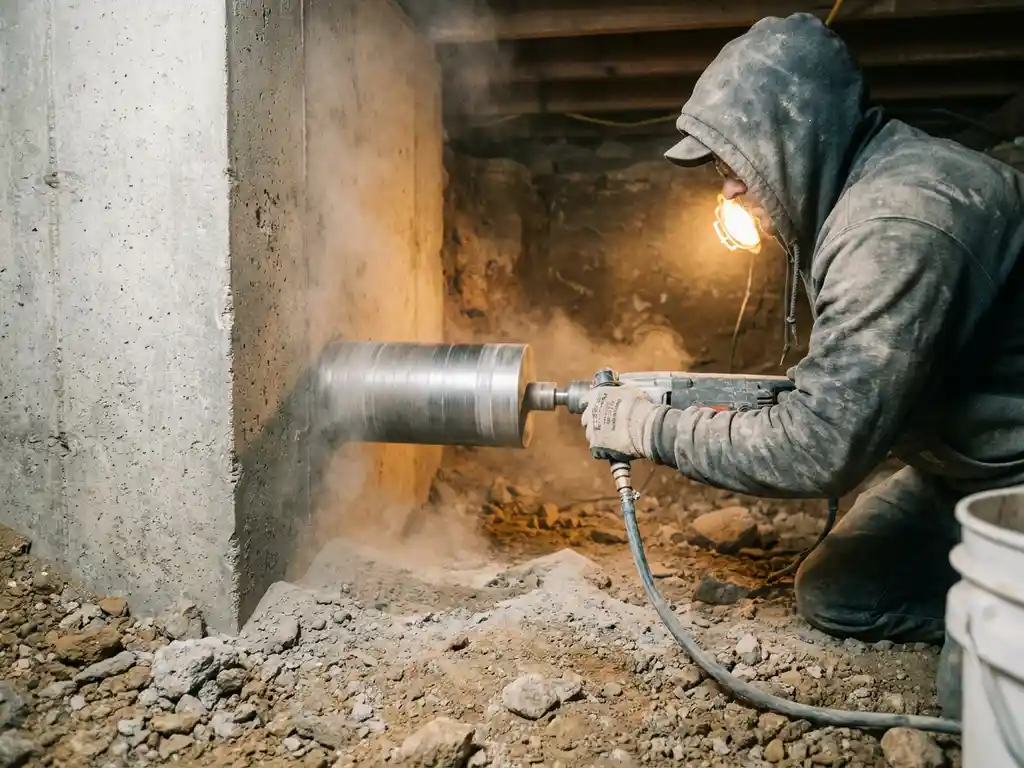
Yes, crawl space ventilation can be installed in concrete foundations without any problems. This requires diamond drilling, in which a precise hole is drilled using a specialized diamond core drill bit without damaging the surrounding structure. This also applies to reinforced concrete, where the reinforcement poses no obstacle for a professional concrete driller.
Drilling into concrete requires the right equipment and knowledge. Diamond drilling works dry or with water for cooling, is virtually vibration-free, and leaves a clean, round opening that aligns perfectly with a ventilation grille. This ensures the foundation remains structurally intact and no unnecessary damage is caused to the surrounding masonry or concrete.
Through our crawl space ventilation service The openings are drilled to size, precisely at the desired location and diameter.
When is it advisable to have crawl space ventilation installed?
It is advisable to have crawl space ventilation installed as soon as you notice moisture problems in the crawl space, a musty odor in the house, or when mold growth is detected on floors or beams. It is also smart to ensure proper ventilation immediately during new construction or renovation.
Concrete signals that action is needed:
- A persistent musty or moldy smell in the home, particularly on the ground floor.
- Condensation or water droplets on the inside of floor joists or insulation material.
- Visible mold or wood rot on the underside of the wooden floor.
- A crawl space without any ventilation openings, which is common in older homes.
- Elevated humidity in the home that cannot be explained by daily use.
The longer moisture problems remain untreated, the greater the risk of structural damage to the foundation and floor structure. Early intervention saves significantly in the long run.
How is crawl space ventilation installed in practice?
In practice, installing crawl space ventilation consists of a number of clear steps: the situation is assessed, the locations for the openings are determined, holes are drilled into the foundation, and finally, the ventilation grilles are installed. The entire process is usually completed within a day.
The step-by-step procedure:
- Inspection: The professional inspects the crawl space, determines the size, and identifies the best positions for the ventilation openings.
- Highlight: The boreholes are marked on the foundation, taking into account the desired airflow and the height relative to ground level.
- To drill: With a diamond core drill, the openings are drilled precisely to size. This is done quickly and without excessive vibration or dust.
- Installing grilles: The ventilation grilles are bricked in or secured, and fitted with mesh to keep out pests.
- Cleaning up: The workplace is left tidy, including the removal of drilling debris and dust.
In most situations, the nuisance for residents is minimal. The drilling produces some noise, but because diamond technology is used, vibrations are barely felt in the rest of the home.
How De Betonboorder helps with crawl space ventilation
Good crawl space ventilation prevents moisture problems, reduces musty odors, and contributes to better insulation of your home. De Betonboorder takes care of this for you from start to finish, even if your foundation is made of concrete or reinforced concrete. This is what we do for you:
- Professional drilling of ventilation openings in concrete, reinforced concrete, and other foundation materials.
- Use of high-quality diamond core drills for a tight, precise opening without damage to the surroundings.
- Installing ventilation grilles in the correct locations for optimal airflow.
- Operating throughout the Netherlands, with a nationwide network of experienced professionals.
- In many cases, a professional will be at your location within two days.
- The workplace is left neat and tidy.
Do you want to know what crawl space ventilation costs for your situation, or do you want to schedule a professional immediately? Contact us and we will respond within 24 hours with a suitable proposal. You can also read more about our working method on the website of De Betonboorder.
Related Articles
- Do I need a permit for an opening in the upper floor?
- Is a stairwell worth the investment for an extra room in the attic?
- There is water in my crawl space: what should I do?
- Is it groundwater or poor ventilation under my house?
- Will my energy bill be higher due to a cold, damp floor?
- How long does the warranty on an air conditioner last?
- How do I know if concrete is reinforced?
- How do you test the cooling performance of an air conditioner?
- How do you prevent mold caused by an air conditioner?
- What happens if damage occurs during drilling?
- What is a steel beam and why do you need one when removing a load-bearing wall?
- Why is an environmental permit required for load-bearing wall removal?