
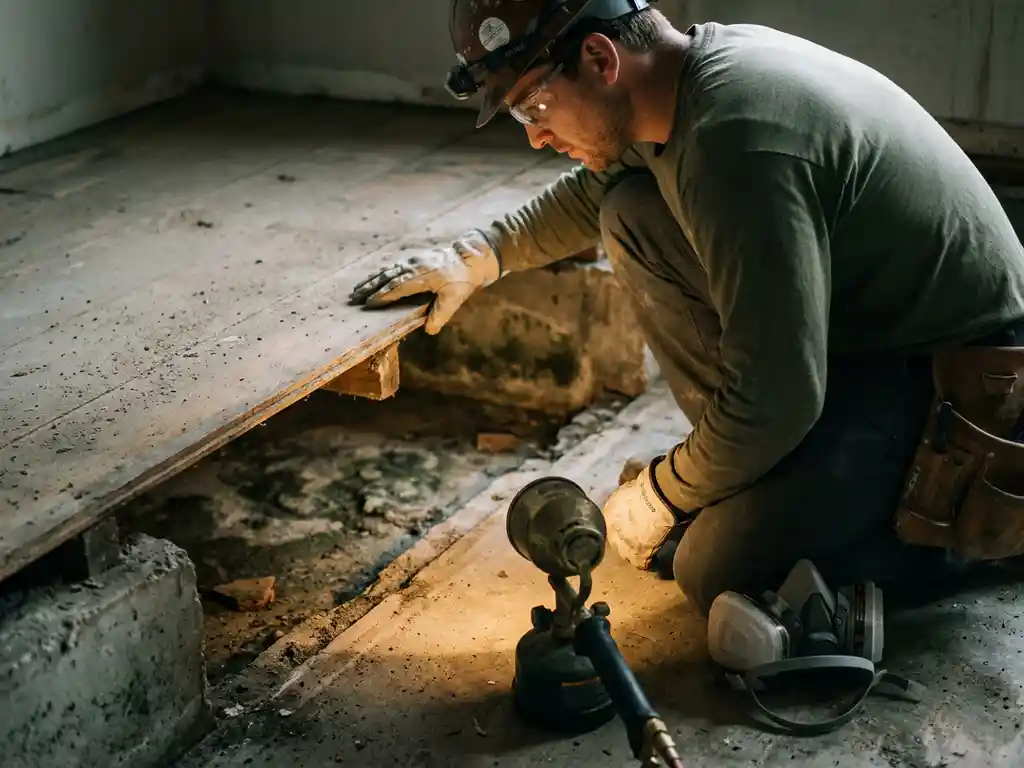
Yes, mold spores under the floor can be harmful to the respiratory system. When mold develops in the crawl space or under a floor, the spores spread through small cracks and openings to the living space above. People with allergies, asthma, or a weakened immune system are at the greatest risk. In this article, we answer the most important questions about mold under the floor and what you can do about it.
How do mold spores under the floor get into the air?
Mold spores travel via air currents. Because warm air rises, the air in a home is constantly drawn upwards from the crawl space or the space under the floor. In doing so, these air currents carry microscopic spores that enter through cracks in the floor, around pipe penetrations, and through ventilation openings.
This phenomenon is called the chimney effect or stacking effect. Even if the floor looks neat on the surface, active mold growth can occur under the floor covering or in the crawl space. These spores are not visible to the naked eye, but they are definitely present in the air you breathe. A musty smell in the house is often the first sign that something is wrong under the floor.
Good one crawl space ventilation plays a crucial role in preventing this spread. When there is sufficient air circulation under the floor, moisture and mold spores accumulate less quickly.
What health problems can mold spores cause?
Mold spores in indoor air can cause a wide range of health complaints, from mild irritation to severe respiratory problems. The most common symptoms are a runny nose, sneezing, itchy eyes, coughing, and fatigue. With prolonged exposure, symptoms can become chronic.
People with asthma or allergies are usually the quickest to notice that something is wrong. In them, mold spores can trigger asthma attacks or worsen existing allergic reactions. Children and the elderly are also more sensitive to the effects of indoor mold because their immune systems are more vulnerable.
In cases of severe or prolonged exposure to certain types of mold, such as the well-known black mold (Stachybotrys chartarum), symptoms can extend beyond respiratory problems. These include headaches, difficulty concentrating, and a general feeling of malaise. It is therefore important to take mold under the floor seriously and not just treat the symptoms.
How dangerous is mold under the floor compared to mold on the wall?
Mold under the floor is often more dangerous than mold on the wall because it is harder to detect and therefore remains unnoticed for longer. Mold on a wall is usually visible quickly, allowing for a faster response. Mold in the crawl space or under floor coverings can grow undisturbed for years.
Moreover, mold under the floor is located in a space that is often poorly ventilated, making the growth conditions ideal. High humidity, little light, and poor air circulation are precisely the conditions under which mold thrives best. As a result, a small damp spot can develop into a major mold problem in a short time.
Another difference is that mold on the wall can sometimes be treated locally with cleaning agents. Mold in the crawl space, in most cases, requires a structural approach, addressing both the source of the moisture and the mold growth itself.
What are the causes of mold under the floor?
The primary cause of mold under the floor is excessive moisture. That moisture can have various sources, and identifying the right source is essential for a sustainable solution.
- condensation: When warm, humid air comes into contact with a cold surface, the moisture condenses. This often happens in poorly ventilated crawl spaces.
- Rising damp: If there is no proper moisture barrier present, moisture can rise from the ground and accumulate under the floor.
- Leaks: A leaking water pipe, a leak in the foundation, or a damaged gutter can bring water under the floor.
- Insufficient ventilation: Without sufficient air circulation, humid air lingers, which promotes mold growth.
- Poor insulation: Thermal bridges in the floor structure can lead to localized condensation and consequently to mold formation.
In many Dutch homes, especially older homes with a crawl space, insufficient ventilation is the main cause. The crawl space is connected to the outside air via vents, but if these vents are blocked or missing, the air stagnates and humidity increases.
How do you structurally solve mold under the floor?
Structurally resolving mold under the floor requires two steps: removing the mold and addressing the cause of the moisture. Treating only the mold without eliminating the source of moisture almost always leads to a recurrence of the problem.
Step 1: Remove the mold
Depending on the severity of the mold growth, this can range from treating affected materials with an antifungal agent to completely replacing affected wooden beams or insulation material. In the case of extensive mold growth, professional cleaning is necessary to prevent spores from spreading further during the removal process.
Step 2: Solve the moisture problem
This is the crucial step that many people skip. Depending on the cause, this can mean:
- Improving or repairing ventilation openings in the crawl space
- Installing a vapor barrier on the floor of the crawl space
- Repairing leaks in pipes or the foundation
- Installing a mechanical ventilation system in the crawl space
- Improving insulation to eliminate thermal bridges
Having a ventilation grille installed in the crawl space is in many cases an effective and affordable first step. This improves air circulation, lowers humidity, and prevents moisture from accumulating. View the options for crawl space ventilation if you suspect that poor ventilation is the cause of your moisture problems.
When should you call in a professional for mold under the floor?
You must call in a professional when mold growth exceeds a few square centimeters, when you cannot determine the cause, or when residents are already experiencing respiratory symptoms. In those cases, self-intervention is insufficient and can even worsen the situation by spreading spores.
Specific situations where you need to call a professional immediately:
- The fungus has returned after you treated it yourself earlier.
- There is a musty smell throughout the entire home, not just in a specific room.
- Wooden floorboards or beams feel soft or porous, which indicates wood rot.
- You cannot safely inspect the crawl space yourself.
- There are children, the elderly, or people with respiratory conditions in the household.
A professional can not only remove the mold but also identify the underlying cause and recommend a sustainable solution. This saves time, money, and health risks in the long run.
How De Betonboorder helps with moisture problems in the crawl space
Mold under the floor almost always starts with a moisture problem, and a moisture problem often starts with poor ventilation in the crawl space. We help you solve this structurally. This is what we can do for you:
- Install ventilation grille: We drill an opening in the concrete foundation or wall and install a ventilation grille to create sufficient air circulation in the crawl space.
- Quickly arranged: In many cases, we schedule a professional within two days and contact you within 24 hours.
- Neat finish: Our professionals leave the workplace neat and tidy.
- National network: We work with experienced professionals throughout the Netherlands, so also in your region.
Good crawl space ventilation can prevent moisture problems, reduce musty odors in your home, and improve your home's insulation. Would you like to know what we can do for your situation? Contact us and we are happy to think along with you.
Related Articles
- How long do I have to wait after a stairwell before the stairs can be installed?
- What is the cost difference between keeping a loft ladder and having a fixed staircase installed?
- Why does the musty smell get worse after a wet period?
- How much nuisance does drilling ventilation holes in the foundation cause?
- Is it necessary to drill through concrete for crawl space ventilation?
- Why is it so damp under my house?
- Innova 9HP Mini vs Innova 12HP: small but powerful or generously sized?
- Can an air conditioner run on solar energy?
- What is a monoblock air conditioner?
- Can you cool your entire house with 1 air conditioner?
- How do you hang something heavy on a concrete wall?
- What do you do if your drill gets stuck in the wall?