
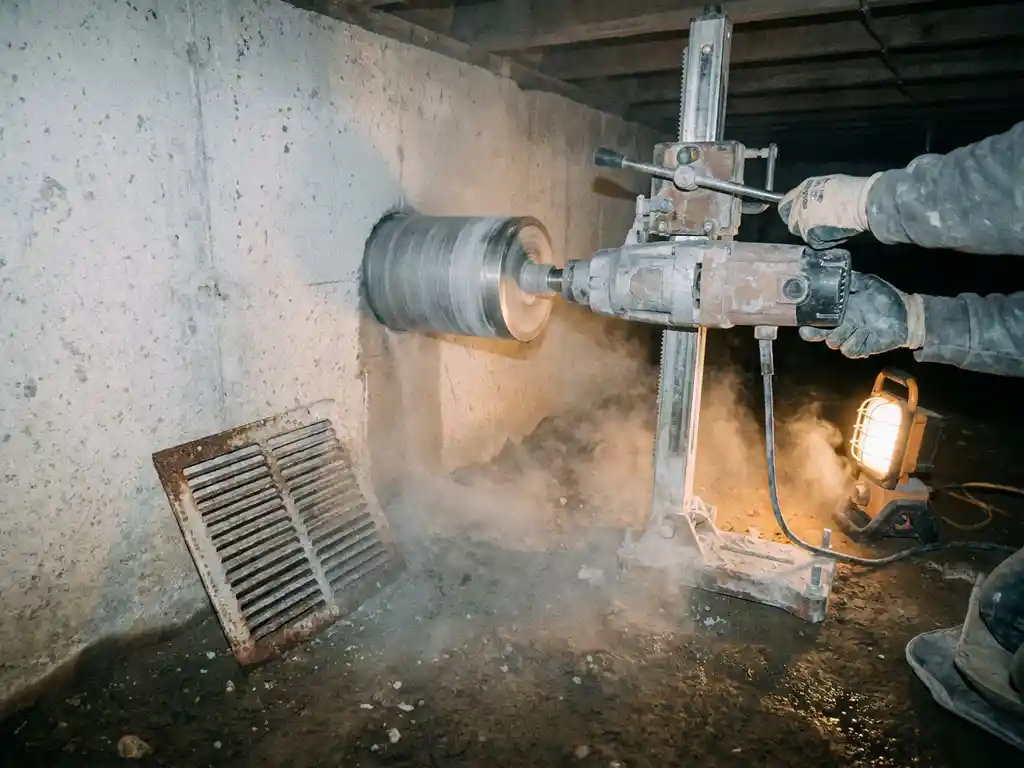
Yes, in most cases, it is necessary to drill through concrete to create a ventilation opening for the crawl space. Many older homes have a concrete foundation or a concrete plinth beneath which the crawl space is located, and the only way to create an opening in it is by drilling. Whether this is always necessary depends on the construction method of your home. In this article, we answer the most frequently asked questions regarding crawl space ventilation and drilling ventilation holes.
Why is ventilation in the crawl space so important?
Good ventilation in the crawl space is essential to prevent moisture buildup, mold growth, and wood rot. Without sufficient air circulation, humidity under the floor rises rapidly, leading to structural damage to the wooden floor joists and a musty odor in the home. In the long term, this can also negatively affect the insulation value of your home.
The ground beneath a home constantly releases moisture. If this moist air has nowhere to go, it condenses against cold surfaces such as concrete foundations and wooden beams. This is one of the most common causes of hidden moisture damage in Dutch homes. A properly functioning ventilation system for the crawl space ensures that humid air is expelled and fresh outside air can enter.
In addition to moisture damage, crawl space ventilation also plays a role in the air quality in your home. Mold spores forming under the floor can enter the living space through cracks and crevices. Good ventilation significantly reduces this risk.
Is it always necessary to drill through concrete for a ventilation opening?
Not always, but in most cases. Whether drilling is necessary depends on the type of foundation and the construction method of your home. For homes with a concrete foundation or a masonry plinth with concrete elements, drilling is virtually unavoidable. For older homes with exclusively a brick foundation, an opening can sometimes be created by removing bricks, but even then, drilling is often preferred due to the precision and clean result.
In practice, two situations can be distinguished:
- Concrete foundation or plinth: Diamond drilling is the method of choice here. Drilling is fast, accurate, and causes minimal damage to the surrounding structure.
- Brick masonry foundation: Sometimes a brick can be broken out here, but drilling results in a neater and more dimensionally accurate opening, especially if a ventilation grille needs to be installed.
In both cases, the result is a round, tight opening onto which a ventilation grille or a mechanical ventilation system can be mounted. Drilling is preferred over chiseling or breaking, as it generates fewer vibrations and reduces the risk of cracks in the foundation.
How many and what size holes are needed for crawl space ventilation?
As a rule of thumb, the total ventilation surface area must amount to at least 0,5% of the crawl space floor area. For an average home with a floor area of 80 to 100 square meters, this quickly means multiple ventilation openings. The holes are typically drilled with a diameter of 100 to 150 millimeters, depending on the type of grille or fan installed.
A number of practical guidelines:
- Distribute the openings evenly over the foundation to ensure good airflow.
- Ensure openings on at least two opposite sides of the house so that a draft effect is created.
- With mechanical ventilation, fewer openings are sufficient, because a fan actively controls the air circulation.
- Take into account the presence of pipes, cables, and supporting structures when determining the drilling locations.
The exact number and size of the holes depend on the specific situation on site. A professional can assess this based on the dimensions of the crawl space and the structural condition of the foundation.
How is a ventilation opening in concrete drilled?
Drilling a ventilation opening in concrete is done using diamond drilling, a technique in which a rotating drill bit with diamond segments cuts through the concrete. This process is precise, relatively quiet, and produces little dust and vibration compared to traditional breaking or chipping methods. The result is a round, clean opening with a smooth edge.
In practice, the process looks as follows:
- Preparation: The professional determines the exact drilling location, checks for the presence of pipes or reinforcement, and marks the position.
- Drill attachment: The diamond drilling machine is firmly anchored to the foundation wall so that drilling proceeds stably and straight.
- To drill: The diamond core drill cuts through the concrete step by step. Depending on the thickness of the wall and the diameter of the hole, this takes a few minutes to fifteen minutes.
- Finish: The drill bit and the concrete core are removed. The edge of the hole is checked and touched up if necessary.
- Placement of the grate: The ventilation grille or ventilation unit is mounted in the opening.
Afterwards, the workplace is left tidy. The drilling debris and concrete core are cleaned up so that you can immediately proceed with the finishing or installation.
How much does it cost to drill a hole in concrete for crawl space ventilation?
The cost of drilling a ventilation opening in concrete varies and depends on factors such as the number of holes, the diameter, the thickness of the foundation wall, and the accessibility of the location. It is therefore advisable to request a targeted quote based on your specific situation so that you get a fair and transparent picture of what the job will cost.
Factors that influence the price:
- The number of holes to be drilled
- The desired diameter of the openings
- The thickness and type of concrete of the foundation
- The accessibility of the crawl space and the drilling locations
- Whether grilles or fans are also installed
By clearly mapping out in advance how many openings you need and what the dimensions are, a professional can prepare an accurate quote without any surprises afterwards.
How De Betonboorder helps with crawl space ventilation
At De Betonboorder, we take care of drilling ventilation holes in concrete from start to finish. Whether you need one opening or multiple, we handle it quickly, neatly, and professionally. This is what you can expect from us:
- We work with high-quality diamond drill bits for an accurate and clean result.
- We serve the entire Netherlands through a nationwide network of experienced professionals.
- In many cases, we can schedule a professional within two days.
- We will contact you within 24 hours of your request.
- The workplace is left neat and tidy afterwards.
- We work for private individuals as well as contractors and SMEs.
Do you want to know what drilling a ventilation opening costs in your situation, or do you want to schedule a professional immediately? Contact us and we provide a suitable solution for your crawl space ventilation.
Related Articles
- How many ventilation holes does my crawl space need?
- Innova 12HP vs Innova 15HP: how much power do you really need?
- Innova vs Qlima: which brand offers the best monoblock air conditioner?
- How do you prevent ice formation in an air conditioner?
- Which air conditioner is the quietest?
- How much of a nuisance does drilling indoors cause?
- What exactly does a concrete driller do?
- How deep are electrical cables embedded in a wall?
- What is a chemical anchor and when do you need it?
- What happens if you put too many holes in one wall?
- What happens if damage occurs during load-bearing wall removal?
- How long does it take to apply for an environmental permit in 2026?