
Crawl space ventilation can be installed in the vast majority of home types, provided there is a crawl space under the floor. Whether you live in a 1930s home, a post-war terraced house, or a modern house, solutions are possible in most cases. In this article, we answer the most frequently asked questions about crawl space ventilation by home type.
Which types of homes have a crawl space?
Not every home has a crawl space. In the Netherlands, crawl spaces are primarily found in homes built before the 1990s, with a wooden ground floor resting on piers or walls. Homes with a concrete ground floor on sand, such as many 1970s apartment buildings and modern new builds, generally do not have a crawl space.
House types where you can expect a crawl space:
- Detached houses and semi-detached houses from the first half of the twentieth century
- Row houses and mid-terrace houses from the 1930s through the 1980s
- Bungalows with wooden floor construction
- Older farmhouses and country houses
Are you unsure whether your home has a crawl space? Then check if there is a hatch in the floor or an access hatch on the exterior wall. If there is no hatch present but there is a raised ground floor, there is a good chance that a crawl space is hidden underneath.
Can crawl space ventilation also be installed in older homes?
Yes, in older homes it is actually often most sensible to crawl space ventilation to install. Older homes more frequently suffer from moisture accumulation under the floor, because the construction methods of the time paid less attention to moisture control. Ventilation grilles in the foundation or facade can address this problem structurally.
In many older homes, the foundation consists of bricks or masonry blocks. Drilling or milling openings into these is feasible, provided the foundation is stable enough. A professional assesses beforehand whether the structure permits this and selects the appropriate drilling technique. For masonry foundations, diamond drills are often used so that the surrounding structure remains intact.
An additional advantage in older homes: the floor structure is almost always made of wood, making moisture particularly damaging. Good ventilation significantly extends the lifespan of the wooden floor joists and prevents rot and mold formation.
What are the challenges with new-build homes?
In new-build homes, crawl space ventilation is less frequently necessary, but not always superfluous. Homes built after the 1990s often have a concrete ground floor without a crawl space. Nevertheless, there are new-build homes where a narrow crawl space is still present, particularly in detached houses or homes on a specific type of foundation.
If there is a crawl space in a newly built home, other challenges come into play:
- The foundation is often made of concrete instead of brick, which requires special drilling equipment.
- The crawl space is sometimes narrower than in older homes, which makes access difficult.
- New-build homes are constructed to be more energy-efficient, meaning the ventilation system must be tuned more precisely to prevent heat loss.
- Mechanical ventilation systems may already be present that affect the airflow.
If in doubt about the situation in a new-build home, it is wise to have the necessity and feasibility of ventilation assessed before drilling any holes.
How are ventilation holes drilled in concrete or masonry?
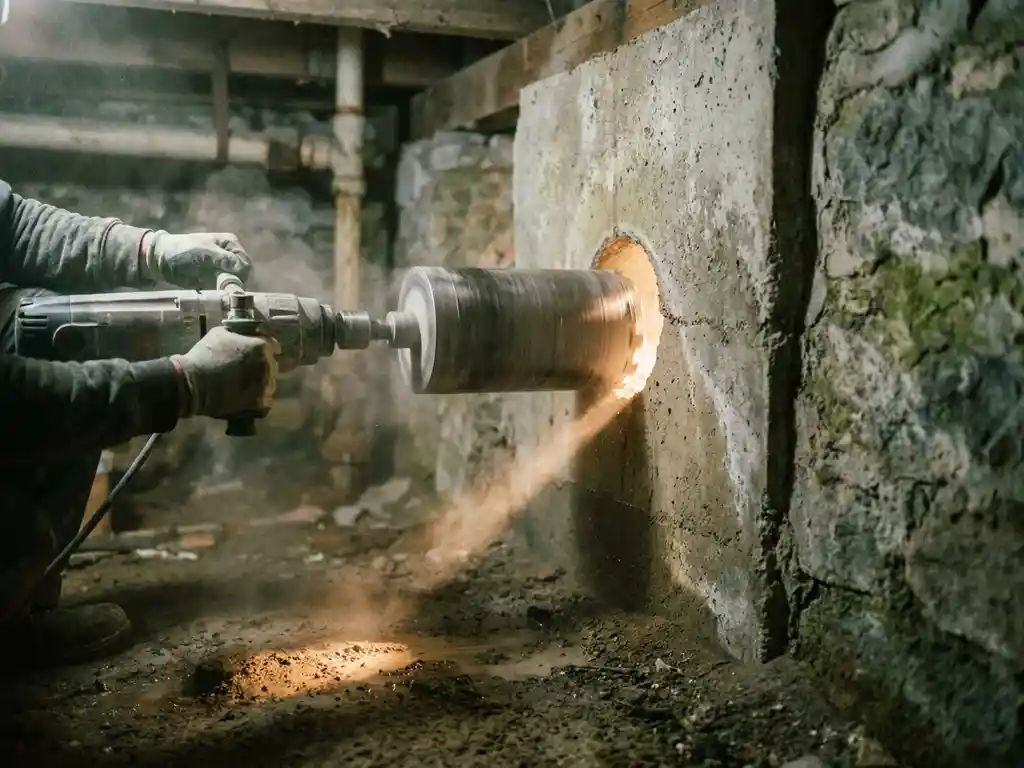
Ventilation holes in concrete or masonry are drilled using diamond core drills. These are special drills with a diamond cutting edge that can drill accurately and cleanly in reinforced concrete, aerated concrete, and brick. The diameter of the hole is matched to the ventilation grille that is installed in it.
The process proceeds broadly as follows:
- The exact position of the hole is determined, taking into account pipes and structural elements.
- The diamond drill bit is set to the correct diameter.
- The hole is drilled with water cooling to limit overheating and dust formation.
- The ventilation grille is installed and secured.
- The workplace is left tidy.
A big advantage of diamond drills The advantage is that the surrounding area is minimally damaged. No cracks form in the surrounding material, which is important for older foundations and masonry facades. Moreover, the drilling process is relatively fast, keeping disruption to a minimum.
When is crawl space ventilation not possible or not recommended?
Crawl space ventilation is not always the right solution. In some situations, it is technically impossible or even unwise to install ventilation grilles. It is good to be aware of these cases before making a decision.
Situations where ventilation is not possible or not recommended:
- No crawl space present: In homes with a concrete floor on sand, there is simply no room to ventilate.
- Unstable foundation: If the foundation is already weakened, drilling additional openings can place further stress on the structure.
- Crawl space is already well insulated and sealed: In a fully vapor-open or vapor-impermeable system, additional ventilation can disrupt the balance.
- High groundwater level: In areas with a high groundwater level, ventilation can draw humid outside air indoors instead of removing moisture.
- Presence of asbestos or other hazardous materials: If there are hazardous substances in the crawl space, they must be remediated first.
A professional can assess the situation on-site and advise on the best approach for your specific home and surroundings.
How much does it cost to install crawl space ventilation?
The cost of installing crawl space ventilation depends on the number of holes that need to be drilled, the material of the foundation or facade, and the accessibility of the work site. A simple situation with a masonry foundation and good access requires less time than a concrete foundation in a difficult-to-reach location.
Factors that influence the price:
- The number of ventilation grilles that need to be installed
- The material being drilled (brick, concrete, reinforced concrete)
- The thickness of the wall or foundation
- The accessibility of the work location
- Any additional work such as the removal of debris
For an accurate quote, it is advisable to to contact and to discuss the situation. This way, you know exactly where you stand beforehand and there will be no surprises afterwards.
How De Betonboorder helps with crawl space ventilation
De Betonboorder specializes in the expert installation of crawl space ventilation in all types of homes, from older terraced houses with brick foundations to modern homes with concrete structures. We ensure that the work is carried out quickly, neatly, and professionally.
What we arrange for you:
- Assessment of the situation on site, so that we choose the right approach
- Professional drilling with diamond core drills, with minimal nuisance and damage to the surroundings.
- Installation of ventilation grilles in concrete, brick, or masonry
- Neat handover of the workplace upon completion
- In many cases, we can schedule a professional within two days.
Good crawl space ventilation prevents moisture problems, reduces musty odors, and contributes to better insulation of your home. Would you like to know what we can do for your situation? Contact us and request a quoteWe will respond within 24 hours.
Related Articles
- How do I tell if the musty smell in the house is coming from the crawl space?
- Why does my house smell musty after a rain shower?
- Why is it so damp under my house?
- How much does it cost to have crawl space ventilation installed?
- Does moisture damage in the crawl space affect the value of my house?
- Can an air conditioner purify the air?
- What is a ceiling air conditioning unit?
- Can one air conditioner also cool the hallway and adjacent rooms?
- How do you check if an air conditioner is working properly?
- What do I need to arrange before a concrete driller comes?
- How does load-bearing wall removal work in a 70s home?
- Who is allowed to remove a load-bearing wall?