
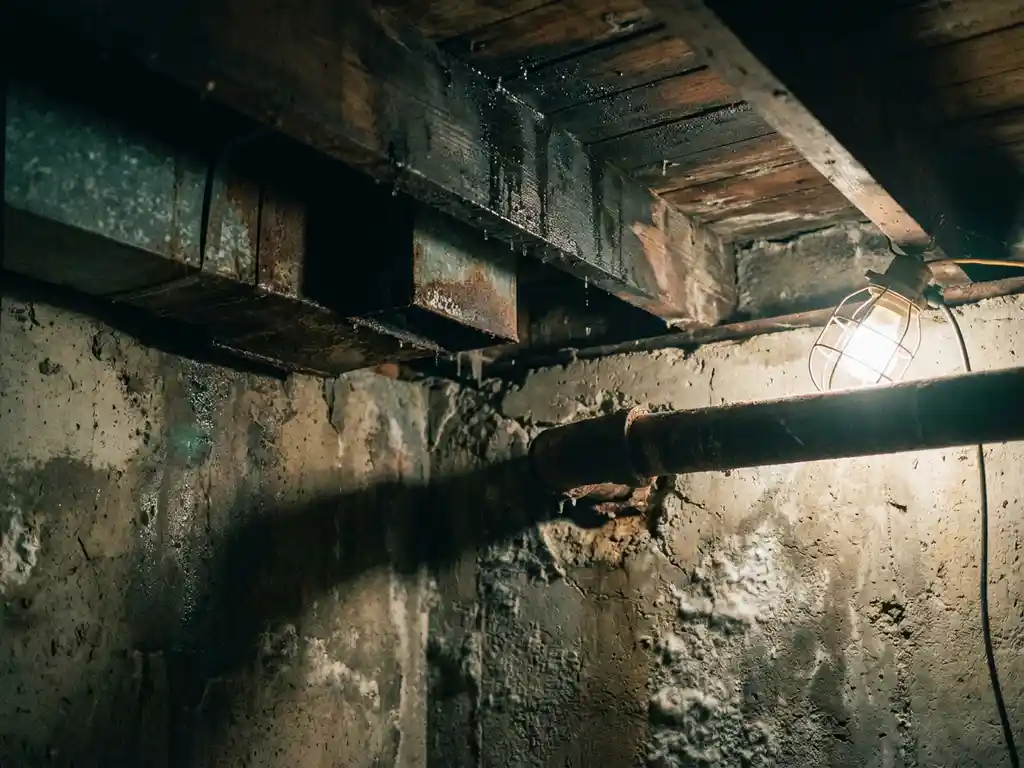
Yes, crawl space ventilation is effective against mold under the floor. By removing moist air and supplying fresh outside air, the humidity in the crawl space is reduced, which strongly inhibits mold growth. However, ventilation is not a miracle cure: additional measures are necessary in the event of an existing mold infestation or structural moisture problems. In this article, you will read how mold forms, how ventilation works, and what you can do if ventilation alone is not enough.
What causes mold under the floor in a crawl space?
Mold under the floor develops due to a combination of high humidity, poor air circulation, and organic material such as wood or soil. When the relative humidity in a crawl space consistently exceeds 70 to 80 percent, mold spores have the opportunity to germinate and spread.
The most common causes are:
- condensation: Warm indoor air cools down in the cold crawl space and condenses on wooden beams and floorboards.
- Soil moisture: Damp soil in the crawl space evaporates constantly, causing the humidity to rise.
- Insufficient ventilation: Without good air circulation, humid air remains trapped.
- Leaks: A leaking water pipe or poorly sealed foundation draws in extra moisture.
Mold is not just an aesthetic problem. It damages wooden structures, degrades the insulation value of the floor, and can affect the indoor air quality of your home through cracks and seams.
How exactly does crawl space ventilation work?
Crawl space ventilation works by installing ventilation openings in the exterior walls or the foundation, creating a constant flow of outside air. Fresh, relatively dry outside air replaces the damp, stagnant air in the crawl space, causing humidity to drop and inhibiting mold growth.
There are two main forms of crawl space ventilation:
- Passive ventilation: Grilles in the foundation ensure natural airflow based on wind and temperature differences. This is the simplest and most affordable solution.
- Mechanical ventilation: A fan or ventilation system actively pumps air through the crawl space. This is more effective in crawl spaces with little natural airflow or in cases of severe moisture problems.
For proper operation, the ventilation openings must be strategically placed: preferably on two opposite sides of the crawl space, to create a continuous airflow. The size and number of grilles depend on the surface area of the crawl space.
Does crawl space ventilation really help prevent mold?
Yes, good crawl space ventilation Demonstrably helps against mold. By structurally lowering humidity, the environment becomes less favorable for mold growth. In many cases, active mold development stops as soon as ventilation is improved and humidity remains below the critical limit.
Ventilation tackles the cause rather than the symptom. Anti-mold sprays or coatings only combat visible mold, but without addressing the underlying moisture problem, the mold returns. Ventilation solves the moisture problem structurally.
However, it is important to be realistic: ventilation prevents and inhibits mold growth, but does not remove existing mold. If mold is already present on wooden beams or floorboards, it must be treated or removed first before ventilation can do its job optimally.
When is ventilation alone not enough?
Ventilation alone is not sufficient in the case of a structural source of moisture, a severe mold infestation, or a crawl space without a vapor barrier on the floor. In those cases, additional measures are necessary to solve the moisture problem sustainably.
Situations requiring additional measures:
- Existing fungal infection: First treat professionally or replace affected wood, then install ventilation.
- High groundwater level: The soil in the crawl space remains damp, regardless of how much it is ventilated. A vapor barrier or foil on the floor helps to limit evaporation.
- Leaks in the foundation: Actively penetrating water must first be addressed via drainage or sealing.
- Insufficient insulation: Poor floor insulation causes large temperature differences and condensation, which ventilation cannot fully compensate for.
In those cases, ventilation works best as part of a combined approach: addressing the source of moisture, installing a vapor barrier, and then installing ventilation.
How are ventilation openings made in concrete?
Ventilation openings in concrete foundations are created using diamond drilling. This is a controlled drilling technique in which a diamond drill bit cuts a perfectly round hole in the concrete without damaging the surrounding material. The technique is suitable for reinforced concrete, aerated concrete, and other hard materials.
The process is as follows:
- The correct diameter for the ventilation hole is determined based on the required airflow and the type of grille.
- The exact position is marked on the foundation, preferably as low as possible but above ground level.
- The hole is drilled using a diamond core drill. This is fast, accurate, and with minimal vibration or dust.
- The ventilation opening is finished with a grille or a mechanical ventilation system.
Diamond drilling is the preferred method for ventilation openings because it is precision work: a hole that is too large or sloppy can weaken the foundation or cause problems with watertightness. Professional execution is therefore highly recommended.
What are the costs of having crawl space ventilation installed?
The cost of installing crawl space ventilation depends on the number of ventilation openings required, the thickness of the foundation, the type of ventilation (passive or mechanical), and the accessibility of the crawl space. For an accurate price indication, a targeted quotation based on the specific situation is the most reliable approach.
Factors that influence the price:
- The number of holes that need to be drilled
- The thickness and type of foundation material
- The diameter of the ventilation openings
- Whether additional materials are needed, such as grilles or fans
- The accessibility of the drilling locations
Always have a quote drawn up before placing an order, so you know exactly where you stand.
How De Betonboorder helps with crawl space ventilation
We handle the entire crawl space ventilation process, from advice to execution. With our experienced professionals and high-quality diamond core drills, we drill precise ventilation openings in your foundation without causing unnecessary damage to the surrounding structure.
What we arrange for you:
- Professional drilling of ventilation openings in concrete, aerated concrete, or other foundation materials
- Working with diamond core drills for a clean, precise finish
- Execution by skilled concrete drillers from our nationwide network
- In many cases, a professional on site within two days.
- Tidy handover: the workplace is left clean and tidy.
Do you want to get rid of moisture and mold in your crawl space? Contact us and we will quickly arrange a professional in your area.
Related Articles
- Is moisture from the ground really coming into my house?
- How does mechanical crawl space ventilation work?
- Is damp air from the crawl space harmful to my children?
- Does crawl space ventilation also work in the winter?
- Which air conditioner suits an open kitchen?
- How can I lower the temperature in my house?
- Air conditioning for a home practice: cool and productive through the summer
- What is a VRF air conditioning system?
- How do you run a cable through a concrete wall?
- What is the difference between an impact drill and a hammer drill?
- What are the risks of drilling in an old house?
- How does the finishing work after removing a load-bearing wall?