
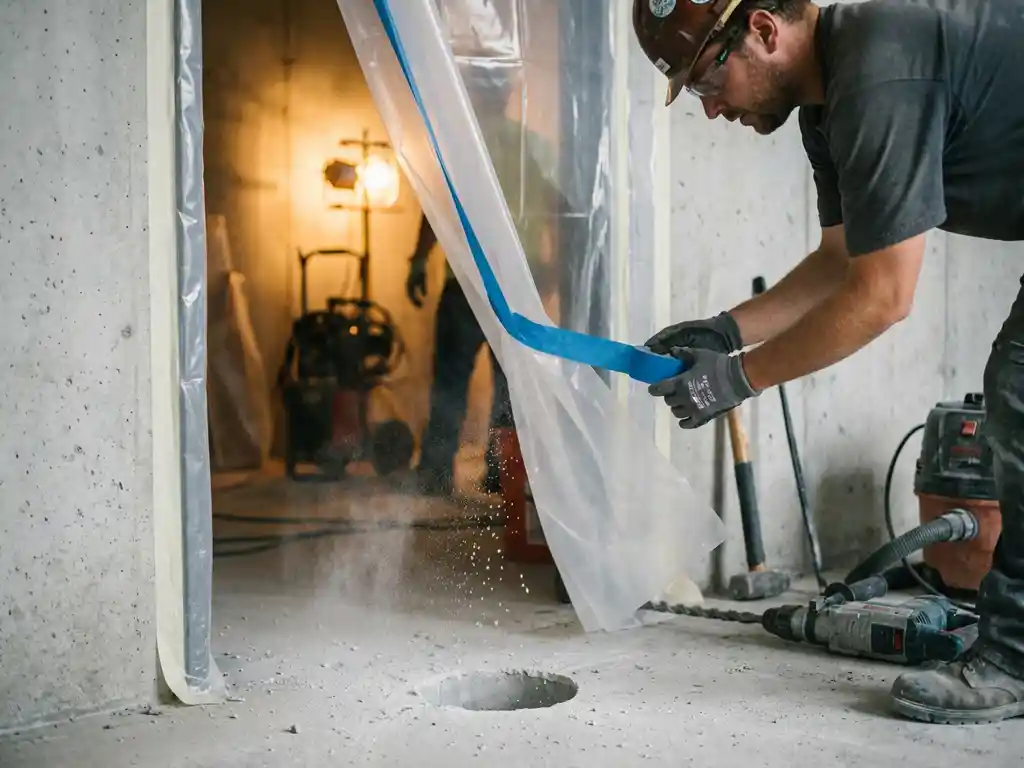
You protect your home from construction dust during a floor breakthrough by sealing off areas with plastic sheeting and masking tape, covering furniture, and ensuring good dust extraction is available while drilling. Drilling concrete, such as with the creating a stairwell, produces fine dust that spreads quickly through a home. If you know in advance what to expect, you can properly prepare your house and keep the nuisance to a minimum. In this article, we answer the most frequently asked questions about dust protection during a floor breakthrough.
What types of dust are released during a floor break?
When a concrete floor is broken through, primarily fine concrete powder is released, consisting of cement, lime, and silica particles. This dust is particularly fine and remains suspended in the air for a long time before settling. In older homes, lime mortar or other historical building materials may also be encountered, which affects the dust composition.
The most dangerous component of concrete construction dust is so-called respirable dust: particles so small that they can penetrate deep into the respiratory tract. Furthermore, reinforced concrete contains iron filings that are released when the diamond drill bit strikes the reinforcing bars. This dust is not only annoying for your interior but can also be harmful to health with prolonged exposure. Therefore, proper preparation is not a luxury but a necessity.
Which areas must be sealed off before drilling begins?
Seal off at a minimum the room where drilling is taking place, but also adjacent rooms connected to the workplace via open doors, ventilation grilles, or cracks. Dust spreads via air currents, so every opening is a potential path for dispersal. Also consider the space under the floor, such as a crawl space or a lower floor.
In practical terms, you approach this as follows:
- Hang heavy plastic sheeting in front of all doorways in and around the workspace and secure it airtight with masking tape.
- Cover ventilation grilles and air ducts with foil or tape to prevent spread via the ventilation system.
- Close the doors to the bedrooms, bathroom, and living room, and place a wet towel or draft strip along the bottom of the door.
- Don't forget the space under the floor: ensure that the underside of the opening is also protected if there is a habitable space there.
The more you isolate the work zone from the rest of the house, the less dust will ultimately need to be cleaned up.
How do you protect furniture and floors while drilling for concrete?
Cover all furniture in the immediate vicinity with plastic sheeting or old sheets, and protect floors with protective cardboard or foil. Even furniture in adjacent rooms can get a layer of dust if the sealing is not perfect, so remove as much as possible or cover it well.
For floors, concrete drilling work also causes vibrations. Loose tiles or fragile floor sections can be damaged as a result. Lay down a sturdy protective layer around the work area, not just directly underneath. Also consider:
- Removing carpet or rugs near the workplace, as dust is difficult to remove completely from them.
- Cover electrical appliances such as televisions and computers, as fine concrete powder can penetrate ventilation openings.
- Protecting kitchens and open cabinets with foil, so that cutlery and crockery remain dust-free.
What does a professional concrete driller do to minimize dust nuisance?
A professional concrete driller standardly works with an industrial vacuum cleaner directly connected to the drill, so that the released dust is extracted directly at the source. This is the most effective way to limit dust dispersion. Additionally, for larger jobs, dust walls and negative air pressure are used to completely isolate the work zone.
Tradesmen who regularly work in occupied properties are aware of the risks and take additional measures:
- Wet drilling: by adding water during drilling, dust is bound and less fine dust is released into the air.
- Foil dust walls surrounding the workspace, so that dust cannot spread throughout the room.
- Cleaning up afterwards: the workplace is left tidy, including the removal of drilling debris and dust.
A craftsman who in inhabited situations works, understands that the resident should experience as little inconvenience as possible. Good communication in advance regarding the measures to be taken is just as important as the technical execution.
Is drilling into concrete dangerous because of the dust?
Drilling into concrete can be dangerous with prolonged or repeated exposure to the released dust, particularly due to the presence of silica. Crystalline silica is a substance that can cause lung diseases if inhaled for a long time. For residents who are present occasionally during a drilling job, the risk is limited, but precautionary measures remain advisable.
Specifically, the following recommendations apply to residents:
- Preferably leave the home or the immediately adjacent part of the home during the work.
- Wear a dust mask (at least FFP2) if you are near the workplace.
- Ventilate the room well afterwards by opening windows and doors so that any remaining dust can escape.
- Keep children and pets away from the workplace, as they are more sensitive to dust particles in the air.
Even stricter standards apply to the professional: professional concrete drillers are required to wear personal protective equipment and work with dust control techniques. This is not only a matter of safety, but also of professional regulations.
How De Betonboorder helps with a dust-free floor breakthrough
Having a floor breakthrough carried out without causing a dust nuisance requires craftsmanship and the right equipment. We take care of the entire process from start to finish, including all measures to limit dust dispersion in your home. Whether it concerns a create stairwell or any other floor breach: we also work in occupied properties and ensure that the workplace is left neat and tidy.
What you can expect from us:
- Working with industrial dust extraction connected directly to the drill.
- Shielding the workplace with dust walls and foil to prevent spread.
- Expert drilling with high-quality diamond core drills for minimal collateral damage.
- Full service for the job, including tidying up afterwards.
- We will contact you within 24 hours of your request; in many cases, we will be at your doorstep within two days.
Do you want to know what we can do for you? Contact us and we discuss the best approach for your situation together.
Related Articles
- How do you minimize nuisance from indoor concrete work?
- How much nuisance does drilling ventilation holes in the foundation cause?
- What if my floor is too thin for a stairwell?
- Can my floor sag due to moisture in the crawl space?
- How much does air conditioning cost, including installation?
- How do I know if a job is too big to do myself?
- Why does a concrete driller use water when drilling?
- How do you drill a hole in the wall for an extractor hood?
- How do you create a wall penetration for an air conditioner?
- What does your buildings insurance cover for the removal of a load-bearing wall?
- Can you partially remove a load-bearing wall?
- How long is a structural calculation valid?