
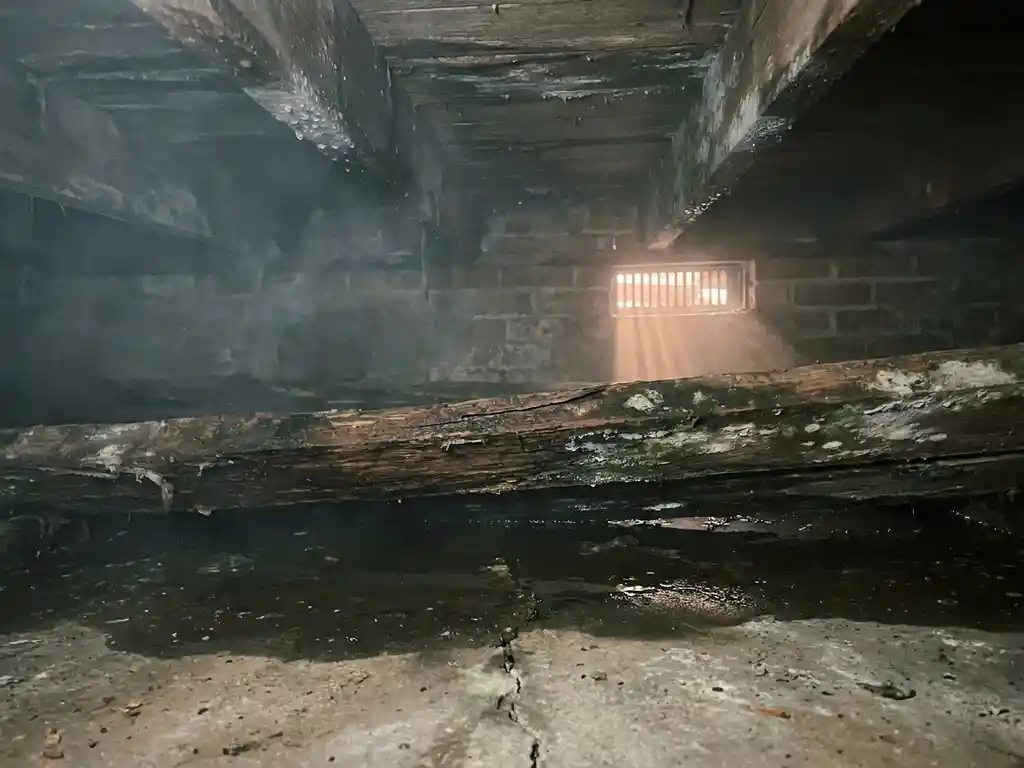
Yes, your floor can sag due to moisture in the crawl space. When there is structurally too much moisture under your home, it affects the wooden beams and floorboards that support your floor structure. This process occurs gradually, but the consequences can be serious and costly. In this article, we answer the most important questions about moisture damage, warning signs, and what you can do about it.
How does moisture in the crawl space damage your floor structure?
Moisture in the crawl space damages your floor structure by causing wood rot and mold growth in the load-bearing beams and floorboards. Wood exposed to high humidity for extended periods loses its load-bearing capacity. This weakens the foundation of your floor from within, which can eventually cause the floor to sag or even collapse.
The problem often starts invisibly. Moisture rises from the ground, ascends as water vapor, and collects in the crawl space. Without sufficient air circulation, that damp air lingers. Wooden structural elements continuously absorb this moisture. Molds and wood fungi thrive in these conditions and slowly break down the wood tissue.
In addition to wood rot, persistent moisture also affects the insulation under your floor. Damp insulation materials lose their thermal effectiveness, leading to cold floors and higher heating costs. It is therefore not only a structural problem, but also an energy problem.
What are the warning signs of a sagging floor?
Warning signs of a sagging floor include: floorboards that creak or spring when walking, visible deflection in the middle of a room, gaps between the floor and the baseboards, and doors or windows that no longer close properly. The sooner you recognize these signs, the better you can prevent further damage.
Listed below are the most common signs:
- Springy or sagging floor: If the floor gives way under your weight, the joists may be affected.
- Cracking and squeaking: Wood that has absorbed moisture warps and moves more than dry wood.
- Gaps at the baseboards: A sinking floor pulls itself away from the walls.
- Musty or moldy smell in the house: This is a strong sign of excessive humidity from the crawl space.
- Mold spots on the floor or underside of floorboards: Visible evidence of prolonged exposure to moisture.
- Poorly closing doors and windows: A sloping floor affects the entire load-bearing structure of your home.
Take these signals seriously. A floor that flexes slightly can deteriorate rapidly if the underlying cause of the moisture is not addressed.
What causes moisture problems in the crawl space?
Moisture problems in the crawl space are caused by a combination of groundwater, condensation, and insufficient ventilation. Groundwater and rainwater seep up through the soil, while warm indoor air causes condensation on cool surfaces in the crawl space. Without proper ventilation, this moisture accumulates.
The most common causes are:
- Capillary rise: Moisture rises from the ground through the floor of the crawl space.
- Poor or absent ventilation: Without air circulation, humid air cannot escape.
- Dense development or adjacent land: Garden soil or paving lying against the foundation obstructs drainage.
- Leaking pipes: A small leak in water or drain pipes in the crawl space can cause major moisture problems over time.
- Missing or damaged crawl space foil: A vapor barrier on the floor of the crawl space keeps out groundwater, but if it is missing or damaged, moisture has free rein.
In older homes, the construction method also plays a role. Many homes from the last century were built without modern moisture barriers, making the crawl space structurally more vulnerable to moisture accumulation.
How is crawl space ventilation installed in concrete?
Crawl space ventilation is installed in concrete by drilling holes in the concrete foundation or wall, after which ventilation grilles are placed. These grilles ensure a constant airflow in the crawl space, removing moist air and supplying fresh air. The drilling process requires specialized tools and expertise to avoid damaging the structure.
The process usually goes like this:
- Inspection and location determination: First, it is determined where the ventilation holes are most effective, taking into account the airflow and the layout of the crawl space.
- Drilling through concrete: Precise holes are drilled into the concrete foundation using a diamond core drill. Diamond drilling ensures clean penetration without cracks or excessive vibrations.
- Installing ventilation grilles: After drilling, the grilles are installed. These are designed to let air through but keep pests out.
- Airflow control: After installation, it is checked whether sufficient flow has been achieved.
The positioning of the grilles is crucial. Ideally, they are installed on two opposite sides of the crawl space to create a continuous airflow. A good crawl space ventilation not only reduces moisture, but also improves the insulation value of your home and tackles musty odors at the source.
When should you call in a professional for crawl space problems?
You should call in a professional for crawl space problems as soon as you see multiple warning signs at once, such as a sagging floor combined with a musty smell or visible wood rot. Professional help is also necessary if you suspect insufficient ventilation but do not have access to the crawl space yourself. Early intervention prevents structural damage that is many times more expensive to repair.
Definitely hire a professional if:
- the floor visibly sags or has springy spots;
- there is a persistent moldy smell in the house that does not go away;
- you find visible wood rot or mold growth upon inspection of the crawl space;
- the existing ventilation grilles are clogged or damaged;
- there is no ventilation system present in an older home.
Never try to ignore moisture problems in the crawl space or solve them yourself with temporary measures. Installing ventilation openings in concrete requires the right tools and an understanding of your home's load-bearing structure. A mistake here can cause more damage than the problem itself.
How De Betonboorder helps with crawl space ventilation
We handle the entire crawl space ventilation process, from the initial inspection to the professional handover of the worksite. With our experienced professionals and high-quality diamond core drills, we drill precise holes in your concrete foundation without causing unnecessary damage to the structure. These are the benefits of working with us:
- Professional drilling in concrete: We use diamond drilling technology for clean, precise drilling without cracks or vibrations.
- Installation of ventilation grilles: After drilling, we place the grilles in the correct positions for optimal air circulation.
- Fast and available nationwide: In many cases, we can schedule a professional for you within two days.
- Tidy workspace left behind: We clean everything up afterwards, so you don't have to worry about anything.
- Suitable for private individuals, SMEs, and contractors: We work for a wide range of clients throughout the Netherlands.
Are you experiencing damp in the crawl space, or do you want to know if your home is sufficiently ventilated? Contact us and we will contact you within 24 hours.
Related Articles
- What is the difference between natural and mechanical crawl space ventilation?
- Air conditioner payback period: when do you recoup the investment?
- Which air conditioner is best for tropical nights in the bedroom?
- Air conditioning for a 30 m² living room: what cooling capacity do you need?
- The complete Innova range compared: from 9HP Mini to 18HP ELEC
- How do you install an air conditioner yourself?
- Can an air conditioner work without an outdoor unit?
- How does an air conditioning heat pump work?
- Which air conditioner is the quietest?
- How long are you allowed to drill indoors per day?
- Who is allowed to remove a load-bearing wall?
- What are the alternatives to removing a load-bearing wall?