
An air conditioner in an apartment is certainly possible and, in hot summers like that of 2026, a smart investment. The most suitable options are a split-unit air conditioner or a portable air conditioner, depending on the possibilities in your home. In this article, we answer the most frequently asked questions about air conditioners in apartments, from permission to installation.
Which type of air conditioner is suitable for an apartment?
For an apartment, there are two main options: a split unit air conditioning expats must register with the local municipality and obtain a Mobiele AircoA split-unit is the most effective choice and consists of an indoor unit and an outdoor unit. A portable air conditioner does not require a fixed installation, but is less efficient and produces more noise.
The split-unit air conditioner is by far the most popular choice for apartments. The indoor unit is mounted on the wall and the outdoor unit hangs on the exterior facade or on a balcony. This type cools a room quickly and quietly, consumes relatively little energy, and also offers heating functionality in the winter. Do you want to know which model best suits your situation? Via the air conditioning selection guide you can easily find the right device.
A portable air conditioner is attractive because you don't have to mount it anywhere, but reality is more complex. The device requires an exhaust hose to vent heat outside, which still requires an opening in the wall or a window. Moreover, portable air conditioners are significantly less energy-efficient than split units.
Do you need permission from the Owners' Association for an air conditioner?
Yes, in most cases you need permission from the Homeowners Association (VvE) before installing an air conditioner in an apartment. This is because the outdoor unit is attached to the exterior facade, which is generally considered part of the building's common property.
It is advisable to always submit a written request to the VvE board for this, even if you think it is a minor intervention. Some VvEs have specific rules regarding the placement of outdoor units, for example, to maintain the appearance of the building. Also, inquire whether other residents have already installed air conditioning and how that went at the time.
Do you live in a rental apartment? Then, in addition to any HOA permission, you also need approval from your landlord. Always ensure that your agreements are in writing before hiring an installer.
How is an air conditioner connected in an apartment?
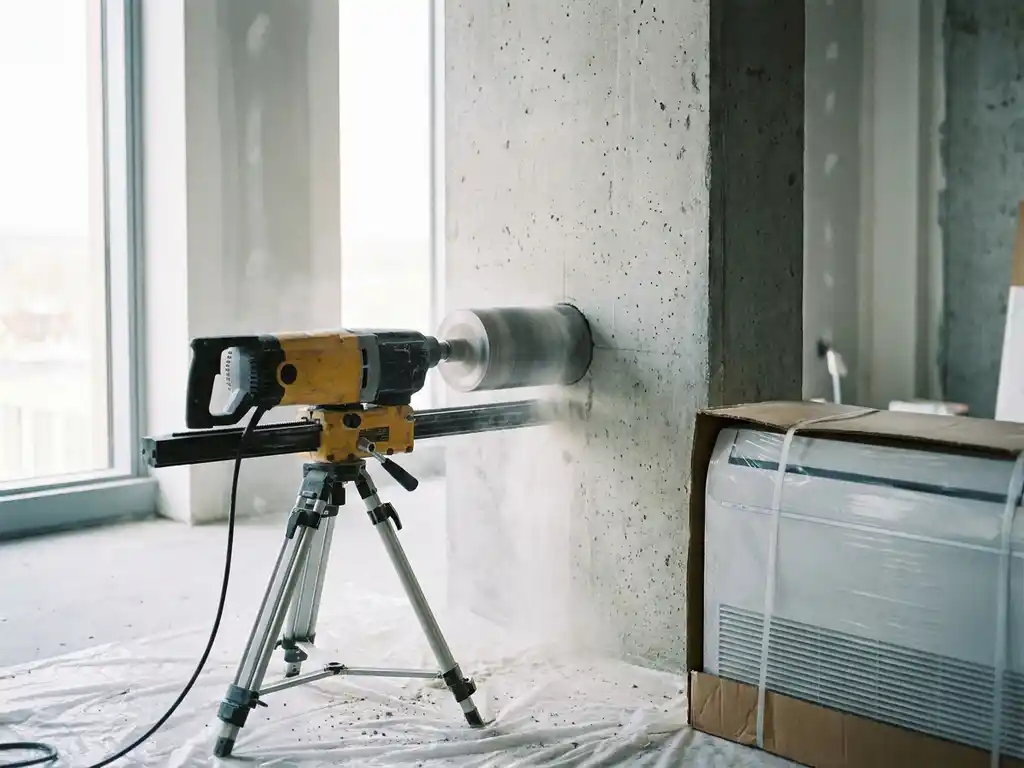
A split-unit air conditioner is connected via a wall penetration through which the pipes run between the indoor and outdoor units. A certified installer drills a hole typically 60 to 80 mm in diameter, pulls the refrigerant lines and electrical wiring through, and connects both units.
Drilling this hole is a crucial step in the installation process. The hole must be drilled at the correct height and angle so that condensation can drain properly. With reinforced concrete, which is common in many apartment complexes, craftsmanship is required to prevent damage to the structure. A diamond drilling rig ensures a tight, perfectly round hole without cracks or vibrations in the surrounding wall.
After drilling, the pipes are neatly concealed and sealed. The installer fills the system with refrigerant, tests its operation, and checks for leaks. In a standard situation, the entire process typically takes half a day to a full day.
How much does it cost to install an air conditioner in an apartment?
The total installation costs for an air conditioner in an apartment consist of the price of the unit itself and the labor costs for installation. The final price depends on the capacity of the air conditioner, the complexity of the installation, and the length of the piping between the indoor and outdoor units.
Factors influencing the costs include:
- The type and power of the air conditioner
- The thickness and material of the wall (concrete takes more time than drywall)
- The distance between the indoor and outdoor unit
- Additional work such as concealing pipes in the wall
Would you like an indication of the costs for your specific situation? Then use the pricing tool to quickly make a calculation based on your wishes.
Can an air conditioner be installed in an apartment without drilling a hole in the wall?
Yes, a portable air conditioner works without a permanent hole in the wall. The exhaust hose can be routed outside through a window opening or a small hole in the window frame. However, this is rarely the ideal solution, as a portable air conditioner cools less effectively and consumes more power than a split-unit.
There are also so-called monoblock air conditioners that are specifically designed for situations where a hole in the wall is not possible. These units work via condensation and sometimes have a water reservoir instead of a drain hose. They are quieter than traditional portable air conditioners, but still less efficient than a split unit.
If a split unit is an option but you are hesitant about drilling, it is good to know that a professionally drilled hole is barely visible if the pipes are finished neatly. It is a small intervention with a big result.
How do you keep an apartment cool without air conditioning?
Keeping an apartment cool without air conditioning is perfectly possible with the right approach. The key is keeping the heat out during the day and letting in cool air in the evening and at night.
Practical tips to keep your apartment cool:
- Darken during the day: Close curtains, shutters, or blinds on the sunny side as soon as the sun shines on the windows.
- Ventilate at night: Open windows and doors when the outside temperature drops to let cool air in.
- Use fans smartly: A fan cools your skin through evaporation; point it at a window to blow warm air out.
- Avoid heat sources: Use the oven as little as possible and switch off electronic appliances when you are not using them.
- Plants and water: Plants evaporate moisture and cool the air slightly. A wet towel in front of a fan has a similar effect.
These measures help, but they offer limited relief during extreme heat. Air conditioning remains the most effective solution for long-lasting comfort during hot summers.
How De Betonboorder helps with installing air conditioners in apartments
For an air conditioner in an apartment, a well-drilled hole in the wall is the foundation of a successful installation. We ensure a clean and professionally drilled pass-through hole, even in reinforced concrete or other hard materials common in apartment complexes. This is what we arrange for you:
- Drilling custom-sized through-holes for air conditioning pipes (typically 60 to 80 mm)
- Working with diamond core drills for a clean hole without vibrations or cracks.
- Professional execution in reinforced concrete, aerated concrete, and other materials
- Tidy handover: the workplace is left clean and tidy.
- Scheduled quickly: in many cases, a professional on-site within two days
Ready to get started? Contact us and we ensure that your air conditioning installation is fitted with a professional ducting.
Related Articles
- What if my floor is too thin for a stairwell?
- What are the long-term consequences of moisture under my house?
- Is damp air from the crawl space harmful to my children?
- How much does an air conditioner cost for an apartment that heats up quickly?
- How long does the warranty on an air conditioner last?
- What is the difference between cooling capacity and electrical power in an air conditioner?
- What is the ideal humidity with air conditioning?
- Can an air conditioner automatically adjust the temperature?
- How do you drill a hole for an outdoor lamp in the facade?
- How does load-bearing wall removal work in a 70s home?
- What are the alternatives to removing a load-bearing wall?
- How much does a structural calculation for load-bearing wall removal cost?