
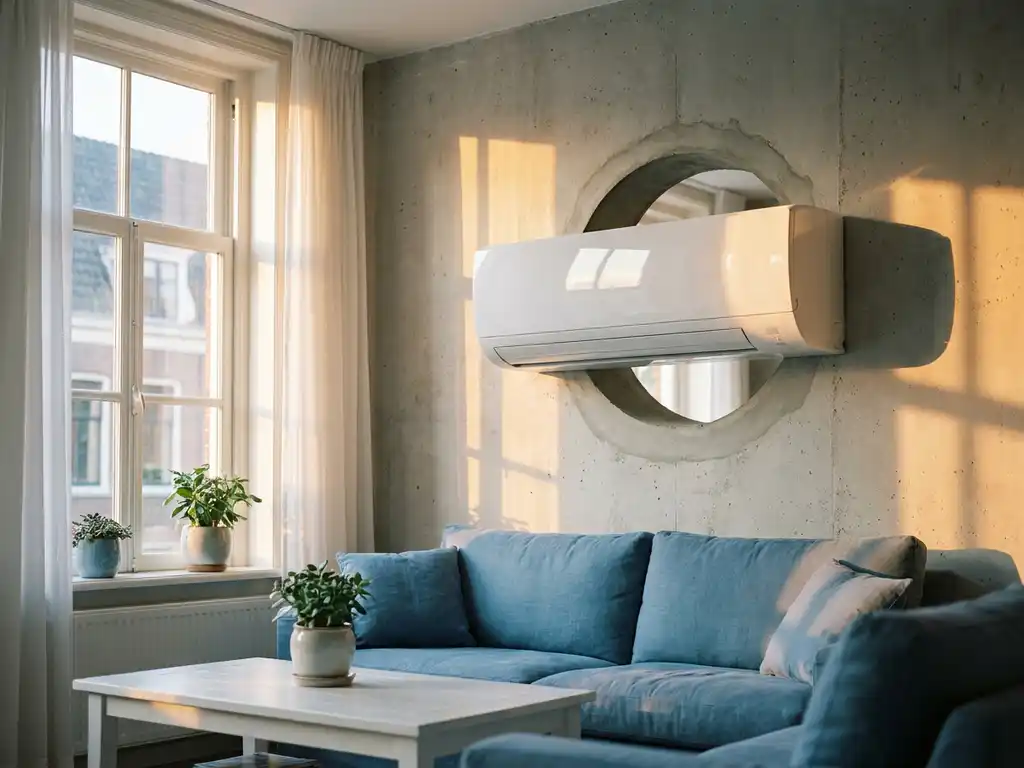
A split air conditioner cools your home most effectively during a heatwave. This type of system offers the most cooling capacity per watt, operates quietly, and is suitable for both small and large spaces. In this article, we answer the most frequently asked questions about air conditioners so that you know exactly what to look out for.
Which type of air conditioner cools the fastest in extreme heat?
A split air conditioner cools fastest during extreme heat. This system consists of an indoor and an outdoor unit and can quickly remove large amounts of warm air. Thanks to its high cooling capacity and efficient compressor system, a split air conditioner reaches the desired room temperature significantly faster than other types.
Portable air conditioners are an alternative, but they lose efficiency because warm air is vented outside through a hose, which limits cooling capacity. Multi-split systems are ideal if you want to cool multiple rooms simultaneously. During a heatwave, when the outside temperature sometimes exceeds 35 degrees, sufficient cooling capacity is not a luxury but a necessity. Use the air conditioning selection guide to determine which system suits your situation.
How much power does an air conditioner need to cool a room?
As a rule of thumb, an air conditioner requires approximately 100 watts of cooling capacity per square meter for an average insulated room. A 20 m² room therefore requires at least 2.000 watts (2 kW) of cooling capacity. With poor insulation, large south-facing windows, or an attic room, that capacity is significantly higher.
In addition to the surface area, other factors also play a role in determining the required power:
- Insulation quality: Poorly insulated homes lose cool air faster and require more power.
- Sun exposure: Rooms with large south-facing windows heat up faster.
- Ceiling height: Higher ceilings mean more air volume to cool.
- Heat sources: Appliances, lighting, and the number of people present increase the heat load.
Always choose an air conditioner with slightly more power than the minimum you need. An undersized system runs continuously at full power and wears out faster, while still failing to reach the desired temperature.
What is the difference between a split air conditioner and a portable air conditioner?
The biggest difference is the installation and cooling efficiency. A split air conditioner has a fixed indoor and outdoor unit and cools more powerfully and quietly. A portable air conditioner does not require a fixed installation but is less efficient because the exhaust hose returns heat to the room.
Advantages of a split air conditioner
A split air conditioner offers higher cooling capacity with lower energy consumption. The indoor unit is quiet and discreetly mounted on the wall. Because the compressor is located outside, you hear hardly any noise indoors. This type of system is also suitable for use as a heater in the winter, making it a versatile investment.
Advantages of a portable air conditioner
A portable air conditioner requires no professional installation and is ready for immediate use. You place the exhaust hose through a window or door, and the unit is ready for use. This makes it an attractive choice for tenants or as a temporary solution. The disadvantage is that the device is noisier and consumes more energy for the same cooling result.
How energy-efficient is an air conditioner during a heatwave?
Modern air conditioners with a high energy label, such as A++ or A+++, are significantly more energy-efficient than older models. Thanks to inverter technology, the compressor speed automatically adjusts to demand, preventing unnecessary energy consumption. Nevertheless, power consumption increases during a heatwave, simply because the system has to work harder.
To limit energy consumption during warm periods, there are a number of practical measures you can take:
- Set the air conditioner to a temperature of 24 to 26 degrees instead of 18 or 20 degrees. Every degree lower noticeably increases consumption.
- Close curtains and blinds during the day to block direct sunlight.
- Ventilate at night when the outside air cools down, so that the air conditioner doesn't have to run as much.
- Ensure regular maintenance, as clogged filters increase energy consumption.
A properly installed split air conditioner with a high energy label has a COP (Coefficient of Performance) of 3 or higher. This means that the system delivers at least 3 kilowatt-hours of cooling for every kilowatt-hour of electricity, making it an efficient choice.
What should you look out for when choosing an air conditioner?
When choosing an air conditioner, you consider cooling capacity, energy label, noise level, and the type of installation that suits your home. Additionally, the long-term costs of installation and maintenance are important factors to take into account in your decision.
An overview of the key points:
- Cooling capacity (BTU or kW): Ensure that the capacity matches the size and insulation value of the room.
- Energy label: Choose at least A++ for a favorable performance-to-consumption ratio.
- Noise level: An indoor unit of less than 30 dB is pleasantly quiet, especially for bedrooms.
- Installation options: For a split air conditioner, a hole must be made in the wall for the pipes.
- Additional features: Think of a heat pump, dehumidifier, timer, or control via an app.
Compare different models based on these criteria before making a choice. Via the pricing tool you can quickly get an indication of the costs associated with your situation.
Can an air conditioner also help ventilate your house?
Yes, many modern air conditioners have a fan mode that circulates air without actively cooling. This helps improve air quality and reduce humidity. Some models also feature a built-in dehumidifier, which offers extra comfort during humid summers.
It is important to distinguish between ventilation and cooling. An air conditioner moves and treats air, but does not automatically supply fresh outside air like a mechanical ventilation system does. For an optimal indoor climate, it is advisable to combine the air conditioner with good ventilation, for example by opening windows in the evening when the outside temperature drops.
Air conditioners with a heat exchanger can in some cases also be used for controlled ventilation with heat recovery. However, this is a more advanced system that is not suitable for all homes. Always consult a professional to determine which combination works best for your home.
How De Betonboorder helps with installing an air conditioner
For a split air conditioner, a hole in the exterior wall is required to run the pipes between the indoor and outdoor units. This is exactly where we at De Betonboorder make the difference. We drill precise holes in concrete, masonry, and other materials, so that the installer can get to work immediately without unnecessary delays or damage to the facade.
- Professional drilling of through-holes for air conditioning pipes in concrete and masonry
- Working with diamond core drills for clean, dust-free throughput
- Suitable for private individuals as well as contractors and installers.
- Nationwide network of experienced professionals, available within two days in many cases
- The workspace is left neat and tidy.
Would you like to know what we can do for your project? Contact us and we respond within 24 hours.
Related Articles
- Why does my house smell musty after a rain shower?
- What is included in the price of a stairwell?
- Will I get pests or woodworm from a damp crawl space?
- Innova 15HP ELEC vs Innova 18HP ELEC: when do you choose more capacity?
- Olimpia Splendid Unico vs Innova: fixed air conditioner without outdoor unit compared
- Innova 15HP vs Innova 15HP Vertical: which variant fits in your space?
- Why is my air conditioner dripping water?
- Can an air conditioner cause noise nuisance for neighbors?
- What is a cassette air conditioner?
- What is the difference between a portable and a monoblock air conditioner?
- What exactly does a concrete driller do?
- What do you need to arrange with the neighbors when removing a load-bearing wall?