
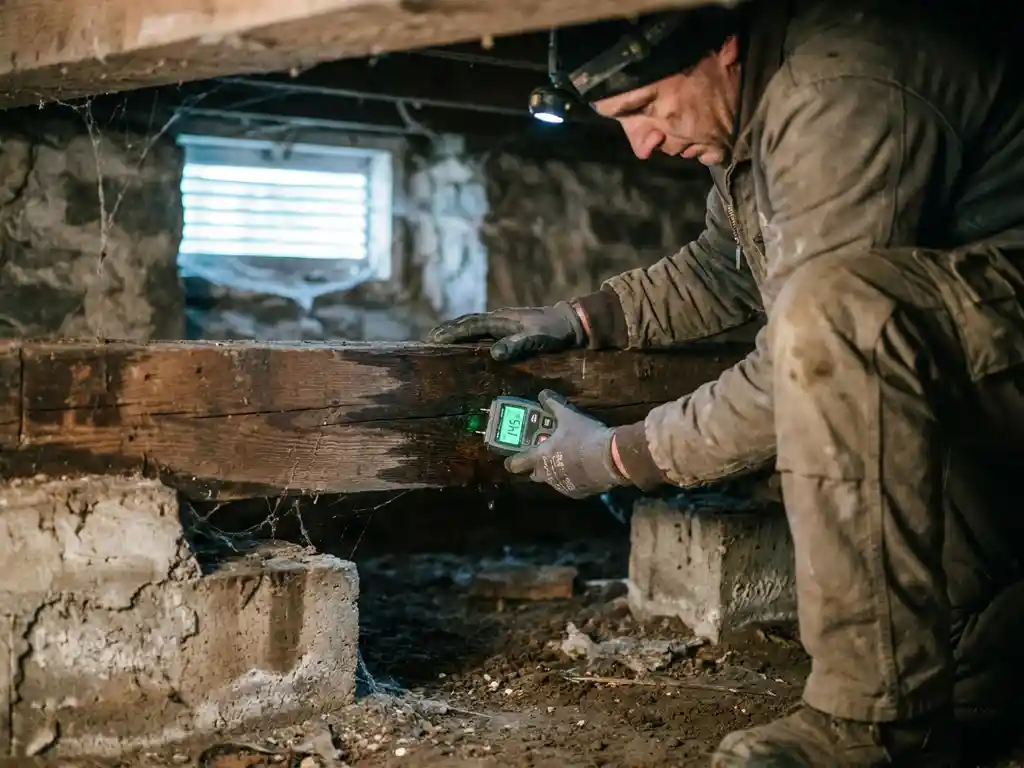
You can tell if your wooden floor joists are damp by looking for visible discoloration, mold growth, a musty odor, or sagging floorboards. A moisture meter provides the most reliable measurement: a moisture content above 18 to 20 percent indicates an increased risk of wood rot and mold. In this article, we answer the most frequently asked questions about damp floor joists, from the first signs to possible solutions.
What are the first visible signs of damp floor joists?
The first visible signs of damp wooden floor joists are discoloration in the wood, dark spots, mold patches, and a sagging or creaking floor. A musty or earthy smell in the room is also an early signal that something is wrong under the floor.
When inspecting the floor, pay attention to the following:
- Dark or gray discolorations on the wood, indicating prolonged exposure to moisture
- White or green mold spots on or between the beams
- Swelling or warped wood that pushes the floorboards up
- A floor that springs or sags with normal use
- Loose floorboards or gaps that are becoming wider
These signs are most clearly visible when you have access to the underside of the floor via a hatch or crawl space. If you do not make the effort, you often only notice the moisture problem when significant damage has already occurred.
How does a damp wooden floor beam feel?
A damp wooden floor joist feels soft, fibrous, or spongy. Healthy wood is hard and resilient; if you poke the joist with a screwdriver or your fingernail and the wood yields, that is a clear sign of moisture damage or wood rot.
Press on various points of the beam with your thumb or a sharp object. Normal wood offers resistance. Damp or damaged wood feels noticeably softer, sometimes even brittle or crumbly. Wood rot often starts at points where the beam is in contact with concrete, masonry, or the ground, because those connection points remain damp the longest.
Also look out for a sticky or tacky surface. This may indicate mold growth that has already started at an early stage, even if the wood is not yet visibly affected.
How do you measure the moisture content in wooden floor joists?
You measure the moisture content in wooden floor joists with a wood moisture meter. This device measures the percentage of moisture in the material via two pins that you insert into the wood. A healthy moisture content for structural timber is between 8 and 15 percent; above 18 percent there is a risk, and above 20 percent intervention is necessary.
Wood moisture meters are relatively inexpensive and available at most hardware stores. Measure at multiple points along the beam, particularly at the ends and at locations close to the outer wall or the ground. These spots are most vulnerable to moisture absorption.
A professional structural engineer or a specialized company can also perform a more extensive inspection, in which not only the moisture level is measured but the cause of the moisture is also identified. This is advisable if you have already discovered visible damage or if multiple beams appear to be affected.
What causes moisture problems in wooden floor joists?
The most common cause of damp wooden floor joists is a poorly ventilated crawl space. When moisture from the soil cannot escape sufficiently, it condenses against the underside of the floor and seeps into the wood. Other causes include leaks, condensation, and rising damp from the foundation.
The main causes listed:
- Bad or missing crawl space ventilation: without sufficient air circulation, moisture accumulates under the floor
- Leaking pipes or drains that slowly release water to the surrounding wood
- Rising groundwater via the foundation or the crawl space floor
- Condensation due to temperature differences between the heated living space and the cold crawl space
- Bad or missing vapor barrier on the crawl space floor
In older homes, the combination of an inadequately ventilated crawl space and an uncovered floor is a common problem. Humid air rises, cools against the floor joists, and condenses, causing the wood to become saturated slowly but surely.
When is a damp floor beam a danger to the structure?
A damp floor beam becomes a structural hazard as soon as the moisture content structurally exceeds 20 percent and wood rot occurs. Wood rot impairs the load-bearing capacity of the beam, causing the floor to sag or, in the worst case, collapse. This risk increases as more beams are affected.
Wood rot develops in two forms: brown rot and white rot. Brown rot makes the wood crumbly and brittle; white rot breaks down the cell structure, causing the wood to become fibrous and soft. Both forms undermine the load-bearing capacity, but brown rot generally progresses faster and is more dangerous to structural stability.
Have a structural inspection carried out when:
- Multiple beams are visibly affected
- The floor noticeably sags or flexes during normal use
- You hear creaking or tearing sounds in the floor
- The damage has remained unnoticed for years
Early intervention prevents a repairable moisture problem from escalating into a costly structural repair.
Can concrete drilling help with moisture problems under the floor?
Yes, drilling into concrete can directly contribute to solving moisture problems under the floor. By drilling ventilation openings in the concrete foundation or in the walls surrounding the crawl space, air circulation under the floor improves significantly. Better ventilation lowers humidity in the crawl space and thus protects the wooden floor joists.
When a crawl space has insufficient ventilation openings, or when existing vents have been bricked up or blocked, drilling new openings in the concrete offers an effective and relatively simple solution. The holes are placed in strategic locations to create a continuous airflow that removes moisture before it can condense on the floor joists.
How De Betonboorder helps with moisture problems in the crawl space
We offer a concrete and professional solution for moisture problems caused by a poorly ventilated crawl space. By drilling ventilation openings in the concrete at the right places, we ensure healthy air circulation under your floor.
What we arrange for you:
- Professional drilling of ventilation openings in concrete, masonry, or foundations
- Installation of custom-made ventilation grilles, tailored to the dimensions of the opening
- Minimal disruption: the workplace is left neat and tidy.
- Nationwide network of experienced professionals, available within two days in many cases
- We will contact you within 24 hours of your request.
Good one crawl space ventilation It not only protects your floor joists but also improves your home's insulation value and eliminates the musty smell caused by damp crawl spaces. Would you like to know what we can do for your situation? Contact us and we will help you quickly.
Related Articles
- How is the strength of my floor calculated after a recess?
- How long do I have to wait after a stairwell before the stairs can be installed?
- Does more ventilation help against moisture under the floor?
- How do I inspect my crawl space for moisture damage myself?
- The complete Innova range compared: from 9HP Mini to 18HP ELEC
- How much does it cost to keep your entire house cool with an air conditioner?
- How quickly does a monoblock air conditioner cool down your room?
- Are you allowed to drill in a residential area on Sundays?
- When do you use a diamond drill instead of a regular drill?
- Why does my drill get so hot when using concrete?
- What is the difference between a foundation and a load-bearing wall?
- Do you need a permit to remove a load-bearing wall?