
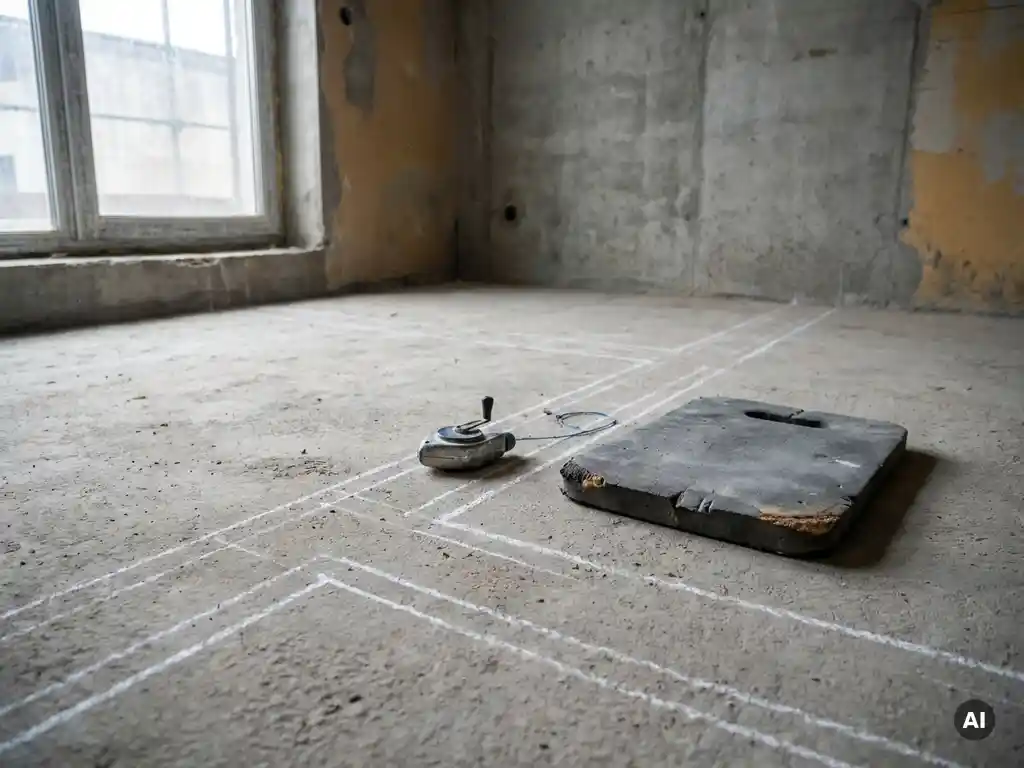
Marking out conduit trenches is the responsibility of the client or the installer who will be laying the pipes. They know exactly where the cables and pipes need to go and are therefore the designated persons to mark the routes on the wall or floor. The milling operator executes what has been indicated but does not determine the exact location of the trenches. In this article, we answer the most frequently asked questions about preparing for a concrete milling job.
Who is responsible for marking out pipe trenches?
The responsibility for marking out pipe trenches lies with the installer or contractor laying the pipes, or with the client if they are in charge. The milling machine operator is an executing specialist who works based on the indicated routes. Without clear markings, the operator cannot determine where to work.
In construction practice, it is often the electrician, plumber, or central heating installer who maps out the routes. They know the required depth and width for their pipes and can coordinate the sequence of work with the milling machine. For a new construction project or renovation, it is wise to coordinate this well in advance so that everyone is in the right place at the right time.
Are you unsure who should do this on your project? Then discuss it with the parties involved early on. Uncertainty about this costs time and money.
What exactly needs to be signed off before the milling machine operator arrives?
Before the milling machine arrives, the following items must be clearly marked on the wall or floor: the exact route of each groove, the start and end points, and any intersections or changes of direction. The more specific the marking, the more accurate the result. concrete milling will be.
Specifically, this means that you sign off on at least the following:
- The route of the trench, drawn with a chalk line or marker pen.
- The desired width of the slot, if deviating from the standard
- The depth required for the pipes
- Locations of sockets, connection points, or distribution boxes
- Any obstacles or zones that must be avoided
With reinforced concrete, it is also wise to know in advance where the reinforcement is located so that the milling machine operator can take this into account. A rebar locator can help with this and prevents surprises during milling.
What happens if the pipe trenches are not marked out?
If the pipe trenches have not been marked out when the milling operator arrives, the job cannot be carried out in most cases. The operator works based on the indicated routes and cannot independently determine where trenches need to be placed. This leads to delays, extra costs, and possibly a rescheduling.
In addition to the practical delay, there is also a risk of errors. If a milling operator proceeds based on verbal instructions, the likelihood of misunderstandings is high. Milling trenches in the wrong location means extra rework and unnecessary damage to the structure. Marking out pipe trenches is therefore not just a formality; it is an essential step in the preparation.
Therefore, always ensure that the marking is complete and clear before scheduling a milling machine. This prevents a professional from being on site unnecessarily.
What is the best way to mark out pipe trenches on concrete?
The best way to mark pipe trenches on concrete is with a chalk line or a permanent marker in a contrasting color, such as orange or red. Draw straight lines with a straight edge or spirit level and also mark the width of the trench on both sides. This way, the milling machine operator knows exactly what to expect.
Practical tips for good marking:
- Use a spirit level or plumb bob for straight, vertical lines on walls.
- Mark the width of the slot on both sides of the line.
- Indicate the desired depth with a number next to the line, for example “30 mm”
- Use arrows to indicate the direction of the trench at corners or branches.
- Ensure that the marking is clearly visible, even under artificial light.
On smooth concrete surfaces, a permanent marker adheres better than chalk paint. On rough or porous surfaces, chalk paint or a spray can works well. Always test the marker on a small area first to check if it remains visible.
How De Betonboorder helps with milling pipe trenches
At De Betonboorder, we mill trenches for pipes daily, in both bare shell buildings and occupied properties. We work precisely and leave the workplace tidy so that the installer can get started immediately. However, even if the preparation is not yet fully complete, we are happy to think along with you.
What we offer:
- Professional milling of pipe trenches in concrete, aerated concrete and other materials
- Experienced professionals who know how to work neatly and precisely.
- Nationwide availability, in many cases on location within two days
- Advice on proper preparation if you are unsure how to mark out the trenches.
- Neat handover, so the workplace is ready for the installer.
Would you like to know what we can do for your project? Contact us and we will respond within 24 hours with a suitable proposal.
Related Articles
- How much dust is generated when milling grooves in an occupied house?
- How long do I have to wait after a stairwell before the stairs can be installed?
- How do I protect my finish when breaking up the floor?
- What is the guideline price for an opening in a concrete floor?
- There is water in my crawl space: what should I do?
- How do I find the cause of moisture under my floor?
- Why is it so damp under my house?
- Innova vs. the competition: why choose an Innova monoblock air conditioner?
- How much does it cost to keep your entire house cool with an air conditioner?
- Can air conditioning worsen allergies?
- Innova vs Qlima: which air conditioner is the quietest in the bedroom?
- What is the difference between a portable and a monoblock air conditioner?