
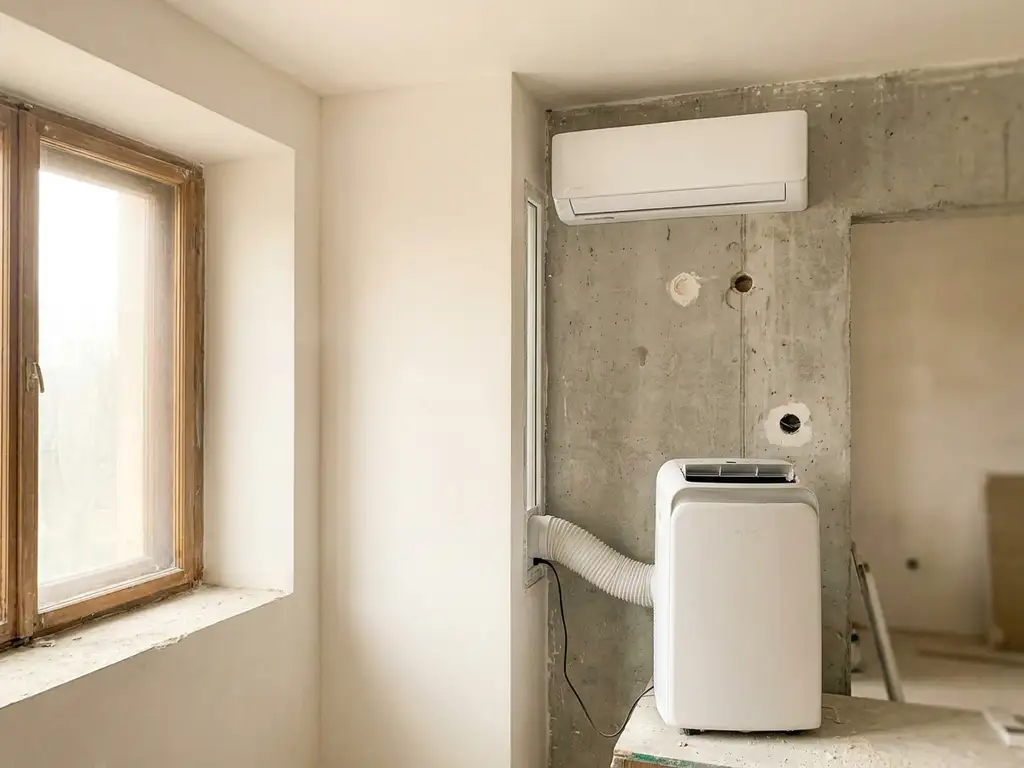
A wall-mounted air conditioner is a better fit for a room with an exterior wall and provides a sleeker, space-saving result. A floor-standing model is the better choice if no exterior wall is available or if you want flexibility without a fixed installation. Which type best suits your situation depends on the room, the interior, and your cooling needs. Below, we answer the most frequently asked questions to help you make the right choice.
What are the main differences between a wall-mounted and a floor-standing air conditioner?
The biggest difference lies in placement and installation. A wall-mounted model is attached high on the wall and requires a fixed outdoor unit, whereas a floor-standing model stands on the floor and operates via an exhaust hose through a window or small opening. The wall-mounted model cools more quietly and efficiently; the floor-standing model is more flexible and does not require a fixed installation.
Both types are suitable for living rooms, bedrooms, and office spaces, but they place different demands on the space. With a wall-mounted model, a hole must be drilled through the wall for the pipes and the connection to the outdoor unit. This makes the installation slightly more invasive, but the result is also more durable and aesthetically neater. A freestanding model, also known as a portable or floor-standing air conditioner, only needs to be plugged into a power outlet and have an exhaust for the warm air.
For whom one want to choose a suitable air conditioner Based on space and need, it pays to compare both options before making a decision.
Which type of air conditioner is suitable for a room without an exterior wall?
In a room without an exterior wall, a floor-standing air conditioner is almost always the only practical option. This is because a wall-mounted model requires a direct route to the outside for the pipes and the outdoor unit. Without an exterior wall, this route is not possible, unless an alternative route via an adjacent room or the ceiling is available.
A portable air conditioner solves this problem by venting warm air via a flexible hose through a window or a small opening in the wall or ceiling. That opening only needs to be small, which keeps the intervention minimal. However, on average, a portable model cools less efficiently than a fixed wall unit, because the exhaust hose can leak heat back into the room if it is not properly insulated.
Do you have an exterior wall but want to know what the installation requires? Via the Pricing tool for a concrete drilling job You quickly gain insight into what is needed.
How does an air conditioner affect the appearance of a room?
A wall-mounted air conditioner has a greater visual impact, but at the same time looks sleeker and more professional than a floor-standing model. The internal unit is mounted high on the wall, pipes run concealed through the wall, and nothing stands on the floor. A floor-standing model is more visible, takes up floor space, and the exhaust hose is always visible.
For people who value a tidy interior, the wall-mounted model is generally the more aesthetically pleasing choice. Modern wall-mounted models are slimmer than they used to be and fit well in both minimalist and classic interiors. Some brands, including models in the innova airco line, offer units in neutral colors that hardly stand out.
A freestanding model has the advantage of being movable and causing no permanent change to the space. For tenants or people who move frequently, this is sometimes a conscious choice, even though the visual result is less polished.
Which model cools more efficiently: wall-mounted or floor-standing?
In most cases, a wall-mounted air conditioner cools more efficiently than a floor-standing model. Because the unit hangs high on the wall, the cold air spreads better throughout the room due to gravity. A floor-standing model blows cold air at floor level, resulting in less effective circulation in higher rooms.
In addition, fixed wall-mounted models typically feature a higher COP (Coefficient of Performance) number, which means they deliver more cooling capacity per kilowatt-hour. Mobile models lose energy through the exhaust hose and more often have a lower energy class.
For large spaces or rooms where you want to cool for extended periods, the wall-mounted model is the smarter long-term investment. A portable model is fine for occasional use or smaller rooms where a fixed installation is not possible.
When is a floor-standing air conditioner the better choice?
A floor-standing air conditioner is the better choice if you need flexibility, do not want a fixed installation, or if the room has no exterior wall. A portable model is also often the only option for tenants who are not permitted to make structural alterations to the property.
Other situations where a vertical model is more logical:
- You want to be able to use the air conditioning in multiple rooms.
- The space is in temporary use, such as a construction site office or temporary office.
- There is no permission from a landlord or HOA for a fixed installation.
- The cooling demand is limited and infrequent.
In these cases, a floor-standing model offers sufficient comfort without the costs and interventions of a fixed wall installation. Do, however, take into account the higher energy consumption and the visible drain hose.
What does the installation of a wall-mounted model cost compared to a free-standing model?
The installation of a wall-mounted model entails higher costs than that of a free-standing model, because a fixed outdoor unit must be installed and pipes must be routed through the wall. A free-standing model does not require professional installation and can be used immediately after purchase.
The following costs apply to a wall-mounted model:
- Purchase of the indoor and outdoor unit
- Material costs for piping and fixings
- Labor costs for the mechanic
- Costs for drilling a hole through the wall for the pipe penetration
That final step, drilling through concrete or masonry, is a job for specialists that must be performed accurately to prevent damage to the structure. A floor-standing model requires only a power outlet and a window or small opening for the drain hose, with no further installation costs.
Do you want to know what it costs to drill a hole for your wall-mounted air conditioner? Use the online pricing tool for a quick indication based on your situation.
How De Betonboorder helps with the installation of your air conditioner
Installing a wall-mounted air conditioner begins with one crucial step: drilling a hole through the wall for the pipe entry. That sounds simple, but in concrete, reinforced concrete, or natural stone, this is truly a job for a specialist. De Betonboorder helps you with this quickly and professionally:
- We drill holes of the correct diameter for air conditioning pipes in concrete, masonry, and other materials.
- We work throughout the Netherlands with a nationwide network of experienced professionals.
- In many cases, we schedule the job within two days.
- We leave the workspace neat and tidy so that your air conditioning technician can continue immediately.
- We also drill into reinforced concrete, aerated concrete, and natural stone without causing unnecessary damage to the surroundings.
Of i nu een innova airco Whether installing or another wall-mounted model, a correctly drilled hole is the basis for a good and safe installation. Contact us and we'll arrange it quickly for you.
Related Articles
- Innova vs Qlima vs Olimpia Splendid: the best monoblock air conditioner of 2026
- How much does an air conditioner for the bedroom cost to sleep cool?
- Innova 15HP vs Innova 15HP Vertical: which variant fits in your space?
- Which air conditioner is best for tropical nights in the bedroom?
- Innova 9HP Mini vs Innova 12HP: small but powerful or generously sized?
- Air conditioning in a monumental building: cool living without altering the facade
- What is the difference between cooling capacity and electrical power in an air conditioner?
- What is an inverter air conditioner?
- How do I know if a concrete driller is reliable?
- Can you remove a load-bearing wall in a corner house?
- Can you partially remove a load-bearing wall?
- How long does it take to remove a load-bearing wall?