
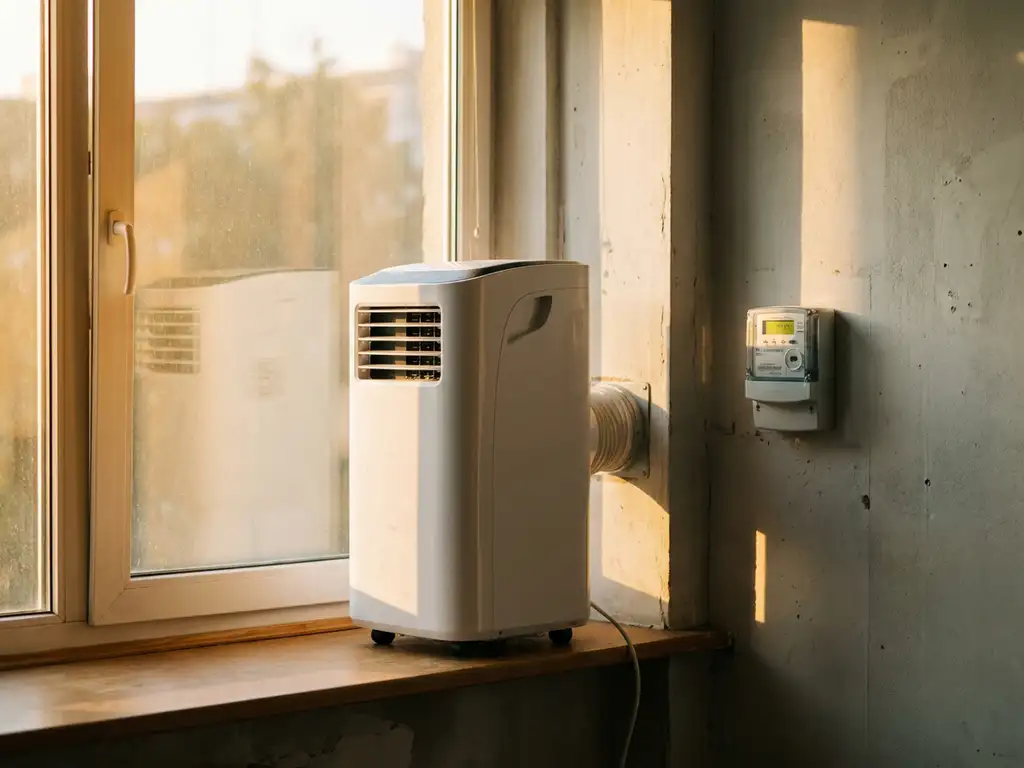
A monoblock air conditioner costs an average of between 20 and 60 euros per month in electricity during the summer, depending on the unit's capacity and how often you use it. A compact model of around 1.000 watts that runs for a few hours daily falls at the lower end of that spectrum. A powerful device that runs all day tends to be at the upper end. Below you will find a clear overview of everything that determines your electricity bill.
How many watts does a monoblock air conditioner consume on average?
A monoblock air conditioner consumes an average of between 700 and 2.500 watts per hour, depending on the cooling capacity of the model. Most compact units for a bedroom or small living room are around 900 to 1.200 watts. Heavier models for larger rooms can reach 2.000 watts or more.
The wattage stated on the device is the maximum consumption. In practice, an air conditioner rarely runs continuously at full power. Modern units switch back as soon as the desired temperature is reached, meaning the actual consumption turns out lower than the peak power suggests. Nevertheless, it is smarter to base your calculations on an average consumption of 70 to 80 percent of the maximum wattage.
Do you want to know which model best suits your space? Via the air conditioning selection guide you will quickly find a suitable device based on your situation.
How do you calculate the monthly electricity costs of a monoblock air conditioner?
You calculate the monthly electricity costs by multiplying the power (in kilowatts), the number of operating hours per day, and the electricity price per kilowatt-hour, and then multiplying that by the number of days in the month. The formula looks like this: kW x hours per day x days x electricity price = monthly costs.
A practical example: suppose you have a 1.200-watt (1,2 kW) monoblock air conditioner and you run it for 6 hours a day for 30 days. At an electricity price of €0,30 per kWh, you arrive at the following:
- 1,2 kW x 6 hours = 7,2 kWh per day
- 7,2 kWh x 30 days = 216 kWh per month
- 216 kWh x 0,30 euros = 64,80 euros per month
If you run the device for fewer hours per day, for example 3 hours, the costs are halved to approximately 32 euros. The electricity price in 2026 varies by supplier and contract, so always check your own rate for the most accurate calculation. Via the pricing tool you can quickly request an indication.
What are the average monthly costs in the summer?
During the summer months, you pay roughly 20 to 70 euros per month for electricity for an average monoblock air conditioner. This is based on normal use: cooling for a few hours a day during warm periods. Those who run the air conditioner at night or have a large unit may end up paying more.
In an average Dutch summer, there are periods of intense heat interspersed with cooler days. On the hottest days, an air conditioner runs harder and longer, driving up the monthly bill. On cooler days, you hardly use the device. As a result, averaged over the entire summer, consumption is reasonable compared to countries with a continuously warm climate.
If you only use the air conditioner during the day in a bedroom or small office space, a compact model will keep you well under 30 euros per month. If the unit cools a large living room and is on almost all day, 60 to 70 euros is more realistic.
What determines the power consumption of a monoblock air conditioner?
The power consumption of a monoblock air conditioner is determined by five main factors: the power of the unit, the size of the room, the insulation of the building, the outside temperature, and the set temperature difference. All these factors together determine how hard and how long the device must work to reach the desired temperature.
- Device power: A heavier device consumes more power per hour, but also cools faster.
- Room size: An appliance that is too small for a large room runs continuously at full power and therefore consumes more.
- Insulation: Poorly insulated rooms let warm air in faster, causing the air conditioner to work harder.
- Outside temperature: The greater the difference between outside and inside, the more energy is needed.
- Set temperature: Every degree lower in cooling costs extra electricity; the difference between 21 and 24 degrees is noticeable on the bill.
The age and maintenance of the device also play a role. A dirty filter causes the air conditioner to operate less efficiently and draw more power than necessary.
Is a monoblock air conditioner more energy-efficient than a split-unit?
A monoblock air conditioner is generally less energy-efficient than a split-unit. Split-units have a higher COP (Coefficient of Performance), which means they deliver more cooling per watt of electricity. A monoblock blows the warm air outside through a hose, which is less efficient than a split-unit system with an outdoor unit.
That being said, a monoblock air conditioner does have clear advantages: the unit is easy to install, requires no permanent installation, and is generally cheaper to purchase. For temporary use or situations where a split-unit is not feasible, a monoblock is an excellent choice.
The difference in power consumption between the two types is noticeable during normal use, but not dramatic. If you use the air conditioner intensively for several months, the difference on the annual bill does add up. For those who cool frequently and for extended periods, a split-unit is more economical in the long run.
How do you reduce the power consumption of a monoblock air conditioner?
You reduce the power consumption of a monoblock air conditioner by setting the temperature slightly higher, sealing the room properly, cleaning the filter regularly, and only using the air conditioner when absolutely necessary. Small adjustments in usage have a direct effect on your monthly electricity costs.
The most effective measures listed:
- Set the temperature to 24 or 25 degrees instead of 20 or 21 degrees. Every degree higher makes a noticeable difference in consumption.
- Close doors and windows when the air conditioner is running. Warm air from outside makes the device work harder.
- Clean the filter every two weeks during intensive use. A clogged filter significantly reduces efficiency.
- Use the timer or sleep mode so that the device automatically cools less or switches off at night.
- Ensure blackout during the day with curtains or sunshades. Less solar radiation means less heat in the room and less work for the air conditioner.
- Avoid heat sources in the refrigerated area, such as ovens, dryers, or a lot of electronics that give off heat.
With these measures, you can easily reduce the monthly power consumption of a monoblock air conditioner by 20 to 30 percent without compromising on comfort.
How De Betonboorder helps with the installation of your air conditioning
A monoblock air conditioner is easy to install, but a split-unit or a fixed exhaust hose routing often requires a hole in the wall. That is exactly what we at De Betonboorder take care of. We drill precise holes in concrete, stone, or other materials so that your air conditioner can be installed correctly and neatly.
- Professional drilling of through-holes for air conditioning installations in concrete, stone, and masonry
- Minimal collateral damage thanks to high-quality diamond drill bits
- Work carried out by experienced professionals, for both private individuals and businesses
- The workspace is left neat and tidy.
- In many cases on-site within two working days
Do you need a professional to drill a through-hole for your air conditioner? Schedule your job immediately and we will contact you within 24 hours.
Related Articles
- Can a damp crawl space become a problem when selling my house?
- How many ventilation holes does my crawl space need?
- Air conditioning for a 30 m² living room: what cooling capacity do you need?
- How much does it cost to keep your entire house cool with an air conditioner?
- How big does an air conditioner need to be for my room?
- Can an air conditioner cause thermal bridges?
- What is the difference between R32 and R410A refrigerant?
- Do I need a structural engineer for a stairwell in the floor?
- How deep are electrical cables embedded in a wall?
- How long does a chemical anchor last in concrete?
- What are the rules for drilling in an apartment?
- How do you increase the value of your home with an internal renovation?