
In a crawl space there are at least two ventilation grilles necessary, but the exact number depends on the surface area of your crawl space. As a rule of thumb, you should install at least one ventilation grille per 50 m² of floor area, with a minimum of two on opposite sides. A good crawl space ventilation prevents moisture problems, mold, and a musty smell in the house. In this article, we answer the most frequently asked questions about ventilation grilles in the crawl space.
How much ventilation does a crawl space need?
A crawl space requires adequate ventilation to remove moisture and prevent condensation. Dutch building regulations stipulate that the total clear opening of the ventilation grilles must be at least 0,1% of the floor area. For a floor of 100 m², this therefore means a total ventilation surface area of at least 1000 cm².
Without sufficient air circulation, moisture accumulates in the crawl space. This moisture originates from the soil, but also from the outside air and the home itself. The result is condensation on wooden beams and floorboards, which eventually leads to wood rot, mold growth, and an unhealthy indoor climate. A well-ventilated crawl space is therefore not only a matter of comfort, but also of maintenance and health.
What is the minimum number of ventilation grilles required per m²?
As a guideline, one ventilation grille per 50 m² of crawl space applies, with an absolute minimum of two grilles. These two grilles must be placed on opposite walls to allow for a continuous airflow. Therefore, for a crawl space smaller than 50 m², a minimum of two grilles is still required.
A standard ventilation grille typically has a clear passage of about 200 to 400 cm². If you calculate the required ventilation surface area based on the 0,1% standard, you will know exactly how many grilles you need. If you have a crawl space of 80 m², you need 800 cm² of clear passage. With grilles of 400 cm² each, you end up with a minimum of two units, but distributed over multiple points, it works better.
Also keep in mind that obstacles in the crawl space, such as foundation piles or low walls, can impede air circulation. In that case, it is advisable to add extra vents to prevent dead corners.
Where should the ventilation grilles be placed in the crawl space?
Ventilation grilles should be installed as low as possible in the exterior wall, just above ground level. They are preferably installed on opposite sides of the building so that outside air can flow straight through the crawl space. Avoid placing them behind bushes, raised areas, or other obstacles that block airflow.
The height above ground level is ideally between 15 and 30 centimeters. Placed too high, you lose the effect of ground ventilation; placed too low, you increase the risk of rainwater seepage. For corner or detached houses, it is advisable to install grilles in multiple facades for optimal airflow.
Which type of ventilation grille is suitable for concrete or masonry?
For concrete, preferably use a recessed grille or a wall grille specifically designed for round or rectangular drill holes. In masonry, you can also use a cavity grille that is placed in a joint or in a drilled hole. Always choose a grille with insect-repellent mesh and preferably a frost-resistant material such as plastic or aluminium.
Concrete gratings are supplied in standard diameters that match common drill diameters, such as 100 mm, 125 mm, or 150 mm. It is advisable to determine which grating you want to use before drilling the hole, so that the sizes align precisely. A hole that is too large is difficult to repair afterwards, while a hole that is too small requires extra work.
How are holes for ventilation grilles drilled in concrete?
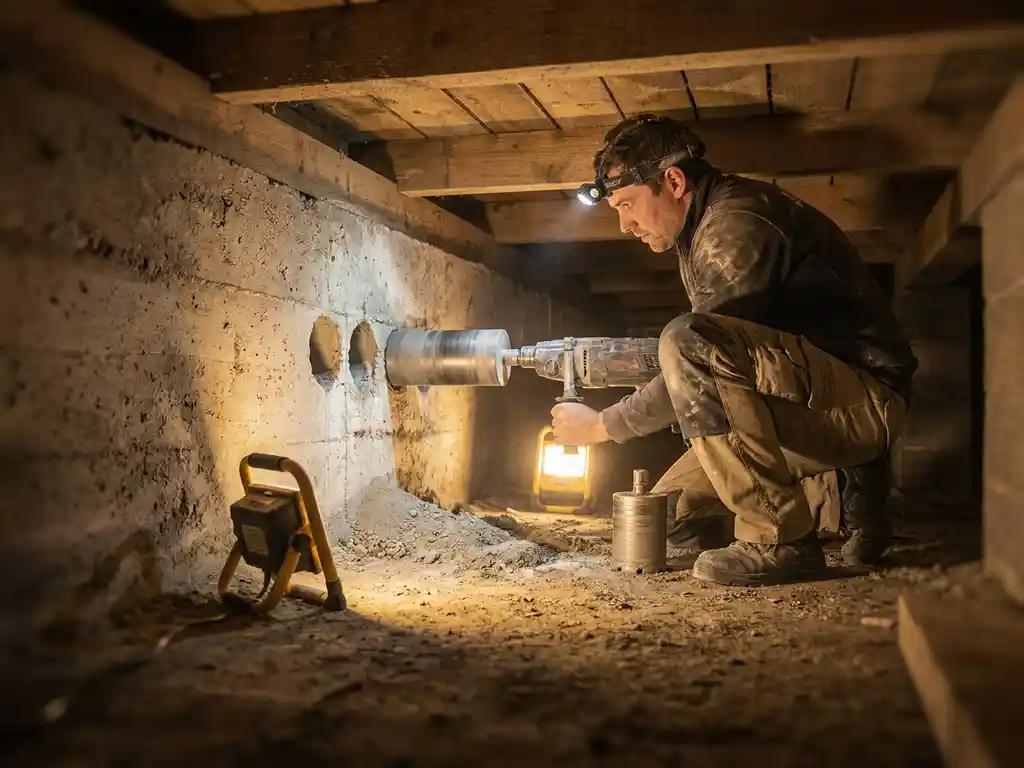
Holes for ventilation grilles in concrete are drilled using a diamond drilling rig. This technique, also known as core drilling or concrete drilling, creates a perfectly round hole without cracks or damage to the surrounding concrete. The drill diameter is matched to the grille to be installed.
Diamond drilling is the most accurate method for making holes in concrete, reinforced concrete, and masonry. The drilling process is accompanied by water cooling to protect the diamond drill bit and limit dust. The result is a clean, straight opening that aligns perfectly with the ventilation grille.
For private individuals, this work is usually impossible to carry out themselves, as the necessary equipment is heavy and specialized. A professional concrete driller has the right machines, core drills, and experience to make the hole quickly and neatly, even in difficult situations such as low crawl spaces or thick foundation walls.
When is mechanical ventilation necessary in the crawl space?
Mechanical ventilation in the crawl space is necessary when natural ventilation via vents is insufficient. This is the case in highly insulated homes, crawl spaces with a high groundwater level, or situations where the placement of vents is restricted by the structural situation. Mechanical ventilation is also a logical next step in the event of persistent moisture problems despite existing vents.
A mechanical ventilation system for the crawl space usually consists of a small fan that actively supplies or extracts air. Some systems use a hygrostat control, causing the fan to switch on automatically when humidity levels become too high. This is an efficient solution for homes where the crawl space is difficult to access or where the geometry of the space prevents good airflow.
Mechanical ventilation is also an option for homes with a concrete floor on the ground floor, where the crawl space is completely sealed off from the outside air. In that case, controlled ventilation is the only way to control moisture and condensation.
How De Betonboorder helps with crawl space ventilation
Installing ventilation grilles starts with making the right holes in concrete or masonry. That is exactly where we, as specialists in concrete drilling, make the difference. We handle the entire drilling process from start to finish, ensuring you have a well-ventilated crawl space quickly and without any hassle.
- We drill precise holes of the desired diameter, tailored to your ventilation grilles.
- We work with high-quality diamond drill bits for a clean and damage-free result.
- We operate throughout the Netherlands through a nationwide network of experienced professionals.
- In many cases, we can schedule a professional within two days.
- We leave the workplace neat and tidy.
Would you like to know what we can do for your situation? View our offer for crawl space ventilation or take it directly get in touch to schedule a professional. We will contact you within 24 hours.
Related Articles
- What is the target price for drilling ventilation holes in the foundation?
- Why do my baseboards feel damp on the underside?
- Air conditioning for a 30 m² living room: what cooling capacity do you need?
- What is a ceiling air conditioning unit?
- Can an air conditioner cause a headache?
- Can an air conditioner prevent equipment from overheating?
- How do you optimize the energy consumption of an air conditioner?
- What is core drilling and when do you need it?
- How do I know if a concrete driller is reliable?
- How do you increase the value of your home with an internal renovation?
- What do you need to arrange with the neighbors when removing a load-bearing wall?
- Can you remove a load-bearing wall without a structural calculation?