
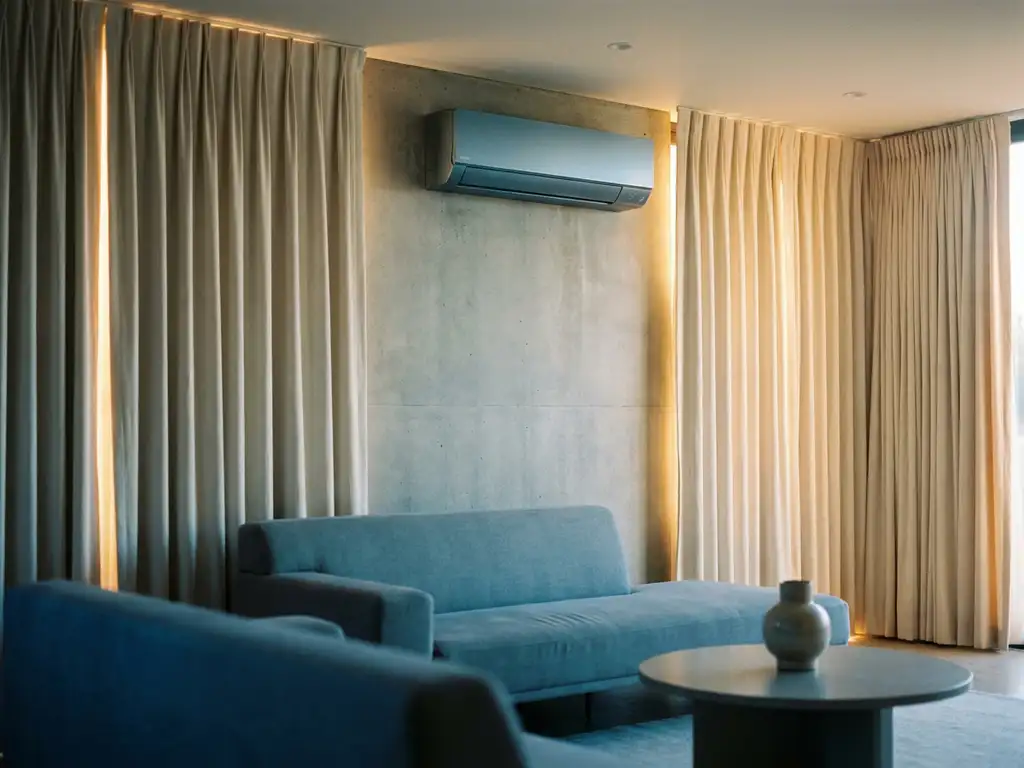
Yes, an air conditioner cools better when windows and curtains are closed. A closed room prevents warm outside air from flowing in, meaning the air conditioner doesn't have to work as hard to reach the desired temperature. Curtains add an extra layer by blocking sunlight before it heats up the room. In this article, we answer the most frequently asked questions about how to get the best performance from an air conditioner.
Why does an air conditioner cool less effectively when windows are open?
An air conditioner cools less effectively when windows are open because warm outside air continuously displaces the cooled indoor air. The device then attempts to compensate for a constant influx of new heat, which overloads the system and wastes energy without achieving the desired result.
An air conditioner works by extracting heat from the indoor air and expelling it outside. If a window is open, you are, as it were, constantly introducing new heat. The air conditioner then runs at full capacity without noticeably cooling the room. This is comparable to a refrigerator with the door open: the appliance works hard, but does not achieve its goal.
Moreover, warm outside air draws moisture indoors. Higher humidity causes the room to become warmer. feels, even if the thermostat indicates a lower temperature. A properly functioning air conditioner also regulates humidity, but this only works in an enclosed space.
Do curtains really help cool a room?
Yes, curtains demonstrably help cool a room, especially on sunny days. Solar radiation entering through glass heats up floors, furniture, and walls. Thick curtains or blackout curtains block that radiation and significantly reduce the heat load in the room.
The effect varies depending on the type of curtain. Light, reflective curtains or blackout roller blinds work best. Dark curtains absorb heat themselves and release it into the indoor air, which is less ideal. External sun protection, such as a sunshade or awning, is even more effective because the heat is blocked outside the building.
A practical approach: close curtains on the sunny side of the house during the day, and open them on the shady side when ventilation is needed. This way, you combine sun protection with some air circulation without unnecessarily burdening the air conditioning.
What is the ideal indoor temperature for an air conditioner in the summer?
The ideal indoor temperature for an air conditioner in the summer is between 22 and 24 degrees Celsius. This is the temperature at which most people feel comfortable, without the body becoming overloaded by the transition between inside and outside.
A common mistake is setting the air conditioning too low, for example to 18 or 19 degrees. This consumes much more energy, and the large temperature difference with the outside can feel unpleasant or even cause symptoms such as a stiff neck or a feeling of having a cold. Moreover, it takes longer for the room to reach that temperature, causing the system to run harder and longer.
A rule of thumb: set the air conditioner to a maximum of 6 to 8 degrees lower than the outside temperature. If it is 30 degrees outside, an indoor temperature of 22 to 24 degrees is comfortable and efficient. Every degree lower noticeably increases energy consumption.
Does it matter at what time of day you close the windows?
Yes, the moment you close the windows makes a big difference. The best strategy is to close windows early in the morning, before the outside temperature rises, and only open them again after sunset when the outside air cools down to below the inside temperature.
In the summer, the outdoor temperature typically rises rapidly after 09:00 AM and reaches a peak between 14:00 PM and 17:00 PM. By closing windows before that time, you keep the cool morning air inside and prevent built-up heat from outside from entering.
Late in the evening, when the outside temperature drops below 20 degrees, it is smart to open the windows again and switch off the air conditioning. This cools the home naturally, which saves energy. This principle, also known as night ventilation, works best in combination with properly closing windows and curtains during the day.
What other factors influence how well an air conditioner cools?
In addition to windows and curtains, there are several factors that determine how effectively an air conditioner cools a room. The most important are the capacity of the unit, the insulation quality of the building, heat sources in the room, and the maintenance of the air conditioner itself.
Power and capacity
An air conditioner that is too small for the room will never cool that room properly, no matter how tightly the windows are closed. The capacity of an air conditioner is expressed in BTU or kilowatts. As a rule of thumb, you need approximately 80 to 100 watts of cooling capacity per square meter of living space, depending on insulation and solar exposure. Via the air conditioning selection guide You will quickly find which assets suit your situation.
Heat sources and insulation
Electrical appliances such as computers, televisions, and lighting produce heat. Furthermore, in a poorly insulated room, cold air escapes through cracks, roofs, or walls. It makes little sense to invest in a powerful air conditioner if the room itself retains heat or leaks. Therefore, also check the seals of doors, windows, and any ventilation openings.
Air conditioning maintenance
A dirty filter obstructs airflow and significantly reduces cooling efficiency. Clean the filters of a split air conditioner at least once a season. Also have the outdoor unit checked periodically for dirt and obstructions. A well-maintained system cools faster, quieter, and more efficiently.
Do you need to drill a hole in the wall for air conditioning installation?
For the installation of a split air conditioner, it is necessary in most cases to drill a hole in the wall. The refrigerant lines, the power cable, and the condensate drain between the indoor and outdoor units run through this hole. The hole typically has a diameter of 60 to 80 millimeters.
This is precision work that requires taking into account the thickness of the wall, the presence of reinforcement in the concrete, and the exact position of the pipes. A drilling error can lead to structural damage or leakage. Therefore, it is strongly recommended to have this carried out by a professional, especially with reinforced concrete or load-bearing walls.
Incidentally, no hole is needed for portable air conditioning systems: they are vented through a window or door using a hose. However, they are less efficient than a fixed split air conditioner and cool larger spaces less effectively.
How De Betonboorder helps with the installation of your air conditioner
For a properly functioning split air conditioner, a neatly drilled hole in the wall is essential. We take care of this from start to finish, so the installer can get to work immediately without delay or hassle. This is what we arrange for you:
- Professional custom drilling: We drill the required hole to the correct diameter and position, even through reinforced concrete, aerated concrete, or masonry.
- Minimal collateral damage: Thanks to high-quality diamond core drills, we work accurately and without unnecessary vibrations or damage to the surrounding structure.
- Neat delivery: After the job, we leave the workplace clean and tidy so that the installation can proceed immediately.
- Quickly helped: In many cases, we schedule a professional within two working days.
Do you want to know what drilling costs for your specific situation? Then use our pricing tool for a specific indication. Or contact us directly get in touch to schedule a professional. The Concrete Driller ensures the hole is positioned correctly so your air conditioner can cool optimally.
Related Articles
- Can crawl space ventilation be combined with ground foil?
- How do I inspect my crawl space for moisture damage myself?
- Will I get pests or woodworm from a damp crawl space?
- How many ventilation grilles need to be installed in the crawl space?
- How do I prevent wood rot on the floor joists under my house?
- Innova 15HP vs Innova 15HP Vertical: which variant fits in your space?
- Which air conditioner suits an open kitchen?
- Qlima vs Olimpia Splendid: which brand is the better choice?
- What are the 10 best air conditioners?
- What is core drilling and when do you need it?
- Which plug do you use in a hollow wall?
- How do I know if I can drill myself or need a professional?