
Installing air conditioning in a listed building is possible, but requires a well-thought-out approach. The core of the challenge lies in protecting the historic facade and meeting the requirements of the municipality or the Cultural Heritage Agency. With the right choices, you can still live comfortably cool without compromising the monumental value of your property. In this article, we answer the most frequently asked questions about air conditioning in listed buildings.
Which air conditioning solutions are permitted in a monumental building?
In a listed building, air conditioning solutions are permitted that do not visibly affect the facade and do not cause irreversible damage. The most accepted options are portable air conditioners, split-unit systems where the pipework is concealed, and systems where the outdoor unit is completely hidden from view.
Portable air conditioners do not require a pass-through of the facade, making them the most accessible option. However, they offer less cooling capacity than fixed systems. A split-unit air conditioner is more efficient and quieter, but requires a small pass-through through the wall or facade for the pipes. This is permitted in listed buildings, provided the pass-through is carried out carefully and as discreetly as possible.
Systems with a high-efficiency heat pump that also cools are becoming increasingly popular in the monument sector because they combine multiple functions and keep the intervention in the building to a minimum. Are you using a air conditioning configuration tool To determine which capacity suits your space, you have a good starting point for the conversation with the municipality.
What does the municipality say about air conditioners in monumental buildings?
The municipality assesses air conditioning installations in monumental buildings based on the impact on the protected appearance of the building. In most cases, an environmental permit is required, even if the intervention appears minor. The municipality then verifies whether the installation is reversible and whether the facade value is preserved.
Moreover, for national monuments, the Cultural Heritage Agency of the Netherlands (RCE) plays a role in the permit granting process. For municipal monuments, the local monuments commission is the deciding party. It is advisable to request an informal consultation with the municipality in advance so that you know which options are feasible before investing in plans or materials.
What municipalities typically refuse are installations where the outdoor unit is visibly placed on the street side, or where large holes are made in the historic facade. What they allow more often are penetrations at the rear of the building or via a roof penetration that is not visible from the public area.
How can an air conditioner be installed without damaging the facade?
An air conditioner can be installed without damaging the facade by placing the pipe penetration in a non-visible location, such as the rear facade, the roof, or through an existing opening such as a ventilation duct. The penetration itself is kept as small as possible and neatly finished with a collar or rosette that matches the material of the facade.
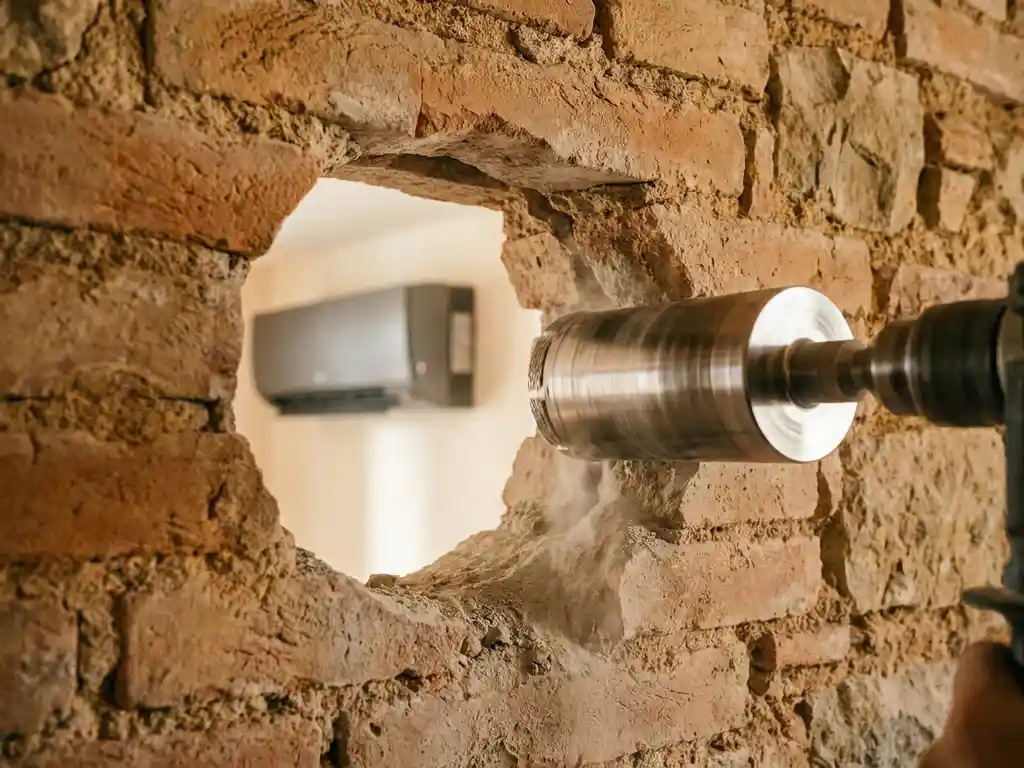
The key to a successful installation is precision work when drilling the conduit. An opening that is too large or a crooked drill hole causes unnecessary damage to the masonry or stone structure. Professional drilling with diamond core drills ensures a clean, straight conduit with minimal collateral damage, which is essential for monumental buildings.
Additionally, you can conceal the pipes on the inside of the building in a pipe duct or behind a finishing strip, so that as little as possible is visible on the outside. Extra caution is required with wooden facades or timber-frame structures, as the material is more sensitive to vibrations and moisture.
Where may the outdoor unit of an air conditioner be placed in a listed building?
In a monumental building, the outdoor unit of an air conditioner should preferably be placed in a location that is not visible from the public space. Examples include the back garden, a courtyard, a flat roof at the rear, or a screened side wall. Placement on the street side is prohibited in almost all cases.
Some municipalities impose additional requirements regarding the screening of the outdoor unit, even if it is located at the rear. A green hedge, a wooden screen, or a stone casing may be required to meet the visibility criterion. Check this specifically with the municipality or monuments commission in your region.
Installation on a flat roof is often the least problematic, provided the unit does not protrude above the roof edge and thus become visible from the surroundings. If in doubt, seek advice from an installer with experience in monumental buildings to avoid unpleasant surprises later on.
Would you like to get an idea of the costs and options in advance? Via the pricing tool you can quickly request an indication for your situation.
How much does an air conditioning installation in a listed building cost?
An air conditioning installation in a listed building is generally more expensive than in a standard building, due to the additional requirements regarding execution, the permit procedure, and the care required when drilling and concealing pipes. The total costs depend on the type of system, the complexity of the installation, and the location of the outdoor unit.
In addition to the costs for the air conditioning system itself, also factor in the following additional costs:
- Fees for the environmental permit (varies by municipality)
- Costs for professionally drilling the pipe penetration
- Finishing of the penetration on both the inside and outside
- Possible shielding of the outdoor unit
- Additional work at hard-to-reach locations or thick walls
It pays to request multiple quotes and explicitly mention that it concerns a listed building. Not every installer has experience with the specific requirements associated with monuments, and this can lead to problems later on with the municipality or the quality of the finish.
How De Betonboorder helps with air conditioning installations in monumental buildings
Drilling a neat, precise penetration for air conditioning pipes is one of the most critical steps in an installation in a listed building. We ensure that this work is carried out professionally and carefully, so that the facade remains intact and the penetration is as inconspicuous as possible.
- We drill with high-quality diamond core drills for a clean, straight feed without unnecessary damage to the masonry.
- We work with concrete, natural stone, brick, and other materials commonly found in monumental buildings.
- We take into account the specific requirements of the location and leave the workplace tidy.
- In many cases, we can schedule a professional within two days.
Would you like to know what we can do for your project? Contact us and we are happy to think along with you about the best approach for your monumental property.
Related Articles
- How do I tell if the musty smell in the house is coming from the crawl space?
- Will my wallpaper or floor be damaged if a stairwell is sawn?
- Is crawl space ventilation a permanent solution or does it require maintenance?
- Which grilles are best for crawl space ventilation?
- Is a more expensive air conditioner really cooler? Price versus cooling performance explained
- Where should you hang an air conditioner in the living room for the best cooling?
- How big does an air conditioner need to be for my room?
- Can an air conditioner cause a headache?
- Can an air conditioner cause condensation problems?
- How do you ensure a hole goes straight into the wall?
- How long does a chemical anchor last in concrete?
- How much does a renovation to combine your living room and kitchen cost?