
An air conditioner in a conservatory or garden room is virtually indispensable in the summer if you really want to use the space. Due to the large glass surfaces, the temperature rises rapidly on hot days, meaning good cooling makes the difference between a pleasant seating area and an uninhabitable greenhouse. In this article, we answer the most frequently asked questions about air conditioners in conservatories: from the right type to installation and smart alternatives.
Which type of air conditioner works best in a conservatory or garden room?
For a conservatory or garden room, a split unit air conditioning almost always the best choice. This system consists of an indoor unit and an outdoor unit that dissipates heat. It cools efficiently, operates quietly, and is suitable for rooms with a large glass surface area. A portable air conditioner is an alternative that does not require a fixed installation, but it is less effective and always requires an exhaust hose to the outside.
A major advantage of a split-unit air conditioner is that it can also heat, which is useful in spring and autumn when the conservatory cools down quickly. Preferably choose a model with a high capacity relative to the size of the room, as glass insulates poorly and the sun heats the space continuously. As a rule of thumb, you need more cooling capacity for a conservatory than for a comparable indoor room. Via the air conditioning selection wizard you will quickly find a suitable model for your situation.
A cassette air conditioner, which is mounted in the ceiling, is an option if you want to keep the indoor unit out of sight. This type is well-suited to conservatories with a suspended ceiling or a wooden roof structure, but requires professional installation.
How hot does a greenhouse get without cooling in the summer?
A conservatory without cooling can easily on a hot summer day become 10 to 20 degrees warmer than the outside temperatureAt 30 degrees outside, the temperature in a fully glass conservatory rises to 40 or even 50 degrees. This makes the space not only uncomfortable but also unhealthy for prolonged stay.
This effect, also known as the greenhouse effect, occurs because sunlight enters through the glass but the heat has difficulty escaping. The orientation of the conservatory plays a major role: a south-facing conservatory catches the most direct sunlight and heats up the most. A north-facing conservatory remains cooler but receives less sunlight.
External sun shading on the glass can significantly slow down warming, but does not completely replace cooling. Good ventilation also helps, but on the hottest days of summer, active cooling is the only way to keep the temperature truly manageable.
How much does it cost to install an air conditioner in a conservatory?
The cost of installing air conditioning in a conservatory depends on the type of system, the capacity, and the complexity of the installation. A split-unit air conditioner, including installation, typically costs more than a portable system, but also provides a better and more sustainable solution. Use the pricing tool to get an indication of the costs for your specific situation.
In addition to the device itself, there are installation costs for the technician, materials such as piping and brackets, and possibly costs for drilling through a wall or facade to connect the indoor and outdoor units. The complexity of the penetration, for example through concrete or masonry, affects the total price.
It pays to request multiple quotes and pay close attention to the warranty conditions of both the device and the installation. A cheaper installation can turn out to be more expensive in the long run if problems arise with the mounting or the cable routing.
Does a hole need to be drilled for the installation of an air conditioner?
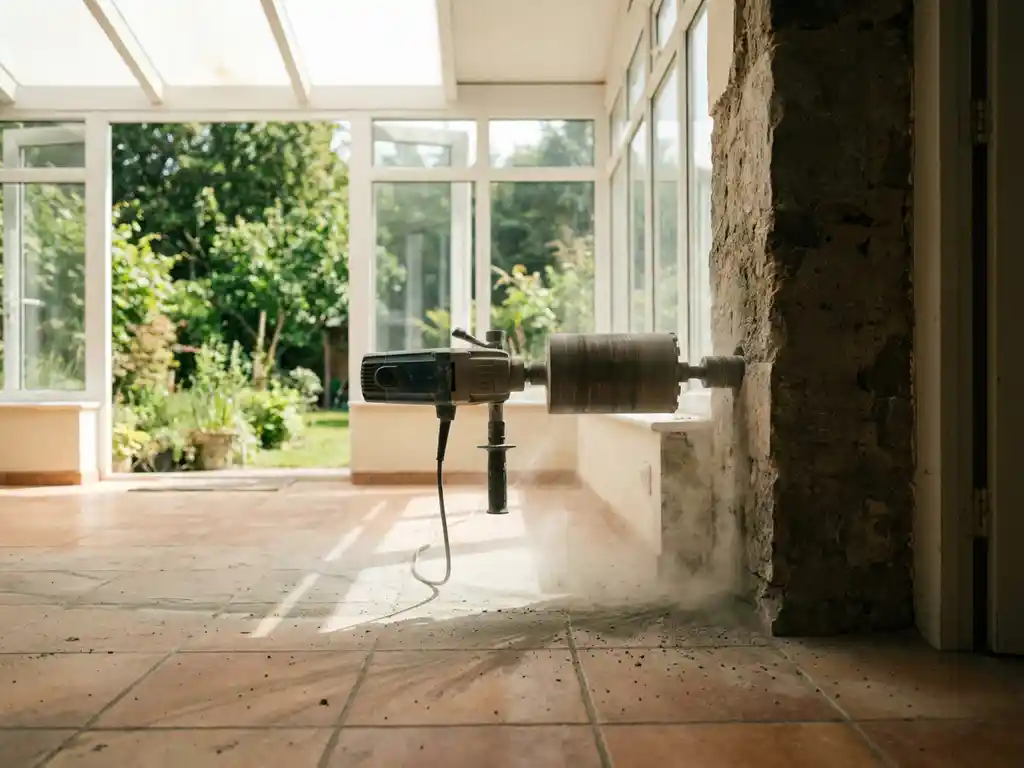
Yes, during the installation of a split-unit air conditioner, there must be almost always a hole needs to be drilled through the wall or facade. The refrigerant lines, power cable, and condensate drain from the indoor unit to the outdoor unit run through this hole. The hole typically has a diameter of 60 to 80 millimeters and must be made neatly and accurately.
In a conservatory, the situation is sometimes more complex than in a standard home. The walls can consist of aluminium profiles, wood, brick, or concrete, depending on the construction. For a concrete or masonry back wall, a diamond drill is necessary for a clean result without cracks or damage to the surrounding structure.
A sloppy or oversized hole can lead to drafts, moisture problems, or even structural damage. It is therefore wise to leave this part of the installation to a professional who uses the right equipment and knows how to handle various materials.
What alternatives are there besides air conditioning for a cool conservatory?
There are several ways to keep a conservatory cooler without a full air conditioning system, although they offer less cooling than active cooling. The most effective alternatives are external sun shading, good ventilation and reflective glassTogether, they can noticeably lower the temperature.
- Exterior sun shading: External screens or sunshades on the glass block sunlight before it heats the room. This is more effective than internal sun shading.
- Skylights or ventilation openings: Warm air rises. Roof windows that can be opened allow hot air to escape and provide natural ventilation.
- Reflective or HR++ glass: During a renovation or new construction, special glass can block a portion of the heat radiation.
- Fans: A ceiling fan or standing fan creates air movement, which lowers the perceived temperature, but not the actual temperature.
- Plants and water features: Evaporation via plants or a small water feature cools the air slightly, but this effect is limited during extreme heat.
These measures are most effective in combination with each other. However, on the hottest summer days, when the outdoor temperature exceeds 30 degrees, they are rarely sufficient as a standalone solution.
When is air conditioning in the conservatory worthwhile?
An air conditioner in the conservatory is worthwhile if you the space regularly used during warm months and do not want to depend on the outside temperature. Especially if the conservatory serves as a living room, dining room, or home office, climate control is not a luxury but a necessity for comfortable use.
If you use the conservatory only occasionally or mainly in the morning and evening, good sun protection and ventilation may be sufficient. However, if you use the space daily, even on the hottest afternoons of summer, air conditioning pays for itself in terms of living comfort.
Also consider the future: summers are becoming warmer and longer on average. What is currently bearable with a fan could become structurally too hot in a few years. Moreover, an air conditioner that also functions as a heat pump offers extra comfort in the winter, spreading the investment over multiple seasons.
How De Betonboorder helps with the installation of an air conditioner in the conservatory
When installing air conditioning in a conservatory, drilling through a wall or facade is a crucial step. We ensure that this is done accurately, cleanly, and without unnecessary damage to the structure. Whether it involves concrete, masonry, or another surface, we have the right equipment and expertise.
- We drill holes with the correct diameter for air conditioning pass-throughs, standard between 60 and 80 millimeters.
- We work with high-quality diamond core drills for a clean result without cracks or damage.
- We operate throughout the Netherlands and can be on-site within two days in many cases.
- After work, we leave the workplace neat and tidy.
- We work for private individuals, SMEs, and contractors.
Would you like to know what we can do for your situation? Contact us and we respond within 24 hours.
Related Articles
- How much ventilation does a crawl space actually need?
- Is it necessary to drill through concrete for crawl space ventilation?
- How are ventilation holes drilled in the crawl space?
- Air conditioner payback period: when do you recoup the investment?
- Innova vs. the competition: why choose an Innova monoblock air conditioner?
- How much does it cost to keep your entire house cool with an air conditioner?
- How do you set an air conditioner optimally for the best cooling?
- Qlima vs Olimpia Splendid: which brand is the better choice?
- How much power does an air conditioner consume per hour?
- How do I know if I can drill myself or need a professional?
- How do you drill a hole in a basement wall without leaks?
- How long does it take to apply for an environmental permit in 2026?