
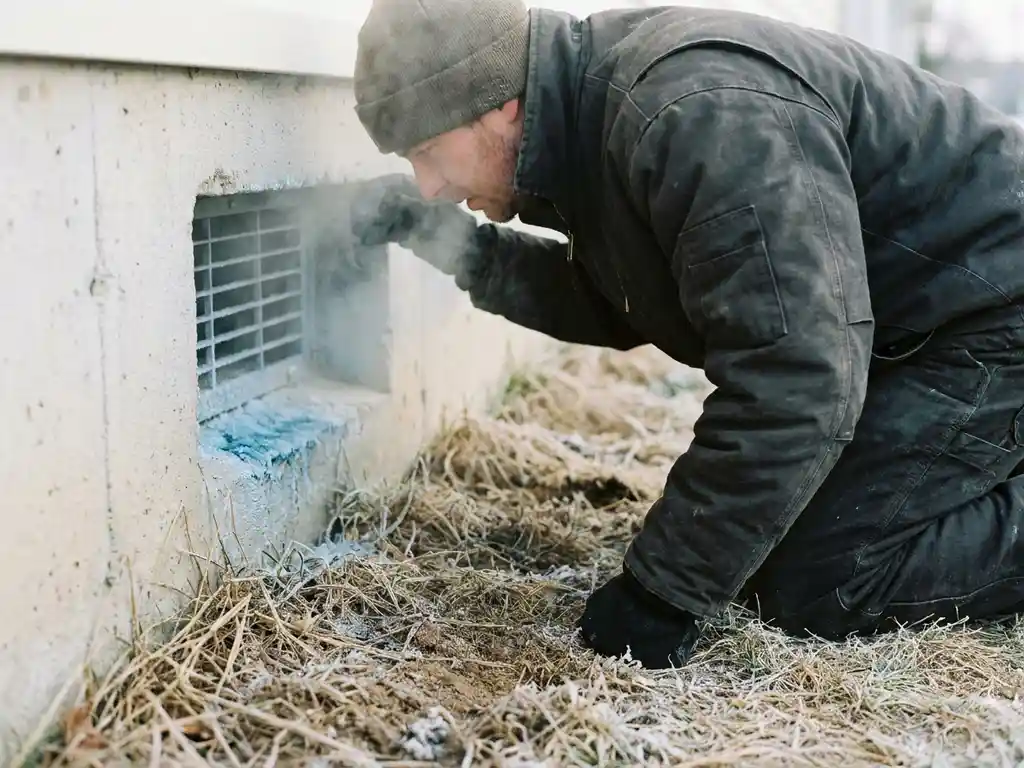
Yes, crawl space ventilation also works in the winter. Its operation does not change with the season, but external conditions do. Cold outside air is often drier than warm inside air, which is precisely what makes ventilation effective in winter for removing moisture from the crawl space. In this article, we answer the most frequently asked questions about crawl space ventilation during the cold season.
How exactly does crawl space ventilation work?
Crawl space ventilation ensures constant air circulation beneath your home, removing humid air and drawing in dry outside air. This prevents moisture buildup, mold growth, and wood rot in your home's structure. Ventilation takes place through openings in the foundation, also known as vents or grilles.
There are two forms of crawl space ventilation: natural ventilation and mechanical ventilation. With natural ventilation, air flows spontaneously through vents in the exterior wall due to pressure differences and wind. With mechanical ventilation, a fan is used that actively draws in or blows out air. The goal of both systems is to keep the relative humidity in the crawl space low, ideally below 70 percent.
A good one crawl space ventilation It not only protects the structure of your home but also improves the indoor climate. Damp crawl spaces can lead to a musty smell in the house and even negatively affect indoor air quality.
Does crawl space ventilation work less effectively in the winter?
Crawl space ventilation works just as well in winter, but the dynamics are different than in summer. Cold outside air naturally contains less water vapor than warm air. This means that cold air flowing into the crawl space is relatively dry and can effectively absorb and remove moisture.
A common misconception is that ventilation in winter makes the crawl space too cold, causing the floor to become colder. In practice, the effect on floor temperature is minimal, especially if the floor is well insulated. The risk of a poorly ventilated crawl space, namely moisture and mold, outweighs the small temperature difference caused by ventilation.
In winter, condensation can become a bigger problem if warm, humid air from the home reaches the crawl space and comes into contact with cold surfaces. Good ventilation actually helps prevent this by keeping the moisture balance stable.
What are the signs of poor ventilation in winter?
Poor crawl space ventilation in winter can be recognized by a number of clear signs. The sooner you recognize these, the sooner you can prevent damage.
- Musty or moldy smell in the house, especially on the ground floor
- Condensation on windows and cold floors, which indicates high humidity
- Visible mold spots on beams, insulation material, or the underside of the floor
- Wood rot on supporting beams or other wooden structural parts in the crawl space
- A moisture measurement above 70 percent in the crawl space
- Opstijgend vocht in walls or floors on the ground floor
Do you notice one or more of these signs? Then it is advisable to check the ventilation openings for blockages and assess whether there are enough grilles present for good airflow.
Should you close ventilation openings in the winter?
No, you should not close off ventilation openings in the crawl space during the winter. This is a common mistake that, in practice, causes more harm than good. Although it seems logical to limit heat loss by closing vents, this actually leads to moisture buildup.
Without sufficient air circulation, the relative humidity in the crawl space rises rapidly. This promotes mold growth and damages wooden load-bearing structures. The cost of repair work due to wood rot or mold is many times higher than the potential energy loss through open ventilation openings.
There is one exception: if your crawl space is fully insulated and hermetically sealed from the outside air as part of a deliberately chosen building system, different rules apply. In that case, a mechanical ventilation system is usually present to regulate air quality. However, for a traditional crawl space, the rule is: keep the vents open, even in winter.
How do you have extra ventilation openings made in concrete?
Have additional ventilation openings in a concrete foundation made by a specialist using diamond drilling procedures. This is precision work involving drilling round holes at the correct position and diameter without damaging or weakening the foundation.
The process is as follows:
- Determine the location of the new openings based on the desired airflow through the crawl space
- Choose the correct diameter for the grate that is placed in it, usually between 100 and 200 millimeters
- Drill the hole with a diamond core drill, which provides a low-dust and accurate result
- Install the ventilation grille in the opening to keep insects and pests out
Diamond drilling is the most suitable method for concrete because it does not cause vibrations or cracks in the surrounding structure. In most cases, the work is carried out quickly and causes minimal disturbance to the surroundings.
When is mechanical crawl space ventilation a better choice?
Mechanical crawl space ventilation is a better choice than natural ventilation when the situation is too complex for passive air circulation alone. This is the case for homes with an unfavorable location, a deep or large crawl space, or severe moisture problems that cannot be solved with vents alone.
Situations in which mechanical ventilation is preferred:
- The crawl space is large or has an irregular layout, causing air not to circulate properly.
- There are persistent moisture problems despite existing ventilation openings.
- The home is situated in an environment with little wind or is surrounded by buildings that block the natural airflow.
- Mold is already present and a more intensive approach is needed.
- You want to be able to actively monitor and regulate the humidity.
A mechanical system operates all year round, even during windless periods in winter, and provides greater control over humidity. It does require a one-time installation and periodic maintenance, but offers a more reliable solution in complex situations than grilles alone.
How De Betonboorder helps with crawl space ventilation
Do you want to have extra ventilation openings drilled into the concrete foundation of your home? We take care of this from start to finish. Our professionals work nationwide and specialize in accurately drilling holes in concrete, without damaging the surrounding structure.
- We drill custom ventilation openings in concrete foundations.
- We use high-quality diamond core drills for a low-dust and precise result.
- We work for private individuals, contractors, and SMEs.
- In many cases, we can schedule a professional within two days.
- We leave the workplace neat and tidy.
Do you have questions about the possibilities or would you like to make an appointment directly? Contact us and we respond within 24 hours. You can also read more about our approach at debetonboorder.nl.
Related Articles
- What is needed to create an opening in the upper floor for a staircase?
- Is creating a stairwell in a precast floor different from that in a cast-in-place floor?
- What is the best solution for a damp crawl space?
- Does the musty smell in the house disappear after installing crawl space ventilation?
- How do I request a quote for crawl space ventilation?
- How can I lower the temperature in my house?
- Innova vs Qlima: which air conditioner is the quietest in the bedroom?
- How do you prevent an air conditioner from freezing?
- Which air conditioner works best in humid rooms?
- How do you prevent mold caused by an air conditioner?
- Do I need a structural engineer for a stairwell in the floor?
- How do you hang something heavy on a concrete wall?