
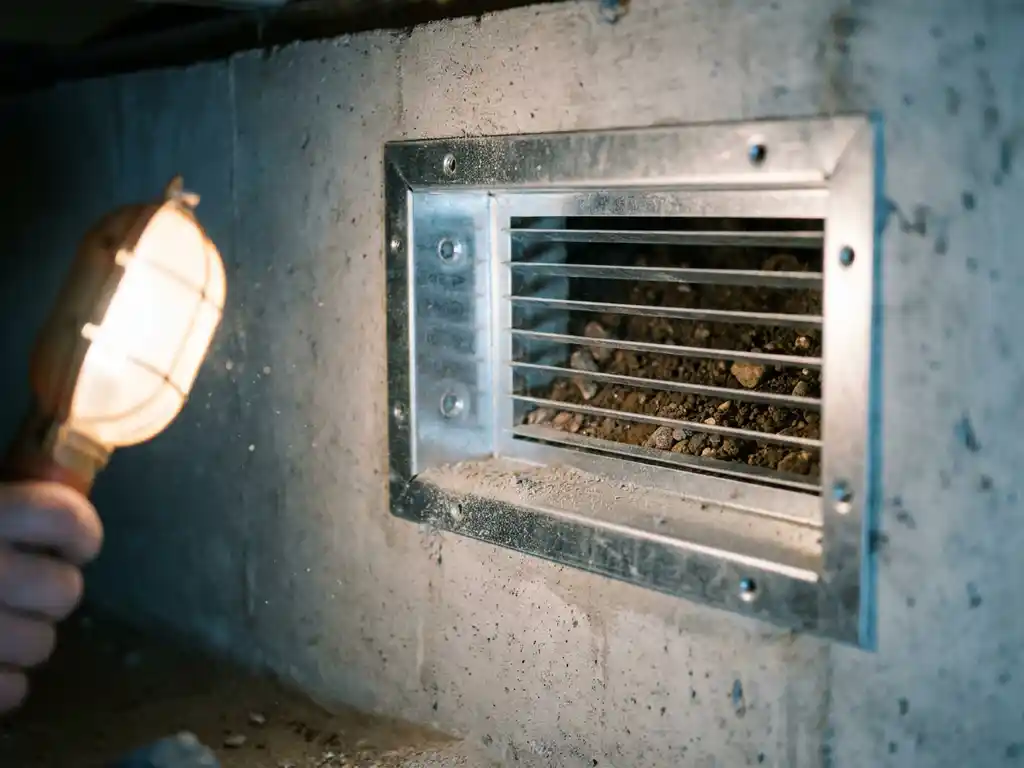
The best grilles for crawl space ventilation are plastic or aluminium ventilation grilles with a free-flow opening of at least 1% of the floor area. These materials are resistant to moisture, corrosion, and temperature fluctuations, making them ideally suited for the harsh conditions in a crawl space. In this article, we answer the most frequently asked questions about choosing, installing, and maintaining ventilation grilles.
What types of grilles are available for crawl space ventilation?
For crawl space ventilation, there are three common types of grilles: fixed grilles, adjustable grilles, and automated ventilation grilles. A fixed grille allows air to pass through continuously and is the simplest and cheapest solution. An adjustable grille can be opened and closed manually, which is useful in winter to limit thermal bridges. An automated system regulates the airflow based on humidity or temperature.
Fixed vents are by far the most commonly used in existing homes. They require little maintenance and operate without any controls. Adjustable vents give you more control, but also require more attention: if you close them in the winter and forget to open them, moisture builds up quickly. Automated systems are the most modern option and are becoming increasingly popular in well-insulated homes where moisture balance is more critical. If you are unsure which type suits your situation, a crawl space inspection is a good starting point.
Which material is the most durable for a ventilation grille?
Plastic (PVC) and aluminium are the most durable materials for a ventilation grille in the crawl space. Both materials do not rust, are resistant to moisture, and require hardly any maintenance. Steel grilles are cheaper, but last considerably shorter in a damp crawl space because they rust and eventually become clogged.
Plastic gratings are lightweight, easy to install, and available in many standard sizes. They are resistant to mold and soil chemicals. Aluminum gratings are slightly sturdier and look neater, which can be an advantage for exposed facades. Wooden gratings are rarely used in crawl spaces nowadays because wood shrinks, swells, and eventually rots in a damp environment. Therefore, always choose plastic or aluminum if you want a grating for the long term.
How many vents does a crawl space need?
A crawl space requires at least two ventilation openings on opposite sides of the home to create a continuous airflow. As a rule of thumb, the total free flow area of all vents combined must amount to at least 1% of the total floor area of the crawl space. For a home of 80 m², this therefore means a minimum of 800 cm² of free air passage.
In practice, more ventilation is almost always better than less. Homes with an elongated floor plan, multiple attached rooms, or a crawl space divided by foundation walls require extra vents to prevent dead corners. Dead corners are places where air barely circulates, and it is precisely there that mold forms. In an existing home, check whether the current vents are clogged with dirt, cobwebs, or old insulation materials, as this can significantly reduce the effective airflow opening. Good crawl space ventilation starts with sufficient and properly functioning openings.
Where should ventilation grilles be placed in the crawl space?
Ventilation grilles must be placed as low as possible in the exterior wall, directly above ground level or just above the ground, and on at least two opposite sides of the dwelling. This positioning ensures a continuous airflow through the entire crawl space, from one side to the other.
Preferably place grilles on the north and south sides or the east and west sides of the house, depending on the prevailing wind direction in your region. Avoid placing them directly behind obstacles such as hedges, fences, or attached sheds, as these block the supply of fresh air. Also ensure that the grilles are not covered by soil, gravel, or vegetation. A grille that is half-buried is of little use. During renovations or for homes with a closed foundation, extra openings may sometimes be required that need to be drilled into the concrete or the wall.
When is it necessary to replace a grate or drill an extra opening?
Replacing a grille is necessary when it is damaged, clogged, or rusted and no longer allows sufficient air to pass through. Drilling an additional opening is necessary when the existing ventilation openings are insufficient for the floor area of the crawl space, or when dead zones without air circulation have been created after a renovation.
Signs that you need to take action include:
- A musty or earthy smell in the house, particularly on the ground floor
- Visible mold growth on floor joists, insulation, or walls in the crawl space
- Condensation on pipes or the underside of the floor
- Grilles that are visibly damaged, blocked, or rusted shut
- A home that has been extended or modified, resulting in an enlarged crawl space.
In many cases, replacing a grate is a simple job. However, if a new opening is required in concrete or masonry, it requires professional tools and expertise to prevent damage to the foundation or surrounding structure.
How De Betonboorder helps with crawl space ventilation
We help you quickly and professionally achieve a well-ventilated crawl space. Whether you need an extra opening in a concrete foundation or want to enlarge an existing hole for a new grate, our specialists ensure a clean and precise execution with minimal disruption.
- Drilling new ventilation openings in concrete, masonry or other hard materials
- Enlarging existing openings so that grilles with the correct flow area can be installed
- National network of experienced professionals, in many cases available within two days
- Neat deliveryThe workplace is left clean and tidy.
- Suitable for private individuals, SMEs, and contractors
Are you suffering from damp, mold, or a musty smell in your home, and do you suspect that the crawl space ventilation is inadequate? Contact us and we will quickly arrange a professional in your area.
Related Articles
- Can I turn my attic into a bedroom without a fixed staircase?
- Innova 12HP Vertical vs Innova 15HP Vertical: the floor-standing models side by side
- Innova 15HP vs Innova 15HP Vertical: which variant fits in your space?
- Having air conditioning installed: how does the installation proceed step by step?
- What does BTU mean for air conditioners?
- How do you set an air conditioner optimally for the best cooling?
- Which air conditioner is suitable for an attic room?
- Which air conditioner fits in a small space?
- What is a recess and when do you need one?
- How is a penetration in an exterior wall made watertight?
- How do you drill a hole for a spotlight in a concrete ceiling?
- What are the risks of removing a load-bearing wall yourself?