
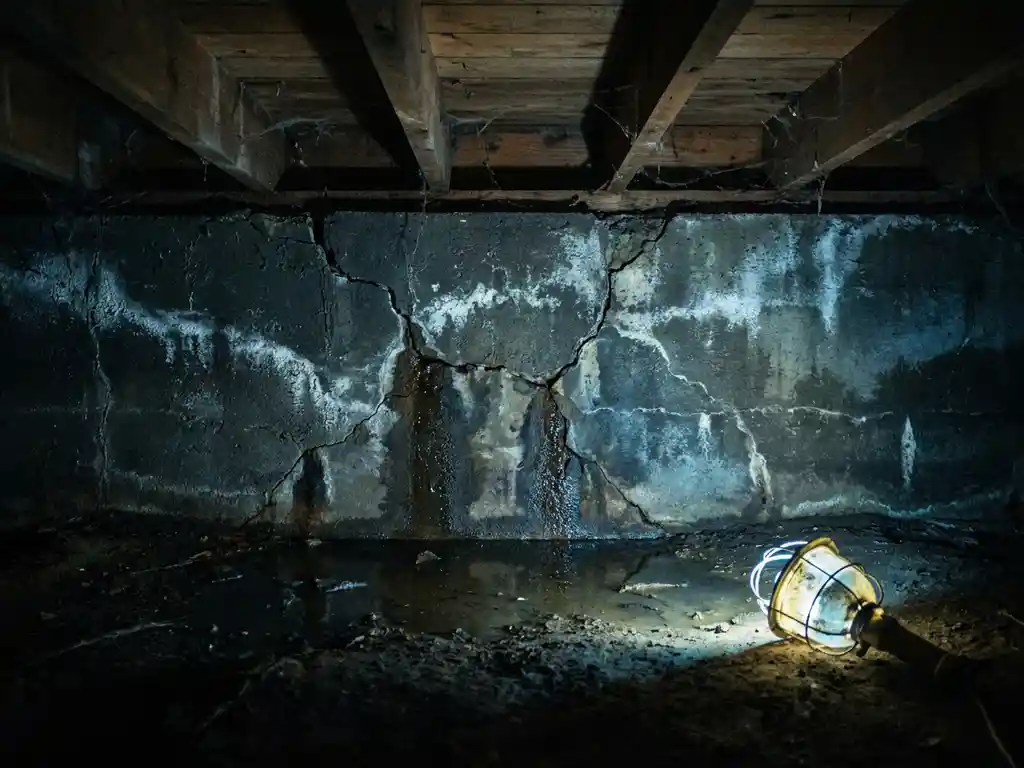
Prolonged damp under your house leads to serious damage to the foundation, wooden load-bearing structures, and interior walls. Mold and wood fungus attack the woodwork, while rising damp damages walls and floors. For residents, this also poses health risks, such as respiratory problems caused by mold spores. In this article, we answer the most important questions about damp problems in the crawl space and what you can do about them.
How does moisture spread from the crawl space to the rest of the house?
Moisture from the crawl space spreads via two routes: rising damp through floors and walls, and moist air drawn upwards through cracks and openings. Because warm air inside the house has a lower pressure than the cold, damp air in the crawl space, that moist air flows upwards naturally. This process is called the chimney effect.
Once inside the home, the moist air condenses on cold surfaces such as exterior walls, windows, and floors. The result is a musty odor, condensation, and eventually mold spots on walls and ceilings. Many residents look for the cause of moisture problems inside the house, while the actual source lies meters below. A poor crawl space ventilation is often the main cause: without sufficient air circulation, moisture accumulates and finds its way upwards.
What are the consequences of prolonged moisture for the foundation and structure?
Prolonged moisture affects both wooden and concrete structures. Wooden beams and floorboards rot away due to wood fungus and mold, reducing load-bearing capacity. Concrete foundations can crack and weaken due to continuous exposure to moisture, especially in combination with frost and thaw. These are structural problems that are costly to repair.
Wooden foundation piles, found in many older Dutch homes, are particularly vulnerable. As long as they remain fully submerged, they stay intact. However, when the groundwater level drops and the piles become partially dry, they begin to rot. Moisture in the crawl space accelerates this process by keeping the area around the piles damp and oxygen-rich—precisely the conditions in which wood rot thrives. In the long term, this can lead to subsidence of the floor or even the entire home.
What health risks does damp under the house pose?
Moisture in the crawl space promotes the growth of mold and bacteria, the spores of which enter the home through the air. This can lead to respiratory complaints, allergic reactions, and the worsening of asthma. Children, the elderly, and people with weakened immune systems are most vulnerable to these effects.
The most common complaints among residents of homes with damp problems are chronic fatigue, headaches, a stuffy nose, and recurring respiratory infections. Mold species such as Cladosporium and Aspergillus thrive in damp spaces and produce substances that severely degrade indoor air quality. A musty smell in the house is often the first sign that air quality is compromised due to moisture in the crawl space.
How do you know if moisture has already caused damage under your house?
There are several signs that indicate moisture has already caused damage in the crawl space or to the structure. You can recognize this by visible mold spots on floors and walls, a persistent musty odor, sagging or flexing floorboards, and condensation on windows. Inspecting the crawl space itself provides the most certainty.
Pay attention to the following during an inspection:
- Standing water or wet soil in the crawl space
- Mold or white efflorescence on walls and beams
- Wood rot on beams, floorboards, or supports
- Visible cracks in the foundation or floor slab
- Rust formation on metal pipes or structural parts
If you recognize one or more of these signs, it is wise to take action quickly. The longer you wait, the greater the damage and the higher the repair costs.
What are the best solutions for moisture in the crawl space?
The most effective solutions for moisture in the crawl space are better ventilation, installing a vapor barrier on the floor, and improving water drainage around the home. Which solution works best depends on the cause of the moisture problem.
In most homes, insufficient air circulation is at the root of the problem. By improving or adding ventilation openings in the crawl space, moist air can escape before it causes damage. A vapor barrier on the crawl space floor prevents groundwater from evaporating and entering the air. Additionally, it helps to:
- Keep existing ventilation openings free of obstacles
- to check rainwater drainage and groundwater level around the house
- To have leaking pipes in the crawl space repaired in time
- Have existing rotten wood replaced by a professional
When is professional intervention necessary for moisture problems?
Professional intervention is necessary as soon as there is structural damage to woodwork or the foundation, when moisture problems persist after home improvement measures, or if the crawl space is not safely accessible for a DIY approach. In those cases, the damage is too complex to resolve yourself.
You can carry out minor measures yourself, such as clearing ventilation openings. However, as soon as beams are affected, the floor is sagging, or cracks are visible in the foundation, you need a professional. Installing a ventilation grille or laying crawl space foil also requires the right materials and knowledge to be effective. Early professional intervention prevents a relatively simple moisture problem from escalating into a costly structural repair.
How De Betonboorder helps with crawl space ventilation
Good crawl space ventilation is the most direct way to prevent and solve moisture problems under your house. We take care of installing ventilation openings and grilles in the crawl space so that moist air is effectively removed. This not only improves the air quality in your home but also contributes to better insulation.
What we arrange for you:
- Drilling ventilation openings in concrete or masonry around the crawl space
- Installing ventilation grilles for optimal air circulation
- Professional execution with minimal disruption and a tidy workplace afterwards.
- Rapid response: in many cases, a professional on site within two days
Are you suffering from damp in your crawl space and do you want to know what we can do for you? Contact us and we respond within 24 hours.
Related Articles
- What happens to the reinforcement when you saw a stairwell opening?
- Can a stairwell opening in concrete be sawn dust-free?
- Where is that musty smell on the ground floor coming from?
- Innova vs Qlima: which air conditioner is the quietest in the bedroom?
- Can you put an air conditioner in the bedroom?
- How does a ducted air conditioning system work?
- How long do you have to wait after air-conditioned transport?
- Can an air conditioner work without an outdoor unit?
- Can an air conditioner work in extreme heat?
- How do I know if my wall is made of concrete or sand-lime brick?
- How do I know if a contractor is allowed to just drill a hole in my wall?
- What are the consequences of incorrect load-bearing wall removal?