
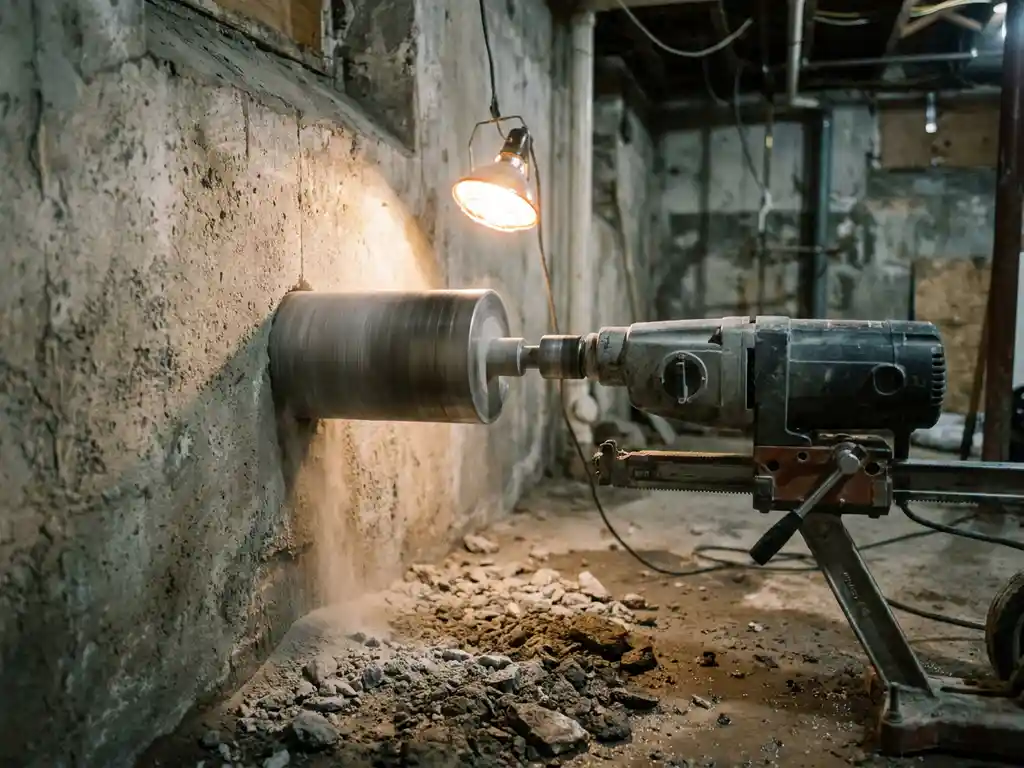
The guideline price for drilling ventilation holes in a foundation varies depending on the number of holes, the diameter, and the thickness of the concrete. There are no fixed prices that apply to every situation, as every job has its own characteristics. In this article, you will read everything you need to know about crawl space ventilation drilling: from the required number of holes to the correct diameter and whether you can do it yourself.
How many ventilation holes are needed in a foundation?
As a rule of thumb, you need at least one ventilation hole per linear meter of foundation. For an average home with a crawl space of approximately 50 square meters, this typically means four to eight holes, distributed across the exterior walls. A good distribution is at least as important as the total number, so that air can flow freely through the crawl space.
When ventilation holes are spaced too far apart or installed on only one side of the foundation, so-called dead corners are created. Air stagnates in these corners, causing moisture to accumulate and mold to form. Therefore, ensure symmetrical placement on multiple sides of the home.
Do you have a corner house or a home with a complex floor plan? Then count on extra holes to adequately ventilate all corners of the crawl space. Based on the surface area and layout of the crawl space, a professional can provide precise advice on the optimal number and ideal positions.
What determines the price of drilling ventilation holes in concrete?
The price of drilling ventilation holes in a foundation is determined by a combination of factors: the number of holes to be drilled, the diameter, the thickness of the foundation wall, and the accessibility of the work site. Each of these elements influences the time required, the tools, and the professional's effort.
- Number of holes: The more holes that need to be drilled, the more time the job takes.
- Diameter: Larger diameters require heavier drill bits and more power, which increases machining time.
- Wall thickness: A thick concrete foundation wall takes more time to drill through than a thin one.
- Opening hours office A cramped crawl space or hard-to-reach foundation requires extra effort and sometimes modified equipment.
- Type of concrete: Reinforced concrete is harder and wears down drill bits faster than unreinforced concrete or aerated concrete.
Because all these factors vary depending on the situation, it is wise to request a quote for your specific job. This way, you know exactly what to expect beforehand and won't be faced with any surprises.
What is the difference between drilling and chiseling for ventilation holes?
The biggest difference between drilling and chiseling is accuracy and damage to the surrounding area. Drilling with a diamond core drill produces a tight, round hole without vibrations or cracks in the surrounding structure. Chiseling is an older method in which material is struck away with a pneumatic hammer or chisel, which causes much more vibration and increases the risk of cracking.
For ventilation holes in a foundation, drilling is almost always the better choice. The reasons are clear:
- A drilled hole has an exact, round shape onto which a ventilation grille fits precisely.
- No cracks or damage occur in the foundation wall around the hole.
- The method is quieter and produces less dust than chopping.
- In occupied situations, drilling is much less stressful for the residents and the structure.
Chipping is rarely used nowadays to create ventilation holes, unless dealing with particularly hard material or a situation where drilling is technically impossible. In most cases, diamond drilling yields the cleanest and most durable result.
What is the diameter of ventilation holes in a foundation?
Ventilation holes in a foundation typically have a diameter of 100 to 150 millimeters. A diameter of 125 millimeters is the most common size and fits most standard ventilation grilles available at hardware stores and from installers. The exact size depends on the required airflow and the type of grille you wish to install.
A diameter that is too small obstructs airflow, causing inadequate ventilation and potentially allowing moisture problems to persist. A diameter that is too large is structurally unnecessary and can undesirably affect the strength of the foundation wall, especially if multiple holes are drilled close together.
Do you want to connect a mechanical ventilation system to the crawl space? Then larger diameters may be required, depending on the system you choose. In that case, seek advice from a specialist so that the diameter of the drill hole matches the dimensions of the chosen system.
Can I drill ventilation holes in the foundation myself?
Technically, it is possible to drill ventilation holes in a foundation yourself, but in practice, this is not a wise choice for most private individuals. Professional concrete drilling requires specific tools, such as a water-cooled diamond drill, and the necessary experience to work safely and accurately in a foundation.
There are a number of reasons why drilling yourself involves risks:
- Without the right core drill and machine, you can easily damage the concrete around the hole.
- In reinforced concrete, steel fibers or reinforcing bars can block or damage the drill.
- Incorrect positioning of the holes can compromise the structural strength of the foundation.
- Working in a cramped crawl space with heavy tools is physically demanding and requires experience.
If you rent professional equipment without the necessary knowledge, there is a high chance that the result will be disappointing or that more damage will occur than you intend. A professional has the right diamond core drills, equipment, and experience to complete the job quickly, cleanly, and safely.
How De Betonboorder helps with crawl space ventilation
Good one crawl space ventilation It starts with professionally drilled ventilation holes in the foundation. We take care of this from start to finish, so you don't have to worry about the right tools, safety, or the finishing of the work area. This is what we arrange for you:
- Tailored advice: We assess the number of holes required, the ideal positions, and the correct diameter for your situation.
- Professional drilling: We work with high-quality diamond core drills for tight, round holes without cracking or collateral damage.
- Quick deployment: In many cases, we schedule a professional within two working days and contact you within 24 hours.
- Neat delivery: After the job, we leave the workplace clean and tidy.
- National network: Through our network of experienced professionals, we are available throughout the Netherlands.
Would you like to know what we can do for your crawl space? Contact us and we are happy to think along with you about the best approach for your situation.
Related Articles
- Can crawl space ventilation be installed in any type of home?
- Air conditioning or fan: what really works against the heat?
- How long does an air conditioner last?
- Can an air conditioner regulate humidity?
- What is the difference between cooling capacity and electrical power in an air conditioner?
- How do you optimize the energy consumption of an air conditioner?
- What to do about a hot house?
- What exactly does a concrete driller do?
- What is wet drilling and why is it used?
- How do you drill a hole in the wall for an extractor hood?
- Why is an environmental permit required for load-bearing wall removal?
- What happens if damage occurs during load-bearing wall removal?