
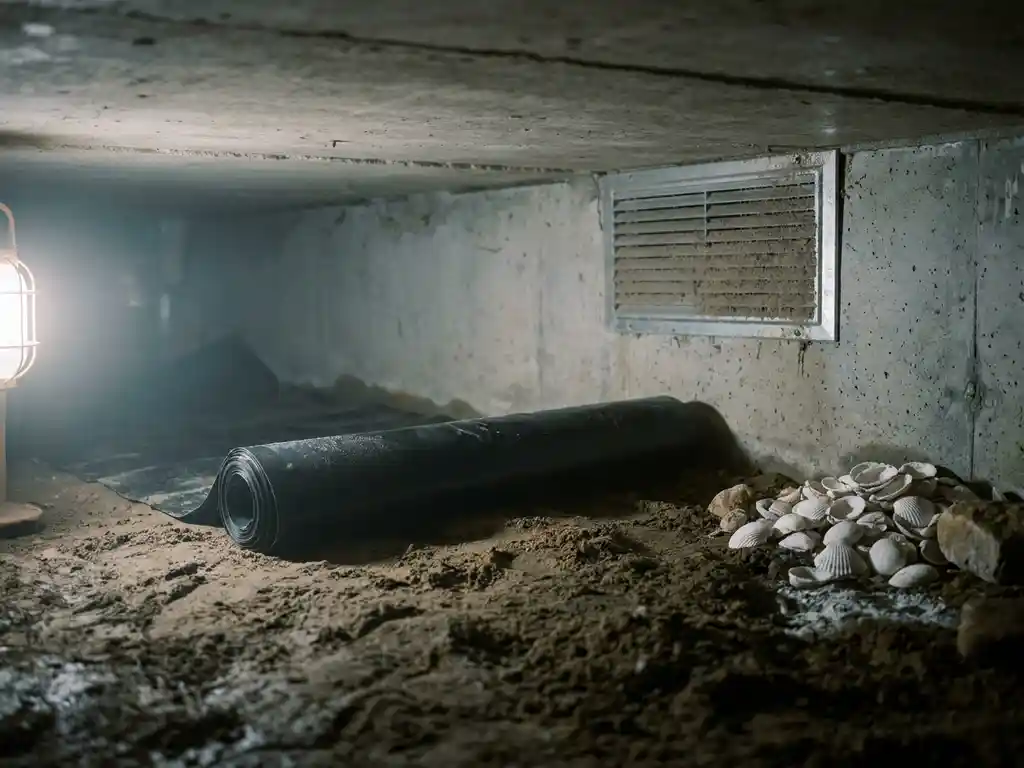
The best approach to combating moisture in the crawl space is almost always a combination: ground foil prevents soil moisture from entering, while good crawl space ventilation ensures that moist air can escape. Shells play a supporting role but rarely solve the problem on their own. Which solution best suits your situation depends on the cause of the moisture problem. In this article, we answer the most frequently asked questions about ground foil, shells, and ventilation.
What causes moisture problems in the crawl space?
Moisture problems in the crawl space arise because damp air or groundwater penetrates the space beneath your home. The soil constantly releases water vapor, and if that vapor has nowhere to go, it condenses against wooden beams, insulation material, and walls. This leads to mold, wood rot, and a musty odor that enters your home through the floor.
There are three common causes:
- Soil moisture: The soil beneath your house continuously releases moisture, especially during wet periods or when groundwater levels are high.
- condensation: Warm, humid indoor air descends to the cooler crawl space and condenses there.
- Poor or absent ventilation: Without sufficient air circulation, humid air remains trapped and the problem accumulates.
It is important to properly identify the cause before choosing a solution. Damp soil requires a different approach than poor ventilation, and in many cases, both factors play a role simultaneously.
How does ground foil work against moisture in the crawl space?
Ground foil acts as a physical barrier between the damp soil and the air in the crawl space. By laying a sturdy, vapor-proof foil on the ground, you prevent ground moisture from evaporating and humidifying the air in the crawl space. This is one of the most effective measures against moisture rising from the ground.
For proper operation, a few important conditions apply:
- The foil must cover the entire floor surface, including the edges along the walls.
- Overlapping strips must overlap by at least 30 centimeters and be properly taped.
- Use foil of sufficient thickness (at least 0,2 mm) so that it is resistant to damage.
Ground foil effectively tackles soil moisture but does not solve condensation problems caused by poor air circulation. Therefore, always combine it with adequate ventilation for a lasting result.
Do seashells really help against moisture in the crawl space?
Shells have a limited effect on moisture problems in the crawl space. They improve the drainage of rainwater entering through ventilation openings or leaks, and they ensure that you do not walk directly on wet ground. However, shells do not stop groundwater and do not solve a ventilation problem.
Shells are sometimes recommended as an inexpensive interim solution, but in practice, they work best as a supplement to other measures. They are useful for keeping the soil slightly drier and allowing air to circulate a little more freely in the bottom layer, but they do not replace ground foil or crawl space ventilation. View shells as a small improvement, not a true solution.
When is crawl space ventilation the better choice?
Crawl space ventilation is the better choice when moisture not only comes from the ground but also lingers in the crawl space due to poor air circulation. This is the case if you suffer from condensation on beams, mold growth, or a persistent musty smell in the house, even after installing ground foil.
Ventilation is also the appropriate solution if:
- Your crawl space has no or too few ventilation openings.
- Existing grilles are clogged or in the wrong place.
- The crawl space is completely sealed and moist air has nowhere to go.
- Your home is situated in a location where the soil is naturally very damp.
A well-functioning ventilation system for the crawl space ensures a continuous supply of dry outside air and the removal of humid indoor air. This not only protects the structure of your home but also improves the insulation value and indoor air quality.
What is the best combination of moisture solutions?
The best combination is ground foil plus crawl space ventilation. Ground foil tackles ground moisture at the source, while ventilation ensures that any remaining moist air is removed. Together, they cover the two main causes of moisture problems in the crawl space.
A practical approach looks as follows:
- Step 1: Lay a vapor-proof ground foil over the entire floor of the crawl space.
- Step 2: Ensure sufficient ventilation openings or install a mechanical ventilation system.
- Step 3: Check for standing water or leaks in the crawl space.
- Step 4: Consider shells as an extra layer on the foil, so that the foil remains protected and the area is more walkable.
Do you already have ground foil but continue to suffer from moisture or odor? Then it is likely that the ventilation is insufficient. In that case, installing a ventilation grille or an active ventilation system is the next logical step.
Is a hole required in the concrete for crawl space ventilation?
Yes, in many cases, a hole must be drilled in the concrete or foundation to install crawl space ventilation. A ventilation grille requires an opening in the outer wall or concrete foundation to allow air to pass through. Without that opening, air circulation is not possible.
This is precision work that requires specialized equipment. A diamond drill creates a tight, clean hole without damaging the surrounding structure, which is essential with reinforced concrete or a load-bearing foundation. The hole is then finished with a ventilation grille that keeps insects and dirt out but allows air to pass through freely.
The size of the hole depends on the type of grille and the size of the crawl space. For a standard ventilation grille, a hole of 15 to 20 centimeters is usually sufficient, but for larger spaces or mechanical ventilation systems, this may be larger.
How De Betonboorder helps with crawl space ventilation
We take care of the installation of crawl space ventilation from start to finish, including drilling the necessary hole in the concrete. Our professionals work with professional diamond core drills, ensuring the hole is tight and clean without damaging the surrounding structure. These are the benefits of working with us:
- Nationwide network of experienced professionals, readily available throughout the Netherlands.
- In many cases, a concrete driller is arranged within two days.
- We will contact you within 24 hours of your request.
- The workplace is left neat and tidy.
- Good crawl space ventilation reduces musty odors and improves your home's insulation.
Would you like to know what we can do for your situation? Contact us and together we look at the best solution for your crawl space.
Related Articles
- How do I choose the best location for a stairwell in my home?
- How do I make an extra floor accessible in a terraced house?
- Is it groundwater or poor ventilation under my house?
- How often should you clean an air conditioner?
- How long does it take to make a stairwell opening in the floor?
- Which air conditioner consumes the least power?
- How does an air conditioning heat pump work?
- How long does it take to run a penetration through an exterior wall?
- How do you run a cable through a concrete wall?
- What happens if you accidentally drill through a pipe?
- Can you drill into concrete with a standard drill?
- How long does it take to remove a load-bearing wall?