
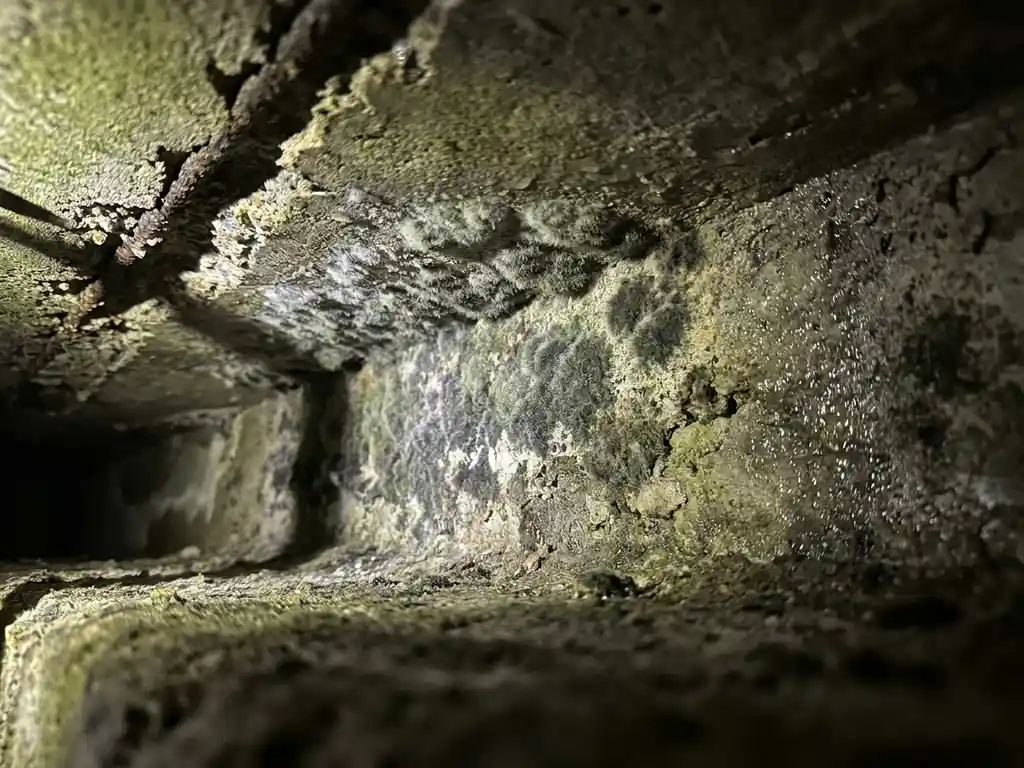
Mold on the underside of your floor is almost always caused by a combination of moisture and insufficient air circulation. The space beneath your floor, the crawl space, becomes too damp, thereby providing ideal conditions for mold growth. In this article, we answer the most frequently asked questions about mold under the floor, from cause to solution.
How does mold form on the underside of a floor?
Mold on the underside of a floor forms when moisture and heat combine in a space with little air movement. The crawl space under a home is naturally dark, cool, and poorly ventilated. When moist air has no escape route here, the moisture condenses on the underside of the floor and mold begins to grow.
The main causes are:
- Rising damp from the ground, especially in older homes without a proper vapor barrier
- Inadequate crawl space ventilation, causing humid air to linger
- Pipe leaks or rainwater entering through foundation cracks
- Condensation due to temperature differences between the crawl space and the heated living space
Wooden floorboards are particularly susceptible to mold because wood is an organic material to which mold spores easily attach and feed. As soon as the relative humidity in the crawl space consistently exceeds seventy percent, the risk of mold formation is high.
What are the dangers of mold under your floor?
Mold under your floor is not only an aesthetic problem but also a health and structural risk. Mold spores spread through the air and can enter the living space through cracks in the floor, which can cause respiratory problems, allergic reactions, and fatigue, especially in children and people with weakened immune systems.
In addition to health risks, mold also damages the structure of your home:
- Wooden floorboards can weaken, warp, and eventually sag or break.
- Beams and load-bearing structures can be affected, leading to costly repair work.
- The insulation value of floor insulation decreases sharply when the material is damp and moldy.
- A musty smell in the house is often the first sign that mold has been active for some time.
The longer mold remains untreated, the greater the damage. It is therefore wise to take immediate action at the first signs.
How do you know if your crawl space has insufficient ventilation?
Your crawl space has insufficient ventilation if the air feels stagnant, stuffy, and damp, and if you find visible moisture, condensation, or mold on the floor joists or the underside of the floor. Structurally high humidity in the crawl space is the most direct evidence of insufficient air circulation.
Practical signs indicating a ventilation problem are:
- A musty or earthy smell in the living room or hallway, even if everything above the floor seems dry.
- Wooden floorboards that creak, expand, or come loose from the subfloor
- Visible damp patches or white efflorescence on the foundation or concrete subfloor
- Condensation on the inside of ventilation grilles, if there are any at all
- A crawl space without any opening to the outside, or with clogged or blocked vents
Good one ventilation in the crawl space ensures a constant flow of air, removing moisture before it has a chance to condense. Many homes, especially those built before the 1980s, have insufficient or outdated ventilation openings.
What is the difference between mold caused by moisture and mold caused by leakage?
Mold caused by moisture develops gradually as a result of structurally high humidity, whereas mold caused by leakage appears suddenly in a specific location following water penetration. The distinction is important because the approach differs fundamentally: damp mold requires better ventilation or insulation, whereas in the case of leakage, the source of the water must be sealed first.
Characteristics of mold caused by structural moisture
With moisture-related mold, you see the infestation spread over a larger area of the underside of the floor or the joists. The mold is often grey-green or black and grows evenly. The crawl space smells musty and the humidity is measurably high. This type of mold is typical of homes with poor crawl space ventilation or a high groundwater level.
Characteristics of mold caused by a leak
Leakage-related mold concentrates in a clearly defined area, often directly under a water pipe, drainpipe, or a spot in the foundation where water is penetrating. Mold growth is more intense and faster and is accompanied by visible water streaks or wet spots. If you do not fix the leak, the mold will always return, regardless of how thoroughly you clean.
How do you permanently solve the problem of mold under a floor?
Permanently solving mold under a floor requires two steps: removing the mold itself and eliminating the underlying cause. Simply cleaning without addressing the source of moisture always leads to a recurrence of the problem.
An effective approach looks like this:
- Identify the cause: Is it poor ventilation, a leak, or rising damp?
- Address the cause first: seal leaks, improve drainage around the foundation, or install ventilation openings
- Remove affected material: heavily moldy wooden parts are often beyond repair and must be replaced
- Treat surfaces: use a professional mold remover on still usable structural parts
- Ensure structural ventilation: install ventilation openings or grilles in the crawl space so that air can circulate freely
- Consider a vapor barrier foil: a foil on the floor of the crawl space significantly limits rising damp
Prevention is cheaper than repair in the long run. A well-ventilated crawl space keeps humidity low and prevents mold from taking hold of your home's structure again.
When should you call in a professional for mold under the floor?
You must call in a professional when the mold has spread over a large area, when load-bearing structures are affected, or when the cause of the moisture problem is unclear. In those cases, the risk of misjudgment or incomplete repair is too great to attempt it yourself.
Definitely seek professional help if:
- Your beams or floorboards are visibly damaged or sagging
- The fungus returns after self-treatment
- You cannot find or reach the source of the moisture
- Ventilation openings must be installed in concrete or masonry
- You are experiencing health complaints that may be related to the fungus
Installing ventilation openings in concrete foundations or walls requires specialized tools and expertise. This is not a job you tackle with an ordinary drill.
How De Betonboorder helps with crawl space ventilation
One of the most effective ways to structurally solve moisture problems and mold under your floor is to improve crawl space ventilation. We provide concrete assistance with this:
- Drilling ventilation openings in concrete foundations, walls, or floors with professional diamond core drills
- Installation of ventilation grilles, so that air can circulate freely and moisture is removed
- Clean and neat executionYour workspace will be left tidy afterwards.
- Rapid deploymentIn many cases, we can schedule a professional within two days.
- National coverageWe work with a network of experienced professionals throughout the Netherlands.
Good crawl space ventilation not only reduces the risk of mold, but also improves the insulation value of your home and reduces musty odors. Would you like to know what we can do for your situation? Contact us and we respond within 24 hours.
Related Articles
- How do I choose the best location for a stairwell in my home?
- How are ventilation holes drilled in the crawl space?
- Will I get pests or woodworm from a damp crawl space?
- Hidden costs when purchasing an air conditioner: what should you look out for?
- Can an air conditioner make the air too dry?
- How does an air conditioning heat pump work?
- What are the rules for drilling in a VvE building?
- How long are you allowed to drill indoors per day?
- How do I know if my wall is strong enough to hang something heavy on?
- Can you remove a load-bearing wall without a structural calculation?
- How much does a structural calculation for load-bearing wall removal cost?
- What is the purpose of temporary support during load-bearing wall removal?