
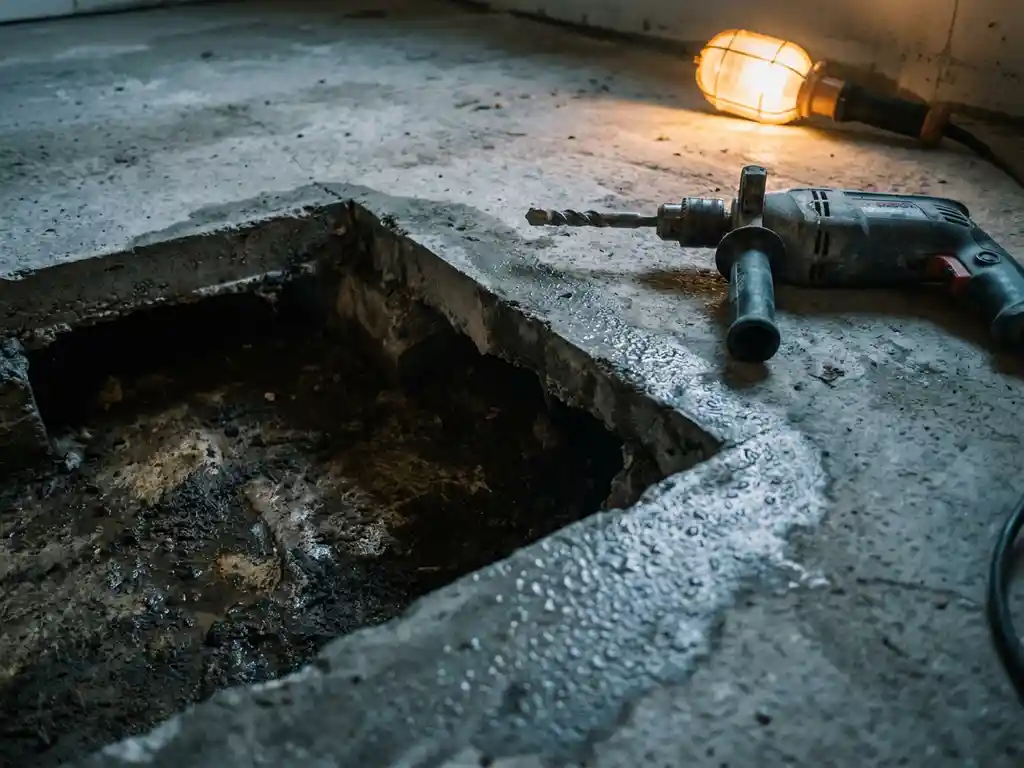
A ground floor that feels damp and cold is almost always the result of moisture rising from the subsoil or crawl space, combined with insufficient insulation and ventilation. The combination of cold concrete floors and stagnant, damp air beneath your home creates a permanently unpleasant feeling, both literally and figuratively. In this article, we answer the most frequently asked questions about this problem, from cause to solution.
What causes moisture and cold in a concrete floor?
Moisture and cold in a ground floor are almost always caused by a combination of capillary rise from the soil, condensation due to temperature differences, and poor or missing insulation beneath the floor. Concrete is naturally a cold and porous material that absorbs and retains moisture, causing the problem to reinforce itself.
Capillary rise means that groundwater is drawn up through the pores in the concrete, similar to how a sugar cube absorbs moisture. This process is slow but continuous and is particularly active during periods of heavy rainfall or high groundwater levels. Furthermore, homes built before the 1980s rarely have a proper damp-proof barrier under the floor, leaving nothing between the damp ground and your living space.
In addition to rising damp, temperature plays a major role. Concrete cools down quickly, especially if there is no insulation underneath. That cold subfloor draws heat from the room above, causing the floor to remain cold, even if the room itself is well heated. The feeling of cold and chilliness you experience is therefore not only psychological, but has a direct physical cause.
How do you know if it is moisture or condensation?
You can distinguish between rising damp and condensation with a simple plastic sheet test. Stick a piece of plastic sheeting approximately thirty by thirty centimeters airtight to the floor and leave it there for twenty-four hours. If the underside of the plastic is wet, the moisture is coming from the floor itself. If the top is wet, it is condensation from the air in the room.
This distinction is important because the approach differs. Condensation occurs when warm, humid indoor air comes into contact with a cold surface. This is seen more often in poorly ventilated rooms or during the transition from winter to spring, when the outside temperature rises but the floor is still cold. Rising damp is a more structural problem related to soil conditions and the construction of the floor itself.
Other indications of rising damp include white efflorescence on the floor or walls, a musty odor that does not disappear with ventilation, and damp patches that follow a fixed pattern. Condensation, on the other hand, is seasonal and partially disappears on its own as temperatures become more consistent.
What does poor crawl space ventilation do to your floor?
A poorly ventilated crawl space is one of the main causes of a damp, cold ground floor. If the air beneath your home is stagnant, the humidity in the crawl space rises rapidly, and that moist air then seeps up through the floor. The result is a floor that feels permanently damp and never truly dries out.
In a crawl space without a good crawl space ventilation Relative humidity can rise to levels where mold growth becomes inevitable. Mold not only attacks the wooden floor joists and insulation materials but also spreads spores to the living space above. This has direct consequences for indoor air quality and can eventually lead to health problems.
In addition, a damp crawl space amplifies the effect of cold. Damp air feels colder than dry air at the same temperature, and a damp subfloor conducts heat away more quickly. A well-ventilated crawl space is therefore not only a moisture solution but also noticeably improves the thermal performance of your floor.
Which solutions work best for a cold, damp floor?
The most effective approach combines insulation on the underside of the floor with good ventilation of the crawl space. Insulation limits heat loss and prevents the floor from acting as a thermal bridge, while ventilation ensures that moisture is removed from under the home instead of accumulating.
Concrete measures that work well are:
- Crawl space insulation: Insulation boards or sprayed PUR foam under the floor significantly reduce heat loss and prevent condensation on the concrete surface.
- Ventilation grille in the crawl space: One or more grilles in the outer wall of the crawl space ensure airflow, thereby removing moisture.
- Mechanical crawl space ventilation: In the case of a severe moisture problem or a crawl space without good airflow, an electric fan is more effective than passive grilles.
- Moisture barrier at ground level: A foil on the floor of the crawl space prevents ground moisture from evaporating and humidifying the air in the crawl space.
- Underfloor heating: If structural solutions have already been implemented, underfloor heating can be the final step to keep the floor pleasantly warm.
Which combination is most suitable depends on the construction of your home, the condition of the crawl space, and the severity of the moisture problem. An inspection of the crawl space quickly provides insight into what is needed.
When should you call in a professional for moisture problems in the floor?
It is best to call in a professional when moisture problems persist despite your own measures, when you discover visible mold growth or wood rot in the crawl space, or when drilling or milling is required in the floor to install ventilation openings. These are situations where expertise and the right tools make all the difference.
Small adjustments such as cleaning existing vents or laying foil in the crawl space are feasible for most do-it-yourselfers. However, as soon as structural interventions are required, such as drilling new ventilation openings in a concrete wall or foundation, professional help is not only more convenient but also safer. Incorrect drilling into load-bearing structures can cause damage that far exceeds the moisture problems.
Even if you are unsure whether the problem lies in the crawl space, the floor, or the foundation, a professional inspection is the fastest way to the right solution. A professional quickly identifies the cause and prevents you from investing in measures that do not address the problem.
How De Betonboorder helps with crawl space ventilation
In many cases, a damp, cold floor can be solved with proper crawl space ventilation, and we are happy to help with that. Via The Concrete Driller You can quickly and easily arrange a professional who takes care of the necessary work from start to finish. What we do for you:
- Drilling ventilation openings in concrete or masonry walls surrounding the crawl space, with minimal collateral damage.
- Installing a ventilation grille in the crawl space for good airflow that removes moisture.
- Working in occupied situations, so that you can simply stay at home during the work.
- Neat delivery, whereby the workplace is left clean and tidy.
- Quick planningIn many cases, we send a technician within two days, with contact within 24 hours.
Good crawl space ventilation can prevent moisture problems, eliminate musty odors, and improve the insulation value of your home. Do you want to know what is needed in your situation? Contact us and we provide a suitable solution.
Related Articles
- What are the long-term consequences of moisture under my house?
- What is the best solution for a damp crawl space?
- Does an air conditioner cool better with windows and curtains closed?
- Innova 12HP vs Innova 15HP: how much power do you really need?
- Can an air conditioner cause a headache?
- How do you prevent an air conditioner from freezing?
- Which air conditioner consumes the least power?
- What happens if you accidentally drill through a pipe?
- How do you drill a hole in a basement wall without leaks?
- How do I know if my wall is strong enough to hang something heavy on?
- Do you need a permit to remove a load-bearing wall?
- What are the signs that a wall is load-bearing?