
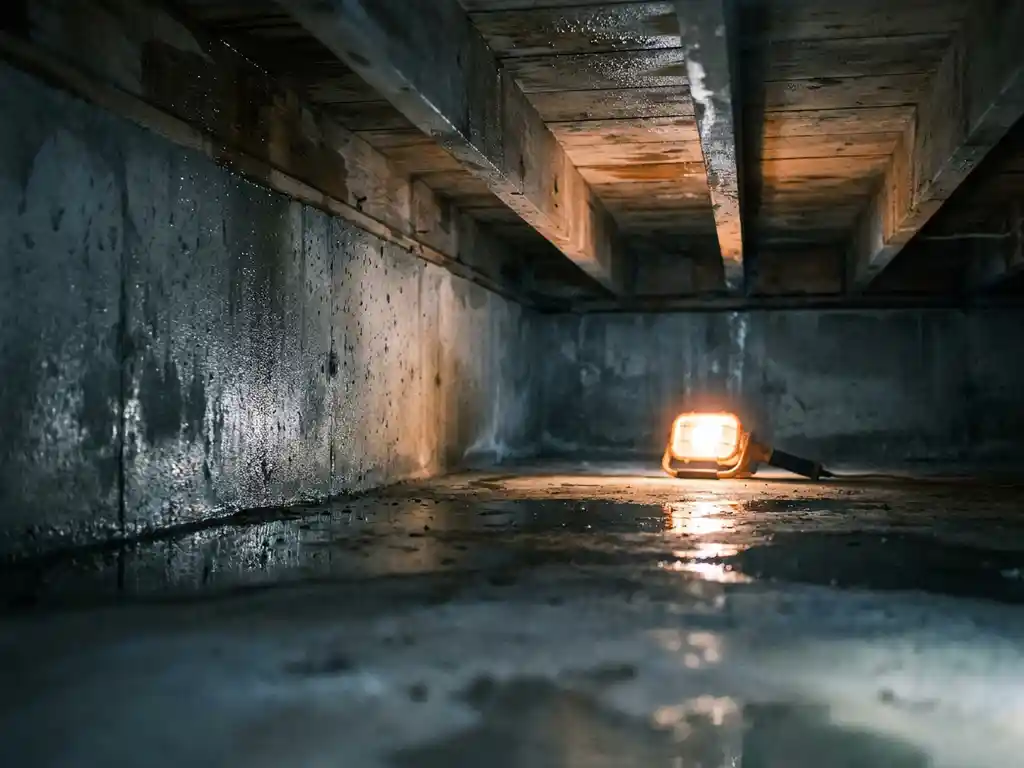
It is so damp under your house because the crawl space is insufficiently ventilated, causing moisture to accumulate and have nowhere to go. Groundwater, condensation, and rainwater seeping along the foundation are the main sources of this moisture. In this article, we answer the most frequently asked questions about a damp crawl space and what you can do about it.
What are the most common causes of damp under a house?
The most common causes of damp under a house are poor or absent crawl space ventilation, rising groundwater, condensation, and leaks along the foundation. In many older homes, the crawl space was simply not designed with sufficient air circulation, causing damp air to linger and problems to arise.
Below are the most common causes:
- Insufficient ventilation: If there is insufficient air circulation under the floor, moist air cannot escape and condenses on cold surfaces.
- Rising groundwater: The floor in the crawl space is often soil or sand, and groundwater can rise via capillary action.
- condensation: Warm, humid indoor air that touches the cold floor or foundation condenses and forms water droplets.
- Leaking pipes: A small leak in a water pipe or sewer under the floor can remain undetected for years and cause significant damage.
- Poor drainage around the house: If rainwater is not drained properly, it can seep inside along the foundation.
It is rarely a single cause. Usually, multiple factors reinforce each other, causing the moisture problems to worsen rapidly if you do nothing about it.
How do you know if the crawl space is too damp?
You know the crawl space is too damp when you smell a musty odor in the house, see visible mold on the floor or walls, or when your wooden floor joists feel soft. A moisture meter indicating more than 70% relative humidity in the crawl space is a clear warning signal.
Not all signals are equally clearly visible. Pay attention to the following indications:
- A persistent, musty, or earthy smell in the living room or hallway
- Condensation on the inside of windows, even in summer
- Wooden floorboards that creak, come loose, or bulge
- Visible mold spots on the underside of the floor or on walls on the outside of the house
- Insects such as woodworm or woodlice that like damp wood
If in doubt, you can purchase a moisture meter and take measurements yourself in the crawl space. A humidity value above 70% requires action. If the value is consistently higher than 80%, there is a serious problem that needs to be addressed quickly.
What are the consequences of a damp crawl space for your home?
A damp crawl space leads to mold growth, wood rot in load-bearing structures, increased heating costs due to loss of insulation value, and health problems for the residents. In the long term, structural moisture damage can compromise the load-bearing capacity of the floor and lead to costly repair work.
The consequences are broader than most homeowners expect:
- Wood rot: Damp wood is an ideal breeding ground for fungi and bacteria that break down the wood. As a result, beams can become severely weakened.
- Mold spores in the house: Damp air from the crawl space rises through cracks in the floor and spreads mold spores throughout the home. This can cause respiratory problems, allergies, and fatigue.
- Poorer insulation: Damp insulation materials lose their insulating effect. Your house cools down faster, which leads to higher energy bills.
- Damage to pipes: Prolonged humidity can accelerate corrosion of metal pipes.
- Depreciation of the property: During a sale or valuation, a damp crawl space can negatively affect the value of your home.
How do you improve the ventilation under a house?
You improve ventilation under a house by creating or enlarging ventilation openings in the foundation, installing a mechanical ventilation system, or installing a crawl space grate that ensures continuous air circulation. Good crawl space ventilation is the most effective long-term solution to moisture problems.
There are various approaches possible, depending on the situation:
Passive ventilation via grilles
By installing ventilation openings or grilles in the exterior wall or foundation, outside air can flow freely through the crawl space. This is the simplest solution and works well in situations where moisture problems are not yet severe. The grilles must be placed on multiple sides of the house to ensure good airflow.
Mechanical ventilation
For more serious moisture problems or a crawl space with limited natural air circulation, a mechanical ventilation system offers a solution. A fan ensures the active removal of humid air. This system is more effective than passive vents and can be adjusted based on the measured humidity.
In addition to ventilation, you can also install a vapor barrier on the floor of the crawl space to limit rising damp. This is a good supplementary measure, but it does not replace ventilation.
When is professional help needed for moisture problems in the crawl space?
Professional help is needed when you observe visible wood rot, severe mold growth, or structural moisture damage, when self-implemented measures do not provide improvement, or when you do not know how to safely install a ventilation opening in the foundation. Drilling holes in concrete or masonry requires specific knowledge and tools.
Hire a professional if:
- The wooden floor beams are visibly affected by rot or mold
- You do not have access to the crawl space yourself or cannot assess the situation
- A ventilation opening must be installed in the concrete foundation or masonry outer wall
- Previous attempts to reduce the moisture have not worked
- There are leaking pipes or structural damage to the foundation
Drilling ventilation holes in concrete is precision work. An incorrect approach can damage the foundation or render the ventilation ineffective. Leave this type of work to professionals with the right equipment and experience.
How De Betonboorder helps with crawl space ventilation
A damp crawl space requires a concrete solution, and good ventilation starts with the right opening in the right place. We take care of this for you from start to finish, so you don't have to worry about a thing.
This is what we do for you:
- Professional drilling of ventilation openings in concrete, masonry, or stone
- Installing ventilation grilles for continuous, effective air circulation
- Work with high-quality diamond core drills for a precise result without unnecessary damage.
- Leave the workplace neat and tidy afterwards
- In many cases, a professional at your home within two days
Good crawl space ventilation reduces moisture problems, limits musty odors, and improves the insulation value of your home. Would you like to know what we can do for your situation? Contact us and we respond within 24 hours.
Related Articles
- Where is that musty smell on the ground floor coming from?
- Can crawl space ventilation be combined with ground foil?
- Is crawl space ventilation through the facade the best option?
- Cheap air conditioning for cooling: is that possible without compromising on quality?
- How do you prevent your air conditioning from having to run all day in the summer?
- Can an air conditioner be bad for your health?
- Which air conditioner is best for asthma sufferers?
- Can an air conditioner prevent equipment from overheating?
- What are the dangers of inhaling concrete dust?
- Are you allowed to drill in a rental property without permission?
- What is the difference between a foundation and a load-bearing wall?
- Do you need a permit to remove a load-bearing wall?