
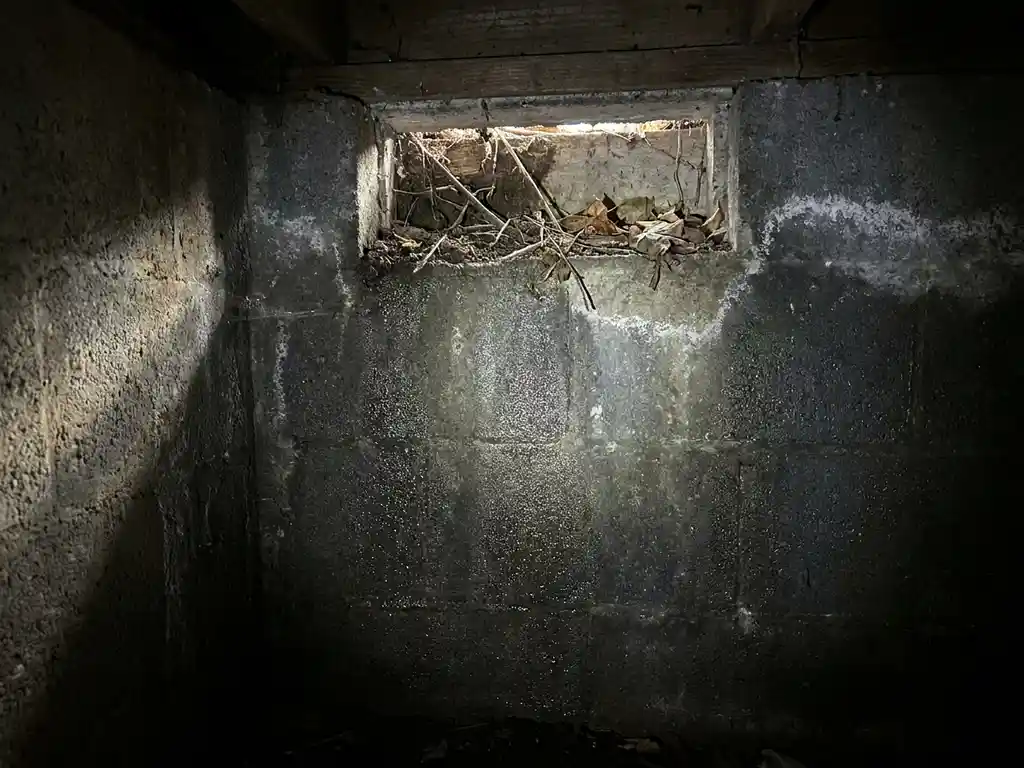
In most cases, the musty smell on the ground floor comes from the crawl space beneath your home. When crawl space ventilation is insufficient, moisture accumulates under the floor, and the stuffy air spreads through cracks and crevices into the living space. In this article, we answer the most frequently asked questions about crawl space ventilation and what you can do about it.
What causes a musty smell in the house?
A musty smell in the house is almost always caused by moisture that has nowhere to go. In homes with a crawl space, the crawl space is the most common source: damp soil, stagnant air, and sometimes mold growth produce a characteristic stuffy odor that rises through the floor.
In addition to the crawl space, other factors can also contribute to a musty smell:
- Condensation on cold walls or floors, especially in poorly ventilated rooms
- Leaks in pipes or the roof that introduce moisture into the structure
- Insufficient ventilation in bathroom, kitchen or bedroom
- Mold behind tiles, in corners, or under floor covering
The distinction is important: if the odor is strongest on the ground floor and less present on the upper floor, this strongly points towards the crawl space. If you smell the odor specifically after showering or cooking, the cause is more likely to be found in the living space itself.
How does air get in from the crawl space?
Air from the crawl space enters through cracks, seams, and openings in the ground floor. Wooden floors are not naturally airtight: small openings exist between planks, around pipe penetrations, and at the junction of the floor with the walls, allowing air to move freely.
This process is amplified by the so-called stacking effect: warm air in the house rises and draws in cooler air from below. This means that the crawl space provides a constant supply of air to the ground floor, as long as there are openings. Concrete floors offer more resistance, but even there, pipe penetrations and connections to the walls are potential weak points.
An additional problem is that damp crawl space air not only introduces odors but also increases the relative humidity in the house. Over time, this can lead to condensation on cold surfaces and further mold growth in the home itself.
What are the dangers of a poorly ventilated crawl space?
A poorly ventilated crawl space poses a serious risk to both the health of the residents and the structural condition of the home. When moisture accumulates in an enclosed space, conditions are created in which mold and wood rot thrive.
The main dangers at a glance:
- Wood rot in the floor joists, which affects the load-bearing capacity of the ground floor
- Mold growth which spreads spores into the living space and can cause respiratory complaints
- Increased humidity in the home, which leads to condensation and damage to furniture and materials
- Damage to insulation material that becomes damp and loses its insulating effect
- Energy loss because wet insulation performs much worse than dry insulation
Wood rot is the most serious problem in this regard. When the floor joists are affected, repairs can be costly and time-consuming. Early intervention by the ventilation of the crawl space Improving this prevents minor moisture problems from escalating into major structural damage.
How do you improve the ventilation of a crawl space?
You improve the ventilation of a crawl space by ensuring sufficient air circulation, so that moist air is removed and dry outside air is supplied. The most effective and sustainable solution is to install ventilation openings or grilles in the exterior wall at the level of the crawl space.
Passive ventilation via grilles
With passive ventilation, grilles are installed on multiple sides of the crawl space so that wind moves air through the space. For proper operation, it is important that the grilles are placed on opposite sides of the house. This creates a continuous airflow that effectively removes moisture. This requires drilling holes in the concrete or foundation of the house.
Active ventilation with a fan
When passive ventilation is insufficient, for example in a crawl space with little wind or a complex layout, a mechanical ventilator can provide a solution. A small crawl space fan actively draws moist air out and ensures constant air exchange, even on windless days. This system works best in combination with a good air intake on the other side.
In addition to ventilation, there are additional measures that help:
- Lay a vapor barrier on the ground in the crawl space to limit moisture absorption from the soil.
- Remove organic material such as wood, cardboard, or leaves from the crawl space.
- Check for the presence of standing water and resolve any drainage problems.
- Ensure that existing grates are not blocked by soil, plants, or insulation material.
When is a professional needed for crawl space problems?
A professional is needed when crawl space ventilation cannot be improved with simple adjustments, or when there is already visible damage to the structure. Drilling holes in concrete foundation walls or exterior facades requires specific equipment and expertise to prevent damage to the structure.
Hire a professional if:
- There are no ventilation openings present and these must still be installed in concrete or masonry
- You find wood rot or mold in the crawl space that needs to be treated professionally.
- The humidity in the house remains persistently high despite my own measures
- Your home has a concrete ground floor where penetrations need to be installed or modified.
- There is standing water or structural moisture problems in the foundation
Drilling a hole in a concrete foundation wall yourself without the right equipment is not only difficult but can also lead to cracks or damage to the structure. A professional has diamond core drills and the right technique to carry this out accurately and without collateral damage.
How De Betonboorder helps with crawl space ventilation
We at De Betonboorder help you quickly and professionally achieve a well-ventilated crawl space. Installing ventilation openings in concrete or a foundation is precision work that requires the right tools and experience. That is what we are here for.
What we do for you:
- Professional drilling of ventilation openings in concrete foundation walls, without damage to the surrounding structure
- Installing ventilation grilles in the correct location for optimal air circulation
- Working with high-quality diamond core drills for an accurate and clean result
- Leave the workplace neat and tidy afterwards
- Fast response: in many cases, a professional at your home within two days
Good one crawl space ventilation It not only eliminates the musty odor but also protects your home's structure and improves the insulation value. Would you like to know what we can do for your situation? Contact us and we respond within 24 hours.
Related Articles
- How is the strength of my floor calculated after a recess?
- Which stair shapes fit a concrete stairwell?
- What if my floor is too thin for a stairwell?
- What is rising damp and how do I recognize it?
- What to do about a hot house?
- Can an air conditioner work in extreme heat?
- What is a recess and when do you need one?
- What exactly does a concrete driller do?
- What is core drilling and when do you need it?
- How do I know which drill diameter I need?
- What happens if you remove a load-bearing wall without a permit?
- What is the difference between removing a load-bearing wall and removing a regular wall?