
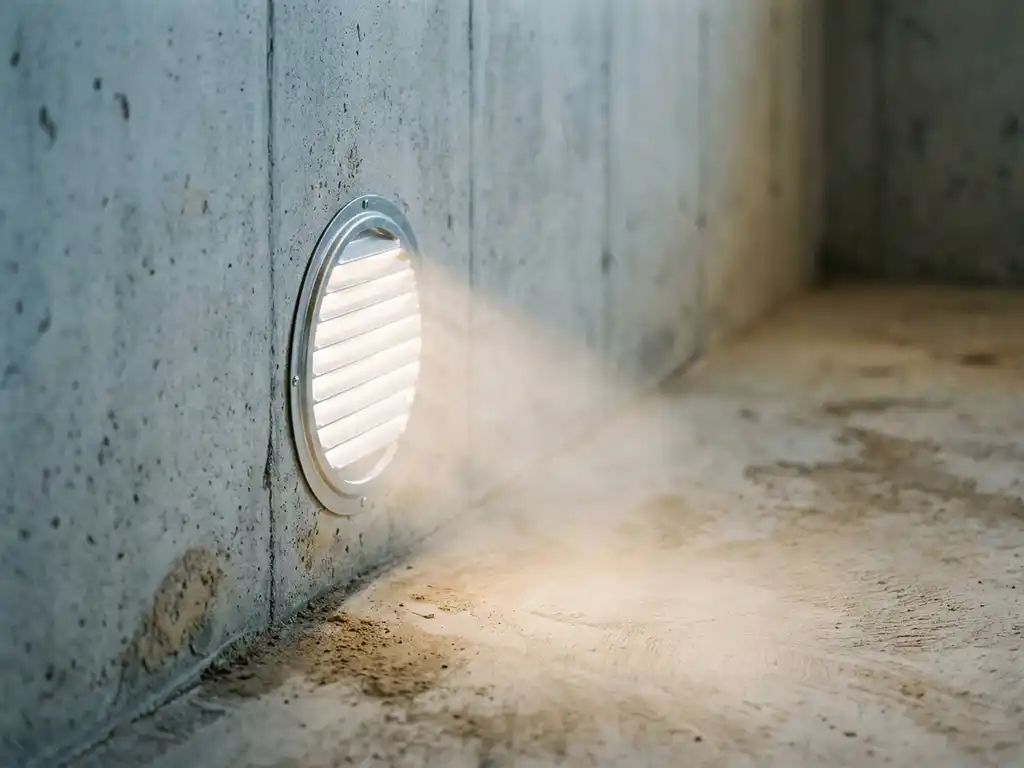
Yes, in most cases, the musty smell in the house disappears after installing crawl space ventilation. Moisture in the crawl space is by far the most common cause of mustiness, and good ventilation tackles this problem at the source. Whether the smell disappears completely depends on how long the moisture has been present and whether mold has already formed.
In this article, we answer the most frequently asked questions about musty odors, crawl space ventilation, and what to expect after installation.
Where does the musty smell in the house actually come from?
In most cases, the musty smell in the house comes from the crawl space. Moisture accumulates under your floor due to condensation, groundwater, or insufficient air circulation. This moisture rises through cracks, seams, and the floor structure, bringing with it the characteristic moldy smell.
Wood is a material that absorbs moisture. When the wooden beams and floorboards in your crawl space are exposed to high humidity for extended periods, an ideal environment for mold and bacteria is created. These microorganisms produce volatile organic compounds, and these are precisely the substances your nose perceives as musty, stuffy air.
Because warm air rises, air is drawn upwards from the crawl space. We call this the chimney effect. Even if the crawl space appears well sealed, air always finds a way up. Small openings around pipes, floor hatches, or cracks in the floor are enough to let the odor seep into your living space.
How does crawl space ventilation work to reduce moisture and odor?
Crawl space ventilation works by letting fresh outside air into the crawl space and removing moist air to the outside. This breaks up the layer of stagnant, damp air that accumulates under your floor. Due to constant air exchange, the relative humidity decreases, inhibiting mold growth and reducing the musty odor.
There are two basic forms of ventilation for the crawl space. The first is passive ventilation via grilles in the exterior wall or the foundation. Outside air then flows naturally through the crawl space. The second form is active ventilation, where a fan or ventilation system drives the air circulation. Active systems are more effective, but also more expensive to purchase.
When installing ventilation openings, holes are drilled through the foundation or the outer wall. Grilles can be placed through these openings to regulate airflow. A good distribution of the grilles throughout the crawl space ensures that no dead corners are created where air stagnates.
Does the musty smell always disappear after installing ventilation?
Not always completely, but in most situations the musty odor decreases significantly after placing crawl space ventilationWhether the odor disappears completely depends on the severity of the moisture damage and whether active mold growth is already present. Ventilation solves the moisture problem but does not automatically remove existing mold.
If the crawl space has been too damp for years, wooden beams and insulation material may be affected. In that case, ventilation is a necessary first step, but additional mold remediation or replacement of damaged material is also required to make the odor disappear completely.
In situations where moisture problems are limited and there is no structural mold growth, the musty odor often disappears completely after ventilation. The air in the crawl space improves, the wood dries out, and the source of the odor is neutralized.
How long does it take for the smell to disappear?
After installing crawl space ventilation, it typically takes a few weeks to a few months before the musty smell in the house noticeably diminishes or disappears completely. The exact duration depends on the extent of moisture damage, the season, and how well the ventilation reaches the crawl space.
In the summer, when the outside air is drier, ventilation works faster than in the winter. Cold, damp outside air in the winter months can slow down the drying of the crawl space. Nevertheless, air quality will improve in the winter as well, simply because the stagnant air is refreshed.
Keep in mind that the odor in the house sometimes persists a little longer than the improvement in the crawl space itself. Moisture and odors may have seeped into furniture, curtains, or carpeting. After the source has been resolved, those odors will also gradually disappear, especially if you ventilate regularly by opening windows.
What is drilled through when installing crawl space ventilation?
When installing crawl space ventilation, holes are drilled through the foundation or the exterior wall of the home. These are typically thick concrete or masonry walls, requiring professional concrete drilling. The boreholes are placed in strategic locations to achieve optimal airflow through the crawl space.
The diameter of the drill holes depends on the size of the ventilation grilles being installed. Common sizes range between 100 and 150 millimeters. Drilling requires diamond core drills, as concrete and masonry cannot be worked accurately without the proper tools.
Accurate drilling is important, because the grilles must fit snugly into the opening to keep out drafts, pests, and precipitation. A sloppily drilled hole can lead to problems that actually worsen the moisture issue instead of solving it.
When is crawl space ventilation insufficient?
Crawl space ventilation is insufficient in the event of active water infiltration, a high groundwater level, or severe mold growth in the crawl space. In those cases, ventilation only addresses the symptoms, but not the underlying cause of the moisture problem.
If water enters the crawl space through cracks in the foundation or via groundwater, drainage or crawl space protection with foil is necessary. Ventilation alone cannot compensate for the moisture ingress in this case. Furthermore, when insulation material or wooden structural components are already severely affected by mold, remediation is required before ventilation can be effective.
Furthermore, in very poorly ventilated crawl spaces with many dead corners, a single ventilation grille may be insufficient. In that case, a combination of multiple grilles or an active ventilation system is the better choice. A prior inspection of the crawl space provides insight into what is needed.
How De Betonboorder helps with crawl space ventilation
Installing crawl space ventilation requires drilling precise holes in the foundation or exterior wall. That is exactly what we are here for. We ensure that the drill holes are placed in the right location and have the correct diameter, so that the ventilation grilles fit perfectly and air circulation is optimal.
- We drill through concrete, masonry, and foundations with high-quality diamond core drills.
- We work accurately and leave the workplace tidy.
- We operate throughout the Netherlands through a nationwide network of experienced professionals.
- In many cases, we can schedule a professional within two days.
- We will contact you within 24 hours of your request.
Are you bothered by a musty smell in your home and do you want to have crawl space ventilation installed? Contact us and we'll take care of it for you.
Related Articles
- How do I know if an opening in my floor is structurally sound?
- Why does my ground floor always feel damp and cold?
- Is crawl space ventilation a permanent solution or does it require maintenance?
- How do I find the cause of moisture under my floor?
- How do I request a quote for crawl space ventilation?
- Can crawl space ventilation be installed in any type of home?
- How much does professional air conditioning installation by a professional cost?
- Can you drill into concrete when it is freezing outside?
- How long do you have to wait after air-conditioned transport?
- Am I allowed to just install an air conditioner in my rental home?
- Do I need a permit for a penetration in the exterior wall?
- How long does it take to remove a load-bearing wall?