
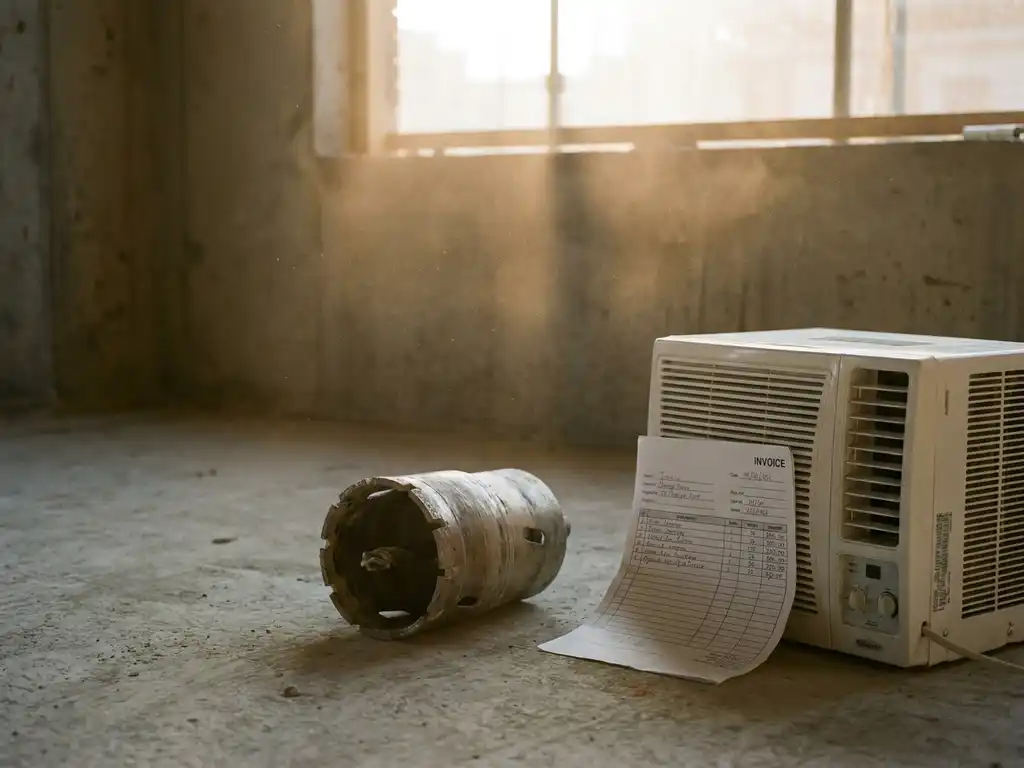
When purchasing an air conditioner, you do not just pay for the unit itself. The actual costs consist of the purchase price, installation costs, annual maintenance, and energy consumption, and these can add up significantly. Those who inform themselves well in advance avoid unpleasant surprises later on. In this article, we answer the most frequently asked questions about the hidden costs of an air conditioner.
What are the installation costs of an air conditioner?
The installation costs of an air conditioner are the costs you pay in addition to the purchase price of the unit itself. These costs cover the work of a certified technician, the necessary piping, electrical work, and potentially drilling through walls. Depending on the situation and the type of system, installation costs can vary significantly.
For a standard split-unit air conditioner, a technician must drill at least one hole through the exterior wall for the pipe entry. This may seem like a minor intervention, but it requires precision work in concrete or masonry. Factors that influence installation costs are:
- The thickness and material of the wall (concrete, brick, insulation material)
- The distance between the indoor and outdoor unit
- The required length of the cables and the electrical connection
- The accessibility of the installation location
- The number of units being installed (multi-split systems)
Always request a detailed quote before agreeing, so that you know exactly what you are paying for. Use the price tool for a quote to quickly gain insight into the costs for your specific situation.
What hidden costs are involved with an air conditioner?
Hidden costs associated with air conditioning are costs that you often do not see immediately at the time of purchase, but which you ultimately pay. These include exchange rate surcharges for refrigerant, disposal costs for your old equipment, additional material costs, and the costs of repairing walls after installation.
The most common hidden costs are:
- Costs for refilling refrigerant upon initial commissioning or after a leak
- Material costs such as pipe penetrations, brackets, condensate drainage, and insulation material, which are not always included in the base price
- Disposal of packaging material and old equipment, which is sometimes charged separately
- Repair work on the wall after drilling, such as plasterwork or paintwork
- Costs for an electrical circuit if the existing distribution board is not suitable for the additional load
- Call-out charges which some installers charge on top of the hourly rate
Always ask the installer for an all-in quote including materials and disposal. This way, you can be sure you won't face unexpected bills afterwards.
How much does air conditioning maintenance cost per year?
Annual maintenance of an air conditioner consists of at least cleaning the filters and checking the refrigerant level. Ideally, you should have a professional maintenance service performed once a year. Neglecting maintenance leads to higher energy costs, a shorter lifespan, and potentially expensive repairs.
Good maintenance typically includes:
- Cleaning of the indoor unit and filters
- Inspection and cleaning of the outdoor unit
- Inspection of the refrigerant pressure
- Checking the condensate drain
- Electrical inspection of the connection and the control system
Some installers offer maintenance contracts where you pay a fixed amount per year. This provides certainty and ensures that maintenance is not forgotten. A maintenance contract is especially recommended for business use.
What are the energy costs of an air conditioner in use?
The energy costs of an air conditioner in use depend on the unit's capacity, the COP value (energy efficiency), the number of hours you use the air conditioner, and the current energy price. A modern, energy-efficient air conditioner with a high SEER value consumes significantly less power than an older or cheaper model.
A few rules of thumb to estimate energy costs:
- The higher the SEER value (Seasonal Energy Efficiency Ratio), the lower the consumption per cooling hour.
- An air conditioner that is too big for the room constantly switches on and off, which actually consumes more energy.
- Poor insulation of the room causes the air conditioner to work harder and consume more energy.
- Sunshades or blackout curtains reduce the heat load and thereby energy consumption.
Do you want to know which appliance best suits your space and consumption needs? Via the air conditioning selection wizard you will quickly find the right model for your situation.
When do you need a permit for an air conditioner?
In most cases, you do not need a permit to install an air conditioner in a home. However, there are exceptions: for listed buildings, protected cityscapes, or certain apartment complexes, a permit or permission from the Homeowners' Association (VvE) may be required.
Situations where you need to take extra steps:
- National monument or municipal monument: An environmental permit is almost always required here for installing an outdoor unit.
- Protected town or village landscape: Consult the municipality, as installation on the front facade may require a permit.
- Apartment with Owners' Association: You need written permission from the Owners' Association before installing an outdoor unit.
- Rental property: Always ask your landlord for permission before having an air conditioner installed.
If in doubt, always check with your municipality or homeowners' association beforehand. This will prevent you from having to undo an installation or risking a fine.
How do you avoid unexpected costs when purchasing an air conditioner?
You can avoid unexpected costs when purchasing an air conditioner by comparing thoroughly beforehand, requesting detailed quotes, and paying close attention to what is and isn't included. Transparency from the installer and good preparation are the keys to a flawless purchase without financial surprises.
Practical tips to control costs:
- Request at least two or three quotes and compare them at a detailed level, not just on total price.
- Explicitly ask whether materials, drainage, refrigerant, and repair work are included.
- Choose a certified F-gas installer to avoid paying extra for repairs later.
- Have the installer assess the situation on-site beforehand so there are no surprises on the installation day.
- Schedule the maintenance immediately upon purchase to maximize the lifespan of your device.
- Choose an appliance with a high energy class to keep monthly energy costs low.
How De Betonboorder helps with the installation of your air conditioner
Installing an air conditioner almost always means drilling a hole through the wall. That sounds simple, but in concrete or reinforced concrete, this requires professional craftsmanship and the right equipment. That is exactly what we help you with.
What we do for you:
- Professional drilling of pipe penetrations in concrete, brick, aerated concrete and other materials
- Work with high-quality diamond core drills for a clean, precise hole without unnecessary damage to the surroundings.
- Available for private individuals as well as contractors and installation companies throughout the Netherlands.
- Tidy handover: the workplace is left clean and tidy.
- In many cases available within two working days
Do you want to know how much it costs to drill a duct for your air conditioner, or do you want to schedule a professional immediately? Contact us and we will respond within 24 hours with a suitable proposal.
Related Articles
- What is needed to create an opening in the upper floor for a staircase?
- Are there hidden costs associated with breaking up a floor?
- Can I have crawl space ventilation installed without damaging the facade?
- Does crawl space ventilation also work in the winter?
- Qlima monoblock vs Innova monoblock: price, noise and cooling performance compared
- How do you test the cooling performance of an air conditioner?
- Which air conditioner works best in humid rooms?
- How long does an air conditioning installation take?
- How does a Wi-Fi controlled air conditioner work?
- What is the difference between a portable and a monoblock air conditioner?
- Can drilling cause cracks in the facade?
- How do I know which drill diameter I need?