
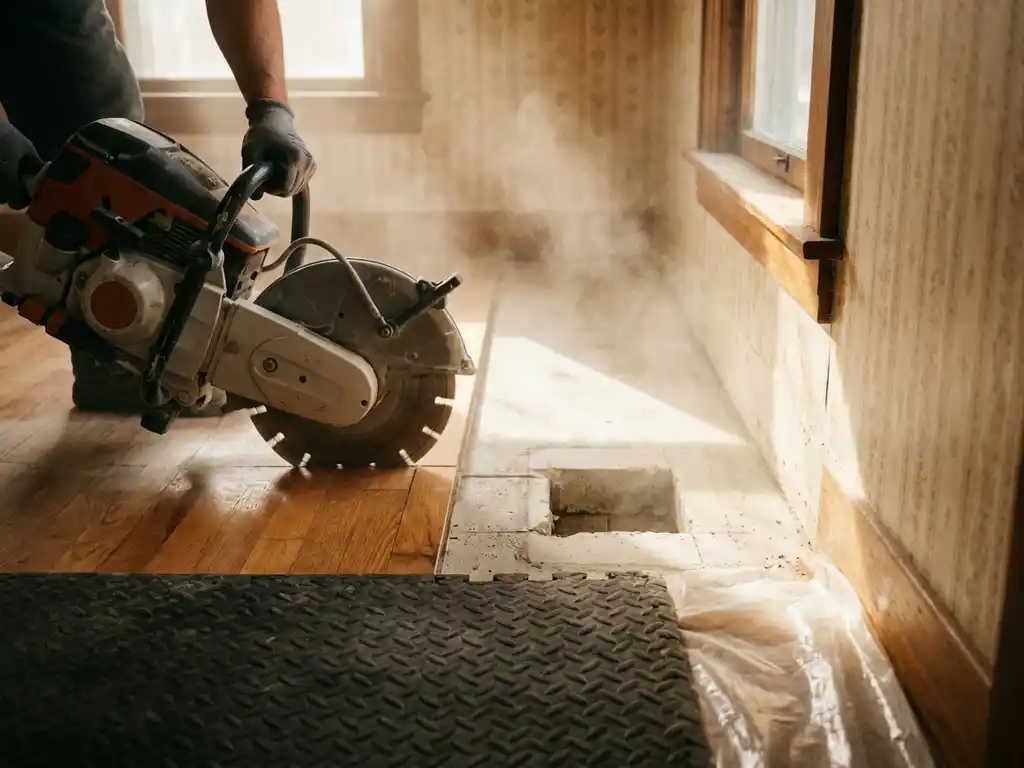
Sawing a stairwell opening causes minimal damage to wallpaper and floor coverings in most cases, provided the work is carried out professionally. The cut itself is precise and controlled, but the immediate surroundings do require attention. In this article, we answer the most frequently asked questions regarding damage, protection, and preparation surrounding the create stairwell.
How much damage does sawing a stairwell cause?
Sawing a stairwell opening generally causes little to no damage to the rest of the floor or the surrounding space, provided the work is handled professionally. The cut is precise and controlled: it is sawn along a predetermined line without affecting the rest of the structure. Dust and vibrations are the main side effects.
Vibrations during sawing are limited but noticeable. With good craftsmanship, the saw line and the structure are carefully prepared so that the concrete surrounding the stairwell remains intact. However, the dust released is a point of concern: concrete sawdust spreads quickly if no measures are taken. An experienced craftsman therefore always works with dust extraction and a protective cover.
What happens to the wallpaper around a stairwell?
Wallpaper directly adjacent to the saw cut is in most cases damaged or removed when sawing a stairwell. After all, the saw cut runs through the floor structure, and if there is wallpaper on the walls surrounding the opening, it can peel off or tear around the edge due to vibrations and the loss of the underlying surface.
Wallpaper on the walls of the room above or below the stairwell will in principle remain intact, as long as the work is limited to the floor. However, fine dust can settle on wallpapered surfaces if the space is not properly sealed. It is advisable to cover vulnerable walls with foil or protective sheeting before the work begins.
Is the floor covering around the stairwell at risk?
Yes, the floor covering directly around the stairwell is at risk of damage. Carpet, laminate, or parquet that extends to the cut edge must be removed or trimmed. Tiles bordering the opening may crack or come loose due to vibrations, depending on how securely they are attached.
Hard floors such as tiles or stone floors are more vulnerable to vibrations than soft floor coverings such as carpet. Carpet can often be rolled back and later trimmed or reattached. Laminate and parquet are less flexible: planks that run to the edge will need to be replaced or professionally cut. Keep in mind that the edge of the stairwell is finished afterwards with a stringer or trim, which usually conceals minor irregularities at the floor edge.
How is the workplace protected during sawing?
When sawing a stairwell opening, the workplace is protected with dust extraction, protective sheeting, and by cordoning off the work area. A professional craftsman ensures that furniture, floors, and walls in the immediate vicinity are covered before sawing begins. This keeps damage to the rest of the home to a minimum.
Specifically, the following protective measures are applied:
- Dust extraction: directly connected to the saw to capture concrete sawdust before it spreads
- Cover film: about furniture, floors and stairs in the area
- Delineation of the work environment: so that housemates or residents stay at a safe distance
- Careful cleanup: The workplace is left tidy afterwards.
In occupied situations, extra attention to dust control is essential. A good professional will discuss this with you in advance and adapt the working method to the situation on site. This minimizes inconvenience for residents, even if the work takes several days.
When is it smart to remove wallpaper or flooring first?
It is wise to remove wallpaper or flooring beforehand if you plan to renovate the room anyway or if the materials are directly adjacent to the saw cut. This prevents unnecessary damage to materials and saves you on repair costs later. In other cases, prior removal is not always necessary.
A few situations where prior removal is preferred:
- Tile floors that extend to the edge of the planned stairwell
- Expensive laminate or parquet that is difficult to repair
- Wallpaper on walls directly adjacent to the opening, especially if you want to keep this wallpaper.
- Situations where the finish of the stairwell connects to the existing floor or wall
If the floor covering is due for replacement anyway, it is practical to do this before the sawing work. This way, you work towards a finished end result in one go, without being left with residual damage afterwards. Always discuss this with the professional beforehand so that the schedule aligns properly.
How much does it cost to have a stairwell cut?
The cost of having a stairwell cut varies and depends on factors such as floor thickness, construction, location, and the necessary steel structure for safety. An exact price is therefore always custom-made. It is advisable to request a targeted quote based on your specific situation.
When comparing quotes, take into account what is included in the price. Consider:
- Determining whether it is structurally sound to create the stairwell at the desired location
- Installing a steel structure around the stairwell for load-bearing capacity
- The disposal of released materials
- Cleaning up the workplace afterwards
The entire process, from sawing the stairwell to installing the staircase, typically takes place in two phases: creating and closing the stairwell takes an average of two days, and installing the staircase takes one day. Always request a custom quote so you know exactly what to expect.
How The Concrete Driller helps with creating a stairwell
The Concrete Driller specializes in the professional creating stairwells, even in occupied situations. We take care of everything from start to finish, from the initial assessment to the neat handover of the workspace. This is what we arrange for you:
- Constructive assessment: We determine whether the stairwell at the desired location is structurally sound.
- Professional execution: The stairwell is drilled and a steel structure is installed for safety.
- Working in occupied situations: We keep nuisance to a minimum and leave the workplace tidy.
- Scheduled quickly: In many cases, we can schedule a professional within two days.
- Custom quote: You will receive a targeted quote tailored to your situation.
Do you want to know what sawing a stairwell opening means for your wallpaper, floor, or structure in your specific situation? Contact us and we are happy to think along with you.
Related Articles
- How do I choose the best location for a stairwell in my home?
- How do I tell if the musty smell in the house is coming from the crawl space?
- Is moisture from the ground really coming into my house?
- Which energy label does an air conditioner need for energy-efficient cooling?
- How many decibels does an air conditioner produce and when is that disturbing when sleeping?
- What does BTU mean for air conditioners?
- Qlima vs Olimpia Splendid: which brand is the better choice?
- How much does air conditioning cost, including installation?
- How do you prevent a tile from cracking when drilling?
- How do you increase the value of your home with an internal renovation?
- How do you report the removal of a load-bearing wall to the Owners' Association?
- As a tenant, are you allowed to have a load-bearing wall removed?