
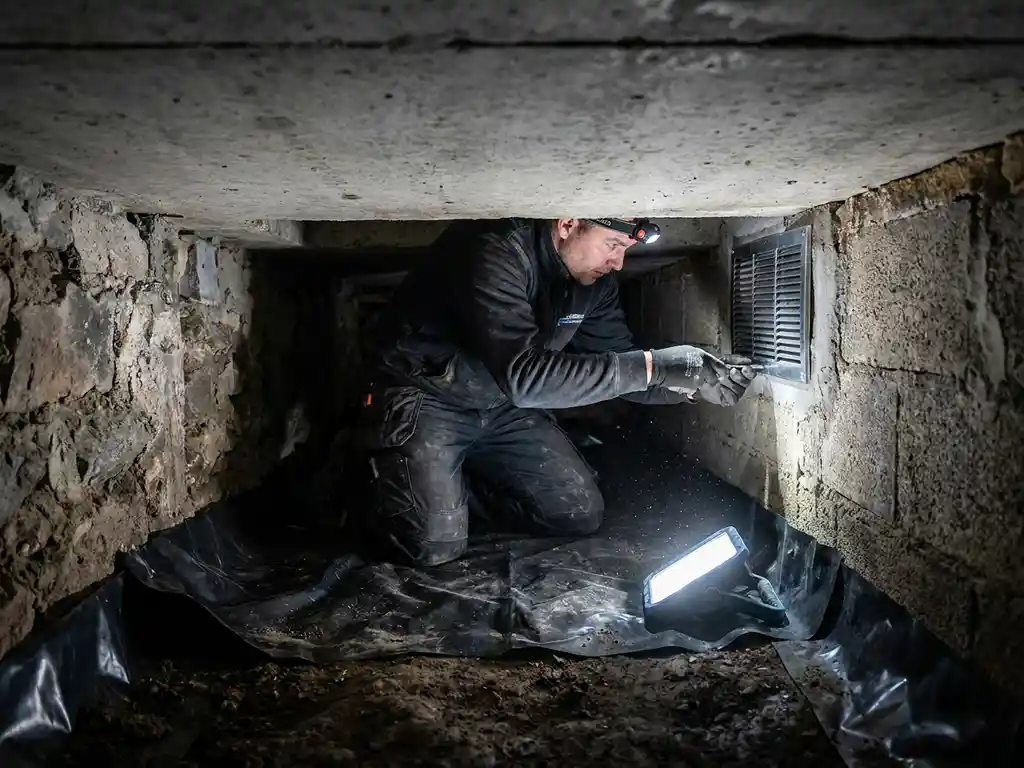
Yes, crawl space ventilation and ground foil can be combined perfectly. In fact, in many situations, the combination of both measures is more effective than either one separately. Ground foil limits moisture rising from the ground, while ventilation removes the remaining moist air. In this article, we answer the most frequently asked questions about this combination.
What effect does ground foil have on humidity in a crawl space?
Ground foil reduces humidity in a crawl space by preventing moisture from evaporating from the soil and entering the air. The foil forms a physical barrier between the damp ground and the air in the crawl space, significantly reducing the amount of water vapor released.
Soil always contains a certain amount of moisture. Without ground foil, that moisture evaporates continuously and rises into the crawl space. This results in high relative humidity, which can eventually lead to wood rot in the floor structure, mold growth, and a musty odor in the house. Ground foil tackles the source of this problem.
However, ground foil is not a complete solution. Moisture can also enter through other routes, such as the crawl space walls or condensation. That is precisely why ventilation remains a valuable addition in many cases, even if you have already installed foil.
Can crawl space ventilation be used together with ground foil?
Yes, crawl space ventilation Ground cover and soil foil can be used together without any problems. The two measures work complementarily: the foil reduces the source of moisture from the soil, while ventilation actively removes the remaining moist air. Together, they offer more robust protection than either measure alone.
There is no technical reason why the combination would not work. Ventilation grilles or mechanical ventilation can simply be installed in a crawl space that is already fitted with ground foil. The only point of attention is that the foil fits snugly against the walls and is secured sufficiently so that airflow does not shift or lift the foil.
In practice, this combination is actually recommended for homes with structural moisture problems, older homes with an earth floor in the crawl space, or situations where the crawl space is difficult to access and you want to solve the problem sustainably.
What are the benefits of ground foil and ventilation at the same time?
The combination of ground foil and ventilation offers more benefits than either measure individually. You tackle the moisture problem on two fronts at once: the foil blocks the influx of moisture from the ground, and ventilation ensures that the air in the crawl space remains dry and fresh.
The main benefits of this combined approach are:
- Lower humidity: By combining both measures, the relative humidity in the crawl space drops faster and remains lower.
- Lower risk of wood rot: A dry crawl space protects the wooden floor joists and load-bearing structures of your home.
- No more musty smell: Moisture and mold are the main causes of musty odor in the home; the combination tackles both causes.
- Better insulation value: Damp insulation materials work less effectively. A dry crawl space ensures that floor insulation can do its job.
- Longer lifespan of the structure: Less moisture means less deterioration of materials in the long term.
When is ground foil alone sufficient and when is it not?
Ground foil alone is sufficient when the only source of moisture is the soil itself and the crawl space is otherwise well ventilated via existing vents. In that case, the foil blocks the primary source of moisture and additional ventilation is not strictly necessary.
However, ground foil is not sufficient in the following situations:
- The crawl space has few or no existing ventilation openings.
- There is rising damp through the walls or foundations.
- The crawl space is regularly flooded or has a high groundwater level.
- Mold formation is already present on beams or insulation material.
- The musty smell in the house persists despite the applied foil.
In all these cases, additional ventilation is necessary to structurally improve the air quality in the crawl space. Applying only foil without ensuring sufficient air exchange can even be counterproductive in some cases, because the air in the crawl space then stagnates.
How are ventilation holes installed in a crawl space with ground foil?
Ventilation holes are created by drilling holes in the exterior wall or foundation of the home, at a height just above ground level. The ground foil has no influence on this, because the holes are made in the masonry and not in the foil itself. After drilling, ventilation grilles are installed to protect the opening.
The process consists of the following steps:
- Determine the locations: Choose positions for the ventilation grilles to ensure good airflow, preferably on two opposite sides of the crawl space.
- Drill the holes: Round holes are drilled in masonry or concrete using a diamond core drill. This is precision work that can be performed dust-free and without vibration damage.
- Place the grids: The ventilation grilles are mounted in the drilled openings and ensure controlled airflow.
- Check the foil: After installing the grids, check that the bottom foil still fits properly and is not damaged or shifted anywhere.
With mechanical ventilation, a fan is also installed that actively supplies or extracts air. This is a good option for crawl spaces that are difficult to ventilate with passive grilles alone.
What are the most common mistakes made with crawl space insulation?
The most common mistake with crawl space insulation is installing ground foil without paying attention to ventilation. As a result, moisture entering through other routes can no longer escape, which can actually worsen the problems in the long run.
Other common mistakes include:
- Foil not adhering properly to the walls: If the foil does not run up along the walls and is secured there, moisture can still get underneath it.
- Failure to seal seams: Overlapping pieces of foil must be taped down with special tape. Loose seams allow moisture to pass through.
- Too few ventilation openings: In most cases, a single grate is insufficient. Airflow is required, which necessitates at least two openings on different sides.
- Installing insulation in a damp crawl space: Insulation material installed before the moisture problem is resolved will degrade quickly and lose its insulation value.
- No subsequent inspection: A crawl space requires periodic inspection. Mold or moisture damage detected early is much easier to remedy.
How De Betonboorder helps with crawl space ventilation
Installing ventilation holes in concrete or masonry requires craftsmanship and the right equipment. We ensure precise execution from start to finish, so you don't have to worry about the drilling. This is what we do for you:
- We drill round holes at the desired locations in concrete, masonry, or foundations using high-quality diamond core drills.
- We work with minimal dust and without unnecessary vibrations, so that no collateral damage occurs to the surrounding structure.
- We leave the workplace neat and tidy.
- We operate throughout the Netherlands and are available within two days in many cases.
- After drilling, a ventilation grille or mechanical ventilation system can be installed immediately.
Would you like to know what we can do for your situation? Contact us and we respond within 24 hours. You can also read more about our services on our website.
Related Articles
- How are ventilation holes drilled in the crawl space?
- Does crawl space ventilation also work in the winter?
- Air conditioner payback period: when do you recoup the investment?
- Can you put an air conditioner in the bedroom?
- What is a VRF air conditioning system?
- Can an air conditioner work without an outdoor unit?
- Which air conditioner fits in a small space?
- What do I need to tell my neighbors before drilling starts?
- How long are you allowed to drill indoors per day?
- Why does my plug keep pulling out of the wall?
- How do you create a wall penetration for an air conditioner?
- What is the difference between a foundation and a load-bearing wall?