
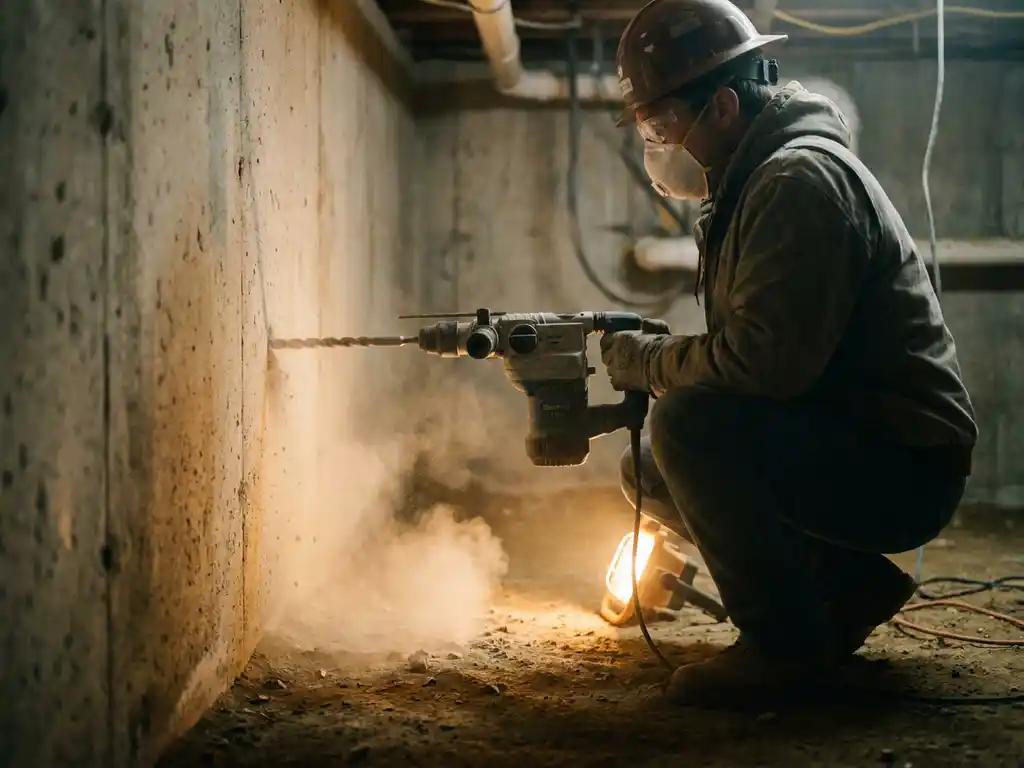
You can handle crawl space ventilation partly yourself, but you need a professional to drill ventilation holes in concrete or the foundation. Simple tasks such as installing grilles or applying foil are perfectly doable yourself, but as soon as drilling into concrete or masonry is required, specialized tools and knowledge are essential. Below you will find answers to the most frequently asked questions about crawl space ventilation.
What are the risks of a poorly ventilated crawl space?
A poorly ventilated crawl space almost always leads to moisture buildup, and this has direct consequences for your home. Moisture with nowhere to go seeps up into floors and walls, causing wood rot, mold growth, and a musty smell in the house. In the long term, this damages your home's structure and reduces its insulation value.
The risks are concrete and noticeable:
- Wood rot: Floor joists and other wooden structural parts rot if they are exposed to moisture for extended periods.
- Mold: A damp crawl space is an ideal breeding ground for mold spores that reach the living space through cracks and crevices.
- Musty smell: The typical basement smell in the house can almost always be traced back to poor air circulation under the floor.
- Higher energy costs: Damp insulation works less effectively, causing you to heat more without the desired result.
- Health complaints: Prolonged exposure to mold spores can cause respiratory problems, especially in children and people with allergies.
Good one crawl space ventilation In many cases, it completely solves these problems. The principle is simple: fresh outside air flows into the crawl space on one side, and moist air leaves the space on the other. This creates a constant airflow that prevents moisture buildup.
Which tasks are you allowed to carry out yourself regarding crawl space ventilation?
There are a number of aspects of crawl space ventilation that you can easily tackle yourself as a do-it-yourselfer, provided the necessary openings are already present. Think of installing ventilation grilles in existing openings, applying a vapor barrier or crawl space foil to the floor, and cleaning the crawl space beforehand.
Specifically, these are tasks you can perform yourself:
- Installing or replacing ventilation grilles in existing wall openings
- Installing crawl space foil or a vapor barrier on the ground
- Removing debris, waste, or organic material from the crawl space
- Checking and clearing existing ventilation openings that are clogged or blocked
It is important to note that you will be working in a space with limited air circulation and sometimes poor air quality. Always wear a dust mask and ensure adequate lighting. Do you have no existing ventilation openings, or are the current openings too small? Then you will quickly reach the point where professional tools are necessary.
When is a professional required for crawl space ventilation?
A professional is necessary whenever new holes need to be drilled in concrete, foundations, or masonry. This also applies when the existing ventilation is insufficient and needs to be expanded with additional openings. Diamond drilling tools and knowledge of the foundation's structure are required for this type of work.
In the following situations, engaging a professional is the only responsible choice:
- There are no ventilation openings present and holes must be drilled in concrete or masonry.
- The existing openings are too small and need to be enlarged.
- The foundation consists of reinforced concrete, where incorrect drilling can cause structural damage.
- The crawl space is difficult to access and specialized tools are needed to work in the right place.
- There is severe moisture damage requiring other repair work as well.
In addition to technical necessity, building regulations and liability also play a role. If you make structural changes to the foundation during a remodeling or renovation without the proper knowledge, you run the risk of rejection during a potential home inspection or problems with insurance claims.
How are ventilation holes drilled in concrete?
Ventilation holes in concrete are drilled using a diamond core drill, a technique in which a rotating drill with diamond segments cuts through the concrete precisely and vibration-free. The diameter of the hole is matched to the ventilation grille to be installed, typically between 100 and 200 millimeters. The result is a clean, round hole without cracks or damage to the surrounding material.
The process proceeds step-by-step as follows:
- Inspection and measurement: The professional determines the optimal position for the ventilation openings, taking into account the airflow direction and the construction of the foundation.
- Marking: The drilling location is accurately marked to guarantee the desired result.
- Drilling with diamond core drill bit: The hole is drilled using a core drill and cooling water. Cooling water prevents the drill from overheating and keeps dust to a minimum.
- Removal of the concrete core: The drilled core is removed and the hole is post-processed if necessary.
- Placement of the grate: The ventilation grille is placed in the opening and sealed to keep out drafts and pests.
Diamond drilling is the preferred technique because it works accurately, causes little vibration, and keeps collateral damage to a minimum. This is particularly important for older homes where the foundation may be more vulnerable, or for reinforced concrete where the reinforcement must remain intact.
How much does it cost to have crawl space ventilation installed?
The cost of installing crawl space ventilation depends on the number of ventilation openings required, the thickness and material of the foundation, and the accessibility of the work location. For a simple situation involving two boreholes and the installation of grilles, the costs are generally lower than for a complex foundation or a difficult-to-access crawl space.
Factors that influence the price:
- Number of boreholes: More ventilation openings mean more work and material usage.
- Foundation material: Reinforced concrete requires more time and is more susceptible to wear from the drill than unreinforced concrete or masonry.
- Wall thickness: Thicker walls require longer drilling times.
- Opening hours office A low or poorly accessible crawl space can extend the working time.
- Additional work: The application of foil or the repair of moisture damage is calculated separately.
Always request a customized quote so you know exactly what to expect before the work begins. This way, you won't be faced with any surprises.
How De Betonboorder helps with crawl space ventilation
We handle the drilling of ventilation holes in concrete from start to finish, so you don't have to worry about the technical execution. Whether it involves a single opening or multiple boreholes at different locations, we work precisely and leave the worksite tidy.
This is what you can expect from us:
- Professional drilling with high-quality diamond core drills for clean, precise holes
- Experience with all types of foundations: reinforced concrete, aerated concrete, masonry, and natural stone.
- Work in both occupied and shell properties
- Nationwide network of professionals, available within two days in many cases
- Contact within 24 hours of your request
Would you like to know what we can do for your situation? Contact us and together we look at the best solution for your crawl space ventilation. You can also read more about our services as a concrete driller.
Related Articles
- How long do I have to wait after a stairwell before the stairs can be installed?
- How much does a structural engineer cost for a stairwell in the floor?
- How much does it cost to remove the concrete after a stairwell?
- How is it prevented that the floor weakens after a stairwell?
- How do I replace a loft ladder with a fixed staircase to the attic?
- How do I get that musty basement smell out of my living room?
- Can I have crawl space ventilation installed without damaging the facade?
- Why is it so damp under my house?
- Air conditioning or fan: what really works against the heat?
- What types of air conditioners exist?
- How do you drill a hole for a spotlight in a concrete ceiling?
- What happens if you put too many holes in one wall?