
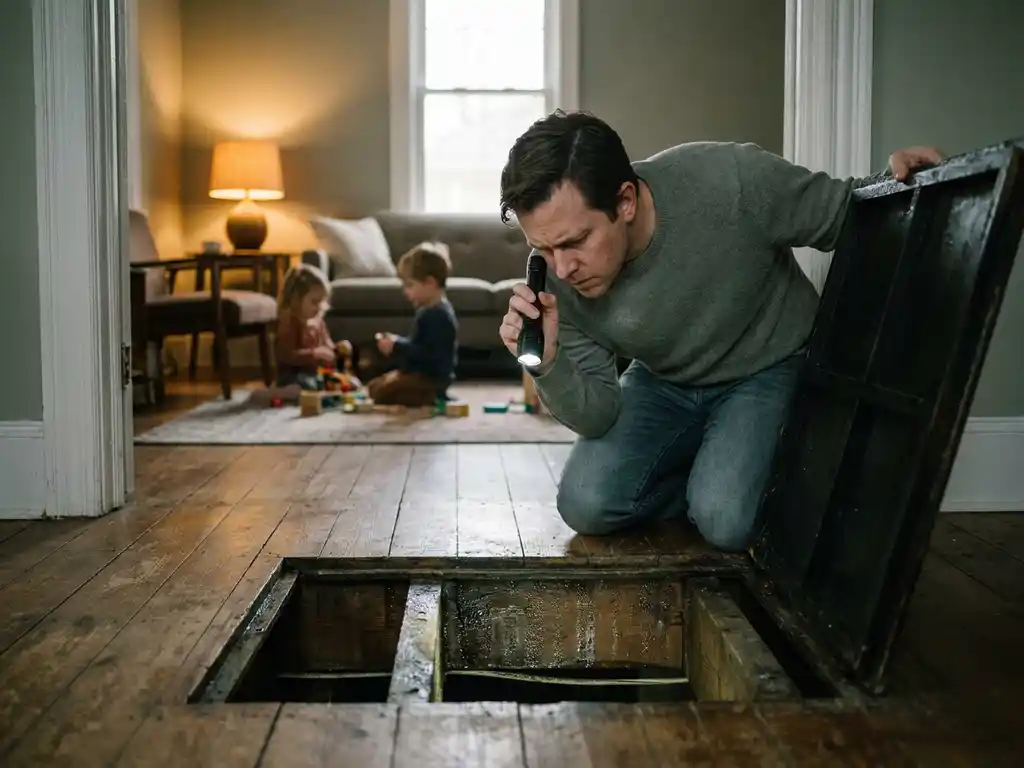
Yes, damp air from the crawl space can be harmful to children. Air from the crawl space rises and mixes with the indoor air, allowing mold spores, dust, and other contaminants to enter the living space. Children are more sensitive to these substances than adults because their airways are still developing. In this article, we answer the most frequently asked questions about moisture, mold, and crawl space ventilation so that you know exactly what to do.
What does damp air from the crawl space do to the air quality in your home?
Humid air from the crawl space deteriorates indoor air quality by carrying mold spores, bacteria, and damp particles into the living space. This phenomenon is called the cumulative effect: warm air in the house rises and draws cold, humid air in from below. The worse the crawl space ventilation, the more polluted air comes in.
In practice, this means that a musty smell in the house can often be traced directly back to the crawl space. But it goes beyond a nasty smell. Increased indoor humidity can cause condensation on windows and walls, which in turn encourages new mold growth on the ground floor. Indoor air quality drops noticeably, while residents are often unaware of the source.
What health problems can arise from moisture in the crawl space?
Moisture from the crawl space can lead to respiratory complaints, allergic reactions, fatigue, and headaches. These symptoms arise from the inhalation of mold spores and fine dust. With prolonged exposure, the symptoms can become chronic, especially in people with a weakened immune system or pre-existing allergies.
The most common health complaints are:
- Persistent nasal congestion or runny nose without a clear cause
- Coughing, wheezing or shortness of breath
- Itchy or watery eyes
- Skin irritations or eczema
- Fatigue and concentration problems
- Headache, especially in the morning after getting up
What makes these symptoms insidious is that they resemble the common cold or seasonal allergies. Many families do not look for the cause in their homes, even though the crawl space is the direct source.
How dangerous is mold in the crawl space for children?
Mold in the crawl space is seriously dangerous for children because their immune systems and airways are still developing. Mold spores rising through the floor can trigger asthma in children, worsen existing respiratory conditions, and cause allergic reactions that are difficult to trace back to the true source.
Certain types of mold, such as black mold, produce mycotoxins. These are toxic substances that are more harmful than ordinary mold spores upon prolonged exposure. Children who spend a lot of time on the floor, such as toddlers and preschoolers, are at increased risk because they breathe closer to the floor, where the concentration of mold spores is highest.
Signs that mold in the crawl space is affecting children's health include recurring respiratory infections, persistent coughing without fever, and worsening of eczema or asthma indoors. Take these signs seriously and investigate the crawl space as a possible cause.
How do I know if my crawl space is too damp?
Your crawl space is too damp if you find visible moisture, condensation, mold, or a musty odor. Other indicators include wood rot on beams, rust on metal parts, and elevated humidity in the house that cannot be explained by normal activities such as showering or cooking.
You can check the humidity of your crawl space in various ways:
- Visual inspection: Use a flashlight to look in the crawl space for visible mold (black, green, or white spots), damp soil, or standing water.
- Scent test: A distinct musty or earthy smell in the house, particularly on the ground floor, indicates an excessively damp crawl space.
- Moisture meter: You can measure the humidity in the crawl space with a simple hygrometer. A value above 70% is too high and requires action.
- Condition of the floor: Does your wooden floor feel soft, does it spring back, or does it show discoloration? Then there is likely a long-term moisture problem.
Are you in doubt after your own inspection? Then have the crawl space checked by a professional who can assess the situation objectively.
What are the best solutions for a damp crawl space?
The best solutions for a damp crawl space are improving ventilation, installing a vapor barrier on the floor, and addressing any water infiltration from the outside. Which solution is most effective depends on the cause of the moisture problem.
Improved ventilation
Good crawl space ventilation ensures that moist air is removed and dry outside air flows through the crawl space. This can be achieved by keeping existing ventilation openings clear, installing additional ventilation grilles, or installing a mechanical ventilation system. In many cases, ventilation is the most direct and cost-effective solution for structural moisture problems.
Vapor barrier on the bottom
A vapor barrier, also known as ground foil, prevents moisture from evaporating from the ground and flowing into the crawl space. Installing a high-quality vapor barrier across the entire floor of the crawl space is an effective complement to ventilation measures, particularly in crawl spaces with an earth floor.
Addressing water infiltration
If water enters the crawl space through cracks in the foundation, poor drainage, or a high groundwater level, ventilation alone will not solve the problem. In that case, a structural inspection is necessary to locate and seal the source of the water ingress.
When should I hire a professional for my crawl space?
Call in a professional if you find visible mold, if health problems in your family persist, if there is wood rot or water infiltration, or if simple measures such as clearing ventilation openings do not bring improvement. Moisture problems in the crawl space are rarely a one-off occurrence and require a structural approach.
A professional can determine the exact cause of the moisture problem, assess the condition of the structure, and recommend an appropriate solution. Do not wait too long to take action: the longer a crawl space remains too damp, the greater the damage to the structure and the greater the risk to your family's health.
How De Betonboorder helps with crawl space ventilation
A damp crawl space is a problem you shouldn't let fester. We help you with a concrete, professional solution that tackles the moisture problem at the source. Through us, we quickly and expertly arrange crawl space ventilation for your home, whether you are a private individual, a contractor, or an SME.
This is what we do for you:
- Installation of ventilation grilles in the crawl space for a continuous flow of air
- Reduction of musty odors in the home through targeted, customized ventilation
- Improvement of the insulation value of your home as an additional benefit
- Neat delivery where the workplace is left clean and tidy
- Rapid deployment from professionals, in many cases within two days
Are you unsure about the situation in your crawl space, or do you want to take immediate action? Contact us and we will respond within 24 hours with suitable advice or a quotation.
Related Articles
- What is needed to create an opening in the upper floor for a staircase?
- Is moisture from the ground really coming into my house?
- What uses more electricity: an air conditioner or ventilating with a fan all day?
- How much does an air conditioner cost for an apartment that heats up quickly?
- Cheap air conditioning for cooling: is that possible without compromising on quality?
- Innova vs Olimpia Splendid: which monoblock air conditioner cools best?
- Can an air conditioner be bad for your health?
- What is the best air conditioner?
- How do you test the cooling performance of an air conditioner?
- Which air conditioner fits in a small space?
- What do you need to arrange with the neighbors when removing a load-bearing wall?
- Can you remove a load-bearing wall without a structural calculation?