
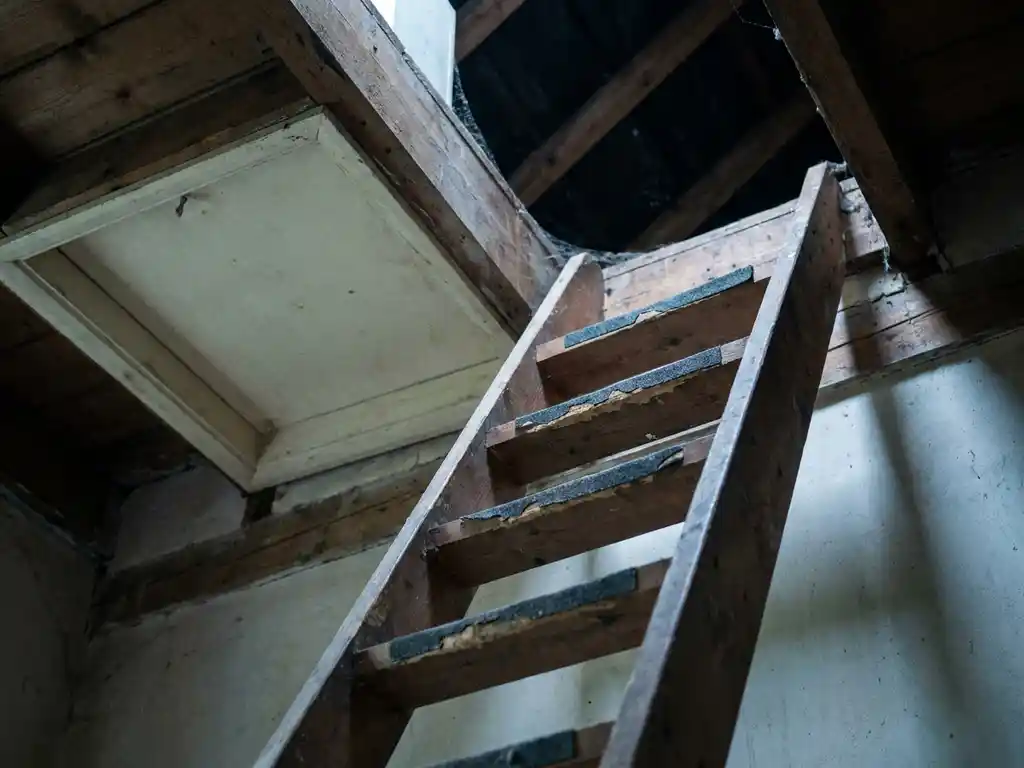
A loft ladder is too steep and dangerous if the angle of inclination exceeds 45 degrees. Above that limit, climbing becomes unsafe, especially for children, the elderly, or people carrying things. Whether your loft ladder needs replacing depends on the angle, the condition of the ladder, and how often you use the attic. In this article, we answer the most frequently asked questions about steep loft ladders and what you can do about it.
When is a loft ladder officially too steep?
A loft ladder is officially considered too steep if the angle of inclination exceeds 45 degrees. The Building Decree states that a fixed staircase may have a maximum slope of 45 degrees. Strictly speaking, loft ladders fall outside this scope, but as a guideline, the risk of falling increases rapidly above 45 degrees, and the ladder is no longer safe for daily use.
In practice, in older homes, you see loft ladders with an angle of 55 to even 70 degrees. These are essentially ladders with rungs, not real stairs. They were installed at the time because the space for the have a stairwell made was limited. The smaller the stairwell, the steeper the stairs must be to reach the attic floor.
An angle of inclination between 30 and 45 degrees is considered comfortable and safe. Is your loft ladder above 45 degrees? Then it is wise to take action, especially if the attic is used regularly.
What risks does a loft ladder that is too steep pose?
A loft ladder that is too steep significantly increases the risk of falling. At an angle of more than 45 degrees, it is difficult to place your feet properly on the rungs, you lose your balance more easily, and there is less room to hold on. This makes every climb a moment of risk, especially if you are carrying something.
The risks are greatest for:
- Children, who sometimes climb the stairs unsupervised
- Elderly, for whom balance and leg strength play a greater role
- People with stuff, such as boxes or tools, which require both hands
- Low-light situations, where the steps are poorly visible
In addition to the risk of falling, a staircase that is too steep also wears out faster. The steps are subjected to uneven loading, causing hinges, springs, and connections to loosen or break sooner. A defective loft ladder that suddenly collapses or sags is an additional danger you want to avoid.
How do you measure the angle of inclination of your loft ladder?
You measure the angle of inclination of your loft ladder with a digital protractor or a spirit level app on your smartphone. Place the measuring instrument along the stile of the ladder when it is unfolded. The displayed angle relative to the horizontal plane is the angle of inclination. Anything above 45 degrees is too steep for safe use.
Don't have a protractor at hand? Then you can also make a simple calculation:
- Measure the vertical height from floor to attic hatch (the rise)
- Measure the horizontal distance which the step occupies when it is unfolded (the tread)
- Divide the rise by the running height and calculate the arctangent.
A rise of 250 cm with a tread of 200 cm results in an angle of approximately 51 degrees, which is too steep. A rise of 250 cm with a tread of 280 cm results in approximately 42 degrees, which is just barely acceptable. Are you unsure about the result? Have a professional measure on-site for a reliable assessment.
Can a loft ladder that is too steep be adjusted or improved?
A loft ladder that is too steep can be improved to a limited extent, but true modification is rarely possible without enlarging the stairwell. You can install anti-slip strips and fit better handrails, but you cannot change the angle of inclination itself without structural interventions. Small improvements reduce the risk but do not solve the structural problem.
What you can do to temporarily improve safety:
- Stick anti-slip strips on the steps for more grip
- Attach a sturdy handle or handrail to the side
- Ensure good lighting on the stairs
- Agree that the stairs are never climbed with full hands
If you really want to reduce the angle of inclination, a larger stairwell is the only solution. With more horizontal space, the stairs can be positioned at a shallower angle. This requires a structural modification to the floor construction, for which it must first be determined whether the change is structurally sound.
When is it better to completely replace the loft ladder?
Replacement is better than modification if the angle of inclination exceeds 50 degrees, the stairs are old or damaged, or if the attic is structurally used as living or working space. In those cases, a new loft ladder or a fixed staircase offers greater safety, comfort, and value for the home.
Choose full replacement if:
- The ladder creaks, sags, or no longer folds smoothly
- The angle of inclination is above 50 degrees and there is no room for improvement
- The attic is used as a bedroom, office, or playroom.
- Children or the elderly regularly use the stairs
- You want to sell the house and the stairs pose a safety risk
In some situations, it is smarter to switch to a fixed staircase rather than a new loft ladder. A fixed staircase is safer, more comfortable, and offers greater ease of use. However, this does require a larger or new stairwell opening in the floor, which is a professional intervention where the load-bearing structure must be carefully assessed. You can find more information about what this entails at debetonboorder.nl.
How De Betonboorder helps with a new stairwell
Do you want to replace your steep loft ladder with a safe fixed staircase? Then everything starts with creating or enlarging the stairwell. We specialize in the professional construction of stairwells in occupied properties and ensure that the process runs safely and neatly from start to finish.
This is what we arrange for you:
- Constructive assessment: We first determine whether the stairwell can be created safely and responsibly.
- Expert drilling and sawing: The stairwell is professionally constructed with minimal disruption to the surroundings.
- Steel structure for safety: we install the necessary steel structure so that the floor remains stable
- Neat delivery: The workplace is left clean and tidy.
- Quick deployment: In many cases, we can schedule a professional within two days.
Ready to make your attic safe and accessible? Contact us and we are happy to think along with you about the best approach for your situation.
Related Articles
- How big does a stairwell need to be for a fixed staircase?
- Why does my ground floor always feel damp and cold?
- What is better against moisture: ground foil, shells, or ventilation?
- What is the difference between natural and mechanical crawl space ventilation?
- What uses more electricity: an air conditioner or ventilating with a fan all day?
- Olimpia Splendid vs Innova: which brand has the lowest electricity costs?
- Innova ELEC series compared: 12HP vs 15HP vs 18HP
- How long does the warranty on an air conditioner last?
- Can an air conditioner cause condensation problems?
- How does the finishing work after removing a load-bearing wall?
- What do you need to arrange with the neighbors when removing a load-bearing wall?
- As a tenant, are you allowed to have a load-bearing wall removed?