
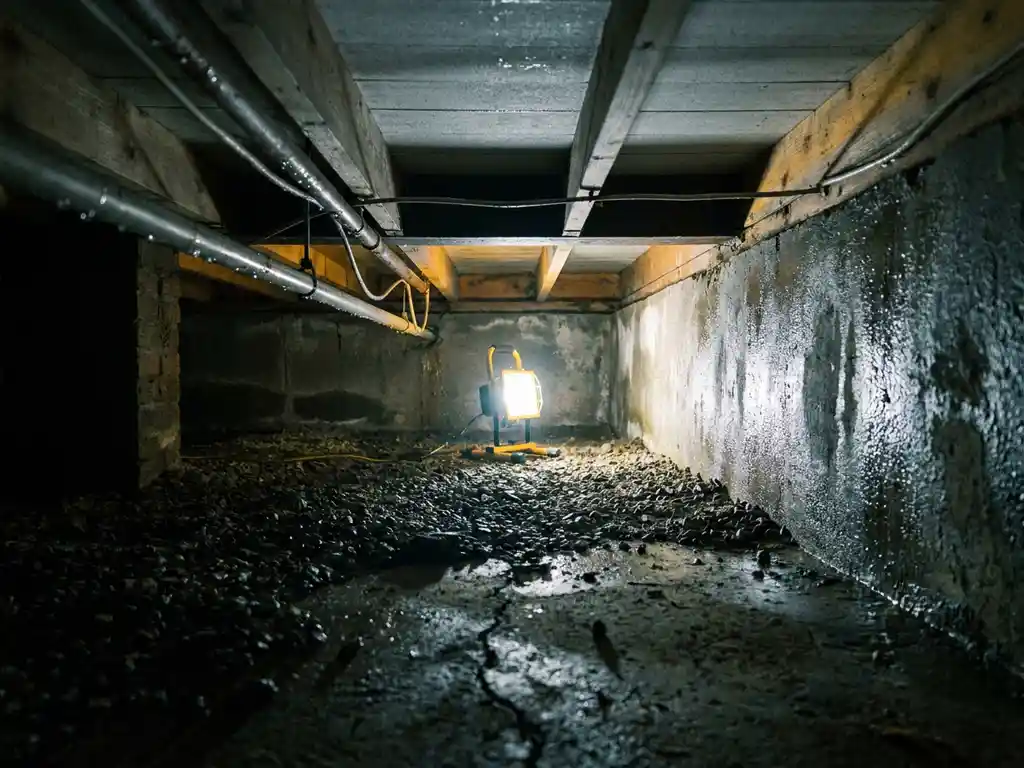
Moisture under your house is caused more often by poor ventilation than by groundwater. Condensation caused by stagnant, damp air in the crawl space is by far the most common cause of moisture problems under Dutch homes. Groundwater only plays a role under specific circumstances, such as a high groundwater level or a leaking foundation. In this article, we answer the most important questions so that you quickly know where the problem lies and what you can do about it.
How do you know if moisture in the crawl space is coming from groundwater?
Moisture in the crawl space comes from groundwater if you find visible water on the bottom, feel wet or soggy ground, or if humidity increases sharply after a period of heavy rain or in the spring when the groundwater level is highest. Groundwater seeps up through the soil or penetrates laterally through the foundation.
There are a few concrete signs pointing to groundwater as the cause:
- Visible puddles of water or muddy floor in the crawl space
- Moisture damage that clearly worsens after heavy rainfall or in wet seasons
- White efflorescence (lime bloom) on the foundation or walls of the crawl space
- A nearby groundwater level known to be high, for example in polder areas
- Visible cracks or leaks in the foundation
Unsure? Lay a piece of plastic sheeting flat on the floor of the crawl space and leave it for a day or two. If moisture collects under the sheeting, it is coming from below, i.e., from the ground. If the moisture is on top of the sheeting, condensation is the culprit.
What are the signs of poor ventilation under a house?
Poor crawl space ventilation You can recognize it by a musty or moldy smell in the house, condensation on floor joists and pipes, and visible mold growth on wood or insulation material. When air cannot circulate in the crawl space, humidity rises to a level where mold and wood rot develop naturally.
The most common signs of a ventilation problem are:
- A musty, earthy smell rising from the floor
- Condensation on the inside of floorboards or beams
- Black or green deposits on wooden structures in the crawl space
- Floors that feel soft or resilient, which indicates wood rot
- Increased humidity in the living spaces directly above the crawl space
- Ventilation openings that are clogged with dirt, leaves, or insulation material
Poor ventilation is a common problem in the Netherlands, especially in older homes where the ventilation openings in the foundation are too small or simply missing. Warm, humid indoor air sinks and collects in the crawl space, where, due to a lack of extraction, it condenses on cold surfaces.
What is the difference between groundwater and condensation in the crawl space?
The difference between groundwater and condensation in the crawl space lies in the origin of the moisture. Groundwater enters from the outside through the soil or foundation and is seasonal. Condensation forms inside the crawl space because warm, humid air cools on cold surfaces, and can occur year-round.
Practically speaking, you can distinguish them based on the following characteristics:
- Groundwater: Visible water on the bottom, moist soil, increase after rain, present in certain seasons
- condensation: Droplets on pipes and beams, damp air without visible water on the floor, present in all seasons but often worse in winter
Condensation is by far the most common cause of moisture problems in Dutch crawl spaces. The danger of condensation is that it works gradually and therefore remains undetected for a long time. By the time you discover mold or wood rot, the damage is already significant. Groundwater is generally easier to recognize, but more difficult and costly to resolve.
How do you solve a ventilation problem in the crawl space?
A ventilation problem in the crawl space is solved by ensuring sufficient air circulation, allowing moist air to escape and dry outside air to flow in. The most effective solution is installing or enlarging ventilation openings in the foundation, possibly supplemented by a mechanical ventilation system.
These are the steps you can take:
- Check existing ventilation openings: Are the grilles free of dirt, leaves, or insulation material? Clean them or replace them if they are damaged.
- Add extra ventilation openings: If there are too few grilles, new holes can be drilled in the foundation for additional air supply and exhaust.
- Consider mechanical ventilation: For persistent moisture problems, an electric fan in the crawl space offers an active solution that continuously refreshes the air.
- Install a vapor barrier: A foil on the floor of the crawl space limits moisture absorption from the ground and lowers humidity.
- Insulate the floor: Good floor insulation keeps the beams warmer, reducing the likelihood of condensation.
Note that ventilation openings must always be located on two opposite sides of the crawl space. Only in this way is a true airflow created. Grilles on only one side do not solve the problem.
When should you call in a specialist for moisture problems?
You call in a specialist for moisture problems in the crawl space when you find visible mold or wood rot, when simple measures such as cleaning vents do not provide improvement, or when additional ventilation openings are needed in the foundation. Drilling into concrete or a foundation is skilled work that requires specific equipment and knowledge.
In any case, seek professional help for:
- Damage to load-bearing structures due to wood rot or mold
- Visible groundwater or structural leakage in the foundation
- The desire to have new ventilation openings drilled in concrete or masonry
- A musty smell that does not disappear after taking your own measures
- Uncertainty about the cause: groundwater, condensation, or something else
A specialist can assess the situation, make the correct diagnosis, and implement the most appropriate solution. Especially when it comes to creating new openings in the foundation, it is wise not to attempt this yourself. A mistake could compromise the load-bearing capacity of the foundation or, conversely, allow more moisture to penetrate.
How De Betonboorder helps with crawl space ventilation
At De Betonboorder, we help you quickly and professionally improve the ventilation in your crawl space. Whether you need extra ventilation openings in the foundation or want a completely new solution installed, our professionals are ready to assist you. This is what we arrange for you:
- Professional drilling of ventilation openings in concrete, masonry, or other foundation materials
- Installing ventilation grilles that ensure good airflow
- Professional execution with minimal disruption and a neat, tidy workplace afterwards.
- Rapid response: in many cases, we arrange a professional at your location within two days.
- We work throughout the Netherlands, for private individuals as well as for contractors and SMEs.
Good crawl space ventilation prevents moisture problems, reduces musty odors, and contributes to better insulation of your home. Would you like to know what we can do for your situation? Then contact us and we respond within 24 hours.
Related Articles
- How big does a stairwell need to be for a fixed staircase?
- How do I request a quote for a concrete stairwell?
- Does crawl space ventilation also help prevent mold under the floor?
- How big does an air conditioner need to be for my room?
- Innova vs Qlima: which air conditioner is the quietest in the bedroom?
- What is a VRF air conditioning system?
- How long does it take to run a penetration through an exterior wall?
- How do you check if an air conditioner is working properly?
- What happens if damage occurs during drilling?
- What are the requirements for a steel beam when removing a load-bearing wall?
- What are the signs that a wall is load-bearing?
- What is the purpose of temporary support during load-bearing wall removal?