
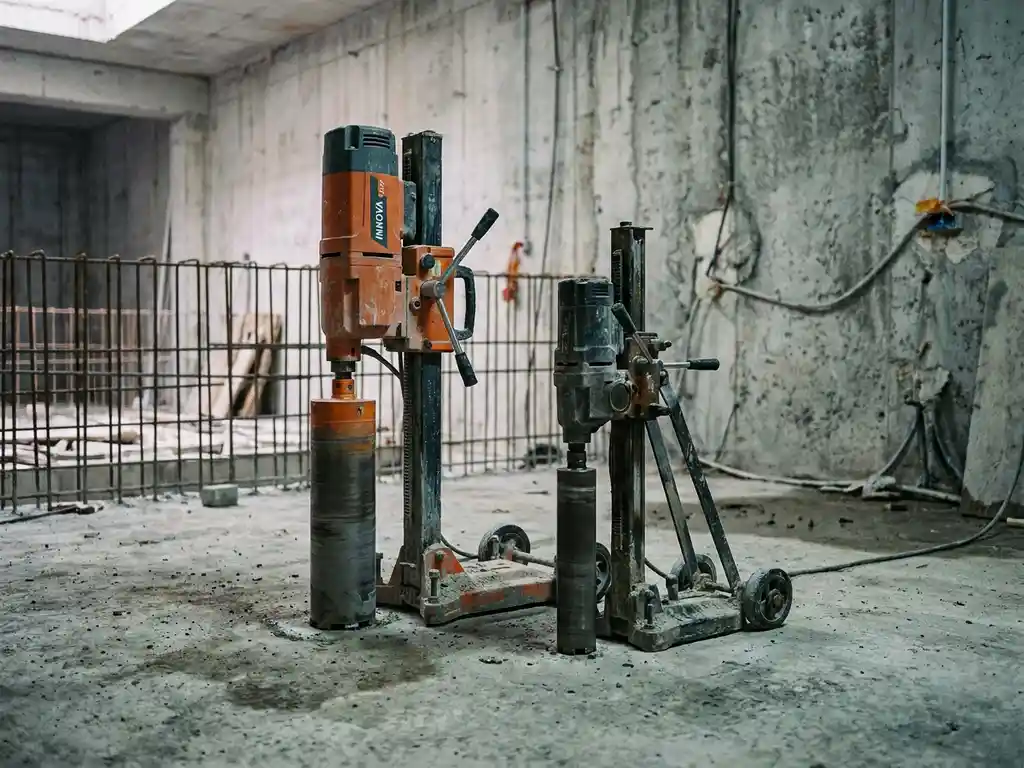
The Innova 15HP and the Innova 15HP Vertical are technically almost identical in terms of power and cooling capacity, but differ in the placement of the outdoor unit: the standard variant has a horizontal air discharge, while the vertical variant blows air upwards. Which one you need depends entirely on the available space around the outdoor unit. Below, we answer the most frequently asked questions about both variants.
What are the technical differences between the Innova 15HP and the Innova 15HP Vertical?
The biggest technical difference between the Innova 15HP and the Innova 15HP Vertical lies in the direction of the outdoor unit's air discharge. The standard Innova 15HP blows air horizontally forward, while the Vertical variant discharges warm air vertically upwards. Both units deliver the same cooling capacity and operate according to the same inverter technology principle.
Furthermore, the dimensions of the outdoor unit in the vertical variant are often more compact in width, but slightly taller. The internal components, such as the compressor, the refrigerant circuit, and the electronics, are identical in both versions. Consequently, energy consumption and the COP value (coefficient of performance) do not differ significantly. Those who, via the air conditioning selection wizard If you are looking for the right unit, you will notice that both variants fall into the same power class.
What are the space requirements of the Innova 15HP Vertical compared to the standard variant?
The Innova 15HP Vertical requires less free space in front of the outdoor unit, but does need sufficient open space above the unit so that the air can flow upwards unimpeded. The standard variant, on the other hand, requires space at the front for horizontal airflow, but is less dependent on free space above the unit.
In practice, this means the following:
- De standard Innova 15HP is ideal when there is sufficient space for the unit and there are no obstacles directly in front of the outdoor unit, such as walls, fences, or dense vegetation.
- De Innova 15HP Vertical fits better in narrow corridors, on balconies with low parapets, or in courtyards where horizontal air outlet space is limited.
- For the vertical variant, you must take into account a clear height of at least one to one and a half meters above the unit, without canopies or overhanging structures that block the airflow.
It is wise to measure the exact installation location beforehand and assess which airflow direction best suits the environment. A wrong choice can lead to the recirculation of warm air, which significantly reduces the efficiency of the air conditioner.
For which drilling applications is the vertical variant most suitable?
The Innova 15HP Vertical is best suited for situations where the outdoor unit is installed in a location with limited horizontal discharge space, such as narrow alleys, enclosed courtyards, or balconies with solid side walls. The vertical airflow prevents warm air from being blown directly against a nearby wall or obstacle.
Specifically, these are the most common application scenarios for the vertical variant:
- Apartments with a narrow balcony where the outdoor unit is positioned close to a side wall
- Homes in urban environments with limited space between buildings
- Installations where the outdoor unit is located on a flat roof and is surrounded by raised edges
- Situations where noise from neighbors or nuisance caused by the airflow plays a role, because the vertical discharge is directed less directly at adjacent properties.
The standard horizontal variant actually works better in open gardens, on the side of detached houses, or in locations where space is not a limiting factor. Unsure about the right choice? Via the air conditioning selection guide you can quickly determine which configuration suits your situation.
Does the motor position affect the drilling speed or the quality of the borehole?
The motor setting of the outdoor unit has no influence on the drilling speed or the quality of a drill hole. The orientation of the outdoor unit (horizontal or vertical discharge) concerns only the air exhaust of the air conditioning system and is completely separate from any drilling work required for the passage of pipes through walls or facades.
When installing an air conditioner such as the Innova 15HP, it is usually necessary to drill a through-hole in an interior, exterior, or facade wall. The quality of that drill hole is determined by the drilling technique and tools used, not by the choice between a horizontal or vertical outdoor unit. A neatly drilled hole with the correct diameter ensures a tight passage for the refrigerant line and reduces the risk of moisture problems or draft loss.
Factors that do influence drilling quality in air conditioning installations are:
- The type of material of the wall (concrete, brick, aerated concrete or cavity wall)
- The presence of reinforcement in concrete walls
- The diameter of the required hole, matched to the piping set
- The angle of the drill hole, which must slope slightly outwards for condensate drainage
Which variant do professionals choose for concrete drilling jobs in the Netherlands?
Professionals installing air conditioning in the Netherlands choose the variant that best suits the specific installation location, not based on personal preference. In practice, tradesmen see the Innova 15HP Vertical more frequently in projects in urban areas and apartment complexes, while the standard horizontal variant is more popular for detached houses and commercial properties with sufficient outdoor space.
When drilling through-holes for air conditioning pipes, installers in the Netherlands typically use diamond core drills, as this method is clean and precise, without unnecessary vibrations or damage to the surrounding structure. This is particularly important for reinforced concrete or older facades where cracks must be prevented. The choice of the correct drill diameter is determined by the manufacturer of the air conditioning unit and is listed in the installation manual.
How De Betonboorder helps with the installation of your air conditioner
Whether you choose the Innova 15HP or the Innova 15HP Vertical, a neatly drilled through-hole in the wall is essential for both variants. We take care of this from start to finish, so that you or your installer can get started immediately. This is what we do for you:
- Custom drills: We drill the through-hole to the exact diameter required by your piping set, in any type of material, from brick to reinforced concrete.
- Clean and precise: Thanks to professional diamond core drills, a clean, vibration-free hole is created without damaging the surrounding wall or facade.
- Quickly arranged: In many cases, we schedule a professional within two days and contact you within 24 hours of your request.
- Workspace left tidy: After drilling, we clean everything up so that your air conditioning installer can continue immediately.
- Available nationally: Through our network of experienced professionals, we operate throughout the Netherlands, serving private individuals as well as contractors and SMEs.
Do you want to know what a concrete drilling job for your air conditioning installation costs? Then use our pricing tool for a quick overview. Or schedule a professional immediately and we will take care of the rest.
Related Articles
- How long do I have to wait after a stairwell before the stairs can be installed?
- How do I know if an opening in my floor is structurally sound?
- Is creating a stairwell in a precast floor different from that in a cast-in-place floor?
- What is rising damp and how do I recognize it?
- What is the difference between natural and mechanical crawl space ventilation?
- Hidden costs when purchasing an air conditioner: what should you look out for?
- How often should you clean an air conditioner?
- What happens if an air conditioner becomes overloaded?
- How much does air conditioning cost, including installation?
- What are the rules for drilling in a VvE building?
- How do you prevent a tile from cracking when drilling?
- How do you increase the value of your home with an internal renovation?