
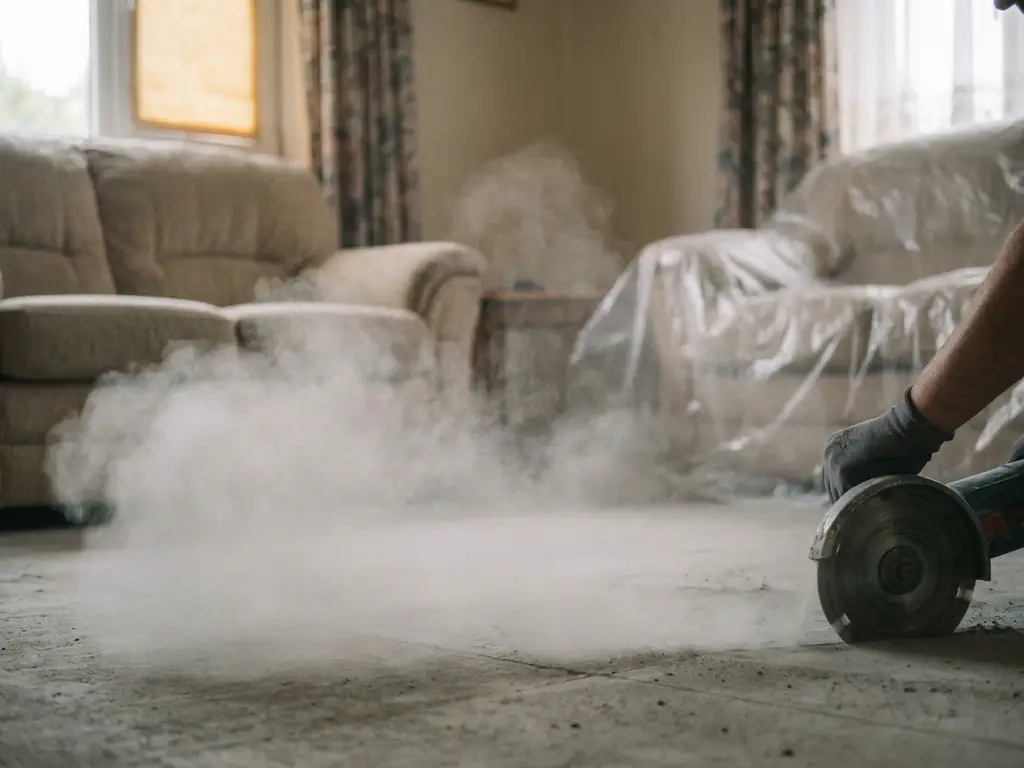
Sawing concrete in an occupied home releases a significant amount of dust, especially without the proper measures. Concrete sawdust spreads quickly through a room and can even reach other rooms via ventilation ducts. In this article, you can read how dangerous that dust is, how far it spreads, and what you can do to limit it.
How much dust is released when sawing concrete?
When sawing concrete without dust control, a large amount of fine dust is released. Concrete consists of cement, sand, and aggregates, and sawing through it creates microscopic particles that remain suspended in the air for a long time. Even a relatively small sawing job, such as the creating a stairwell, produces enough dust to fill an entire room.
The amount of dust depends on several factors: the thickness of the concrete floor or wall, the sawing method used, the working speed, and whether water cooling or dust extraction is applied. Dry sawing without extraction produces by far the most dust nuisance. Wet sawing with water cooling significantly reduces dust formation, but introduces extra moisture to the work floor.
Why is sawdust dangerous in an occupied space?
Concrete sawdust is dangerous because it contains free quartz, a mineral that can cause severe lung damage if inhaled for a long time. The tiniest dust particles, also known as fine dust or respirable dust, penetrate deep into the lungs and are not coughed up. This makes concrete sawdust more dangerous than ordinary household dust.
For residents, and certainly for children, the elderly, or people with respiratory conditions, even short-term exposure is undesirable. Professionals who work with concrete saw dust daily are legally required to take protective measures. The same risks apply in occupied situations, even if it concerns only a one-off job. Moreover, dust that settles on furniture, clothing, and floors can be stirred up by normal movement in the home for hours after the work is completed.
How far does sawdust spread in a house?
Concrete sawdust can spread throughout an entire house without shielding. Fine dust particles are carried along by air currents and reach adjacent rooms through cracks, open doors, and ventilation ducts. In an open-plan home, dust can spread across multiple floors within minutes.
The spread is greater than most people expect. Even a closed door offers no complete protection if there is airflow through the bottom or via a mechanical ventilation system. Once in the air, dust particles can remain suspended for hours before settling. The larger the workspace and the stronger the ventilation, the further the dust travels.
Which methods reduce dust when sawing concrete indoors?
There are several effective methods to limit dust generation when sawing concrete indoors. The combination of the correct sawing method, shielding the room, and professional dust extraction yields the best results.
- Wet sawing with water cooling: Water binds the dust directly at the source. The saw cut is kept continuously wet, preventing dust particles from entering the air. This is the most effective method to protect air quality.
- Industrial dust extraction: A professional construction vacuum cleaner with a HEPA filter captures the dust directly at the saw cut. This works well in combination with wet sawing or as an alternative in situations where water is undesirable.
- Screening of the workspace: Enclosing the work environment with dust tarpaulins or construction foil prevents the spread to the rest of the house. This is standard practice among professional concrete saws working in occupied properties.
- Create pressure: An extractor fan that blows air outwards creates negative pressure in the workspace. In this way, dust is actively removed to the outside instead of into the home.
No single method is sufficient on its own. The best protection is achieved by applying multiple measures simultaneously.
Can concrete sawing be performed safely in an occupied house?
Yes, concrete sawing in an occupied home can be carried out safely, provided the proper precautions are taken. The key lies in professional dust control, proper shielding, and residents temporarily leaving the immediate work area during the work.
An experienced craftsman works with materials and methods specifically tailored to occupied situations. This means: dust-free sawing methods, shielded workspaces, and a neat handover where the dust is also cleaned up. Residents do not need to leave the house completely, but it is advisable to avoid the immediate work environment and keep sensitive individuals, such as children or people with asthma, at a distance.
For more complex jobs, such as the sawing a floor conduit or a full stairwell opening, professional guidance is not a luxury but a necessity. A professional also assesses the structural situation and adapts the working method to the specific circumstances of your home.
What do you need to arrange before a professional comes to cut concrete?
Good preparation makes the difference between a smooth job and unnecessary inconvenience. Before a professional comes to saw concrete in your home, there are a number of practical matters you can take care of yourself.
- Remove furniture, rugs, and personal items from the workspace and adjacent rooms.
- Cover sensitive appliances, kitchens, and built-in cabinets with plastic wrap or old sheets.
- Ensure that the tradesperson has unobstructed access to the workplace and that there are no obstacles in the way.
- Discuss in advance which dust control methods will be used and whether a water connection is required.
- Arrange temporary accommodation for pets and ensure that children or sensitive residents are not nearby during the work.
- Temporarily switch off the mechanical ventilation system or ask the professional to include this in the planning to prevent spread through the ducts.
The better you prepare the workspace, the more efficiently the professional can work and the less dust nuisance you will experience afterwards.
How De Betonboorder helps with concrete sawing in occupied situations
We specialize in concrete sawing in residential areas and know better than anyone how to keep dust nuisance to a minimum. Whether it concerns a small passage or a full have a stairwell madeWe always work with an eye for the situation in your home.
- We assess in advance whether the job is structurally sound, including the necessary steel structure at stairwells.
- We work with professional dust control, shielding, and industrial extraction, tailored to occupied situations.
- We leave the workplace neat and tidy, so that you are inconvenienced as little as possible by the work.
- In many cases, we schedule the job within two days and contact you within 24 hours.
- We handle the job from start to finish, including installing a steel structure and closing off the stairwell if desired.
Do you want to know what we can do for you? Contact us and we discuss the possibilities for your situation together.
Related Articles
- How exactly is a stairwell made in a concrete floor?
- What kind of tools are used to saw a stairwell opening?
- Is it normal for my house to smell earthy and damp?
- Do I need to have the stairwell finished as well, or can I do that myself?
- What is the target price for drilling ventilation holes in the foundation?
- Why is it so damp under my house?
- What are the 10 best air conditioners?
- Can you cool your entire house with 1 air conditioner?
- How do I know if a concrete driller is reliable?
- Removing a load-bearing wall in a terraced house: what should you look out for?
- How much does a renovation to combine your living room and kitchen cost?
- When will temporary stamps be removed?