
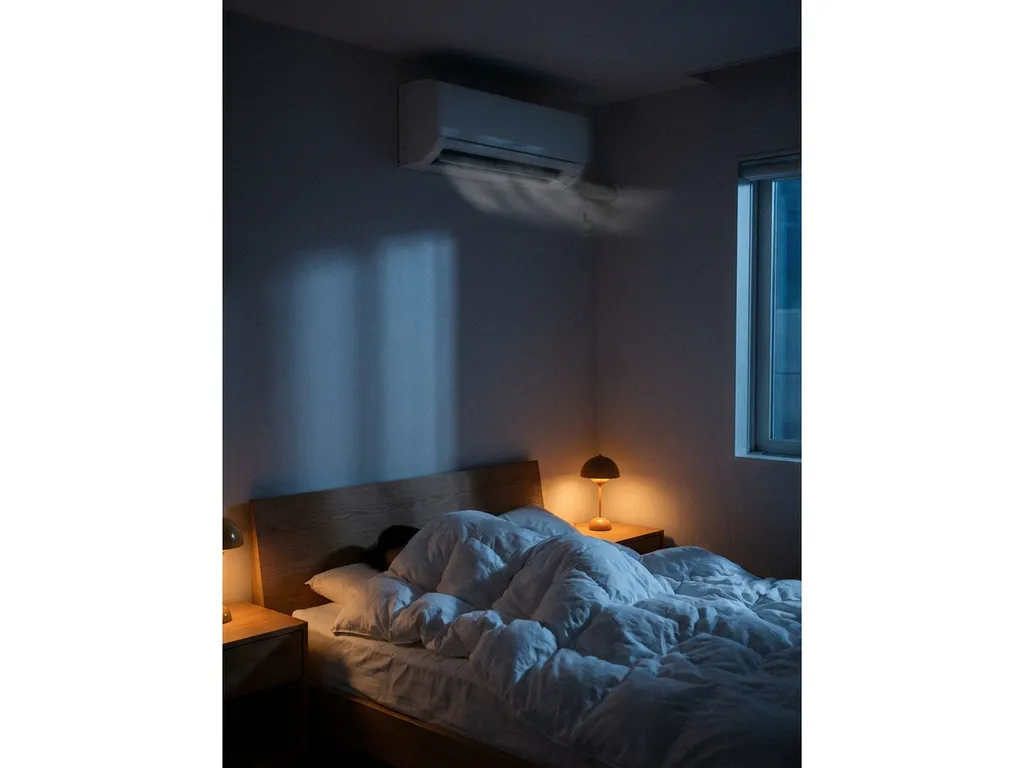
An average indoor air conditioner produces between 20 and 50 decibels, depending on the type and setting. That might sound like a small amount, but for a good night's sleep, even 30 decibels is noticeably disruptive, especially in a quiet bedroom. In this article, we answer the most frequently asked questions about air conditioning noise and sleep, from threshold values to practical solutions.
At what decibels does air conditioning noise become sleep-disrupting?
Air conditioning noise becomes sleep-disrupting from approximately 30 decibels. The World Health Organization recommends a background noise level of no more than 30 dB(A) in bedrooms at night. Above this level, the risk of disturbed sleep, difficulty falling asleep, and waking up more frequently increases significantly, even if you do not always consciously notice the noise.
This concerns not only the volume but also the nature of the sound. Many people perceive a constant, monotonous tone of 35 decibels as less disturbing than a fluctuating sound of 28 decibels, such as an air conditioner constantly switching on and off. That so-called impulse noise captures your brain's attention, even during light sleep phases. Sensitive sleepers notice a negative effect on their sleep quality at as low as 25 decibels.
How many decibels does an average indoor air conditioner make?
An average indoor split-unit air conditioner produces between 20 and 35 decibels on the lowest setting. On a higher setting or with older models, this can rise to 45 to 55 decibels, which is comparable to a quiet conversation or background music in a café.
For comparison: a whisper is about 30 dB, a normal conversation is around 60 dB, and a busy street can reach 70 to 80 dB. The indoor unit of an air conditioner is typically much quieter than the outdoor unit, which produces the compressor noise. Modern energy-efficient models, such as inverter air conditioners, are designed to run as quietly as possible and sometimes reach values of 19 to 25 decibels in sleep mode.
What is the difference in noise between air conditioning types?
The type of noise and decibel level vary significantly depending on the type of air conditioner. Split-unit systems are generally the quietest type for indoor use, while portable air conditioners and window air conditioners make considerably more noise because the compressor is located directly in the living space.
- Split unit (wall-mounted model): Indoor unit 20 to 35 dB, outdoor unit 45 to 65 dB. Ideal for bedrooms.
- Mobile air conditioner: 45 to 60 dB, the compressor is located in the room itself. Less suitable for use while sleeping.
- Window air conditioning: 40 to 55 dB, comparable to a mobile model but fixed installation in the window.
- Multi-split system: Similar to a standard split-unit, but one outdoor unit serves multiple indoor units simultaneously.
- Cassette air conditioner (ceiling): 30 to 45 dB, often used in offices and larger spaces.
Want to quiet air conditioner for the bedroom If you are looking for a split-unit with a low dB level in sleep mode, the best choice is a split-unit with a low dB level in sleep mode. When purchasing, pay specific attention to the stated noise level of the indoor unit in the lowest setting.
Why does an air conditioner sound louder at night than during the day?
An air conditioner sounds louder at night because ambient noise decreases significantly. During the day, background noise, such as traffic, voices, and household appliances, largely masks the sound of the air conditioner. At night, when it is quiet, the same noise level stands out much more and is perceived more consciously.
In addition, your brain's perception plays a role. During light sleep, the auditory system is more active than you might think. The brain continues to process sounds and reacts more quickly to unexpected or changing noises, even while you sleep. An air conditioner that switches on and off in a cycle, or that changes settings, produces precisely those changing sounds that activate your brain. Moreover, the sound from the outdoor unit can be transmitted through the wall or floor via vibrations, which is more noticeable at night.
How do you reduce noise from an air conditioner while sleeping?
The most effective way to reduce air conditioning noise while sleeping is to set the air conditioner to the lowest setting, pre-cool the room, and set the unit to a lower fan speed at night. Many modern air conditioners have a specific “sleep mode” that further limits the noise.
Additional measures that work well:
- Cool the room before going to sleep: Turn on the air conditioner at a higher setting an hour before bedtime, and turn it down or off when you go to sleep.
- Use sleep or night mode: This mode regulates the temperature gradually and reduces the fan speed.
- Check the mounting of the indoor unit: A loose bracket or poorly mounted unit amplifies vibrations and thereby the sound. Have this checked by a professional.
- Ensure proper placement of the outdoor unit: An outdoor unit mounted directly against a bedroom wall results in increased noise transmission. Distance and vibration-dampening mounting help.
- Consider earplugs or white noise: A constant background tone, such as a fan or a white noise app, masks the sound of the air conditioner.
- Have the filters cleaned: Dirty filters cause the air conditioner to work harder, which increases the noise level.
A properly installed air conditioner with a correct wall penetration also makes a big difference. A poorly drilled or insufficiently sealed penetration can cause extra noise and drafts.
What decibel level is legally permitted for an air conditioner?
In the Netherlands, the regulations from the Environmental Management Activities Decree apply to outdoor units of air conditioners. For residential areas, a maximum noise standard of 40 dB(A) during the day, 35 dB(A) in the evening, and 30 dB(A) at night applies, measured at the neighbours' facade. These are guideline values for the long-term average assessment level.
The exact standards may vary by municipality. Some municipalities apply additional local noise standards or specific rules for residential installations. If an outdoor air conditioning unit causes a nuisance to neighbors, they can file a complaint with the municipality or environmental agency. It is then up to the owner to demonstrate that the installation falls within the applicable standards. A noise report or measurement by a recognized agency can provide conclusive evidence in this regard. There are no statutory noise standards for indoor units, but manufacturers are required to state the noise level in the product specifications.
How De Betonboorder helps with the installation of your air conditioner
An air conditioner that makes too much noise is often due to a poorly executed wall penetration. A carelessly drilled hole, a poor seal, or vibrations transmitted through the wall mount significantly amplify the sound. We ensure professional and precise execution so that your air conditioner operates as quietly as possible.
What we do for you:
- Professional drilling of the penetration for the air conditioning pipes, with the correct diameter and angle
- Work with high-quality diamond core drills for a tight, clean drill hole without cracks or unnecessarily large openings.
- Minimal collateral damage to wall, insulation, and finish
- Tidy handover: the workplace is left clean and tidy.
- Rapid response: in many cases, a professional is available within two days
Do you want to know what your specific situation requires or schedule a professional immediately? Contact De Betonboorder and we respond within 24 hours.
Related Articles
- Can I have crawl space ventilation installed without damaging the facade?
- How does mechanical crawl space ventilation work?
- Are mold spores under the floor bad for the respiratory system?
- How do I find the cause of moisture under my floor?
- How much does an air conditioner cost for an apartment that heats up quickly?
- Olimpia Splendid vs Innova: which brand has the lowest electricity costs?
- Air conditioning in a home with many windows: how to prevent a greenhouse effect
- How do you prevent your air conditioning from having to run all day in the summer?
- How much power does an air conditioner consume per hour?
- What are the 10 best air conditioners?
- Can an air conditioner affect sleep quality?
- What do you do if your drill gets stuck in the wall?