
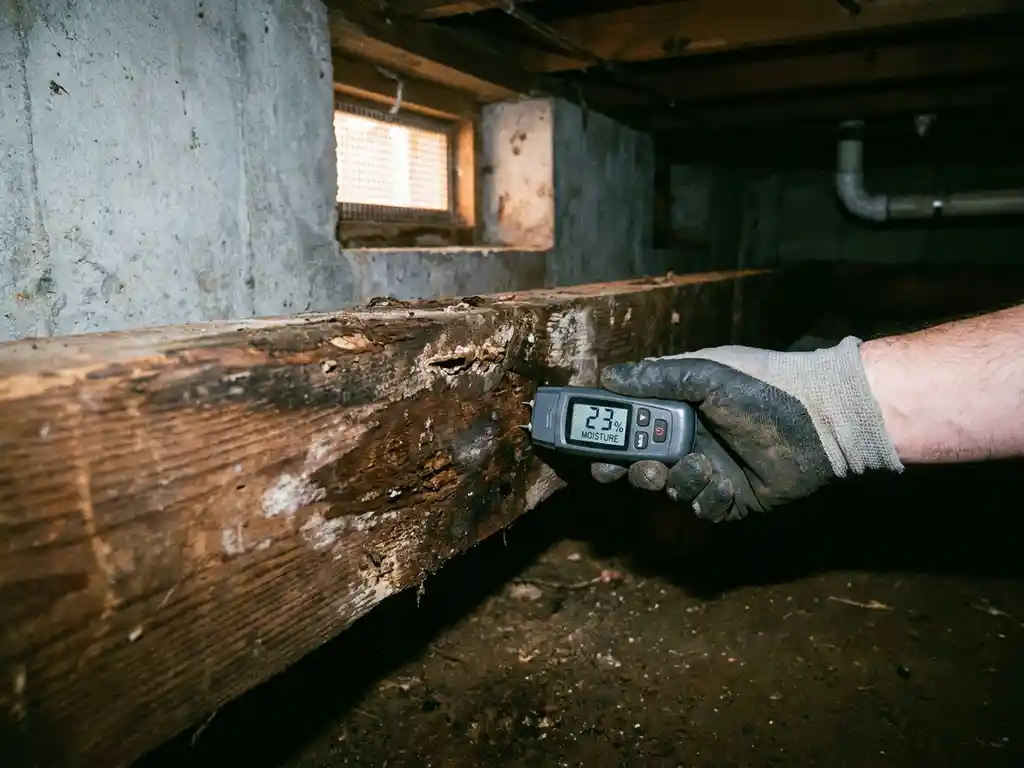
You can prevent wood rot in floor joists primarily by ensuring sufficient ventilation in your crawl space and limiting moisture infiltration. Moisture is the greatest enemy of wooden floor joists: as soon as wood is exposed to high humidity for an extended period, fungi and rotting bacteria have free rein. In this article, we answer the most frequently asked questions about wood rot, ventilation, and protecting your floor joists.
What causes wood rot in floor joists?
Wood rot in floor joists occurs when wood is exposed to excessive humidity or direct contact with water for a prolonged period. Fungi and bacteria responsible for wood rot can only thrive when the moisture content of the wood exceeds twenty percent. A poorly ventilated crawl space is the most common cause of this.
Moisture is almost always present beneath a home: groundwater, rainwater penetrating through the foundation, or condensation that forms when warm air from the home comes into contact with the cold subsoil. If this moist air has nowhere to go, the moisture accumulates in the crawl space. The wooden floor joists absorb this moisture and, over time, become vulnerable to rot.
Other causes include leaking pipes in the crawl space, a vapor barrier on the floor that is too thin or absent, or structural defects that allow rainwater to enter the crawl space directly. Furthermore, older homes often lack proper insulation, causing temperature differences to trigger extra condensation.
How do I recognize wood rot in my floor joists?
Wood rot in floor joists can be recognized by a combination of visual and physical signs. Soft, discolored, or brittle wood is the clearest sign. A musty smell in the house, a springy or sagging floor, and visible mold spots in the crawl space also indicate a moisture problem that can affect the floor joists.
You can perform a simple check yourself by poking the wood with a screwdriver or pointed object. Healthy wood is hard and springs back; damaged wood gives way and feels soft or fibrous. When inspecting your crawl space, also pay attention to:
- Dark discolorations or white mold threads on the beams
- Beams separating from the wall plate or visibly warped
- A strong musty or earthy smell in the crawl space or in the living room above
- Floorboards that move or creak under load
- Visible standing water or a wet floor in the crawl space
Preferably inspect your crawl space after a period of heavy rain to see if water is entering. Early intervention prevents wood rot from spreading further and making costly repairs necessary.
How do I ensure good ventilation in my crawl space?
Good one crawl space ventilation You ensure this by guaranteeing sufficient air circulation under the floor, so that moist air is removed before the wood can absorb it. The most effective approach combines ventilation openings in the exterior wall with a vapor barrier foil on the floor of the crawl space.
Ventilation openings, also known as ventilation grilles, are installed in the foundation or masonry surrounding the crawl space. They allow outside air to enter, displacing the humid indoor air. It is important that the grilles are placed on multiple sides of the home to create a continuous airflow. A grille on only one side provides insufficient extraction.
In addition to passive ventilation, there is also mechanical crawl space ventilation, in which a small fan actively supports air exchange. This is particularly useful in crawl spaces that are difficult to ventilate due to their structural condition, or in homes located in damp environments. Furthermore, a vapor barrier on the crawl space floor reduces the amount of moisture evaporating from the soil, which significantly lowers the load on the ventilation system.
What other measures protect floor joists against moisture?
In addition to good ventilation, there are several measures that protect floor joists against moisture and wood rot. The most important are installing a vapor barrier, checking pipes for leaks, treating the wood with a moisture-repellent agent, and improving water drainage around the home.
A vapor barrier on the floor of the crawl space is one of the most effective and affordable measures. This foil prevents ground moisture from evaporating and entering the crawl space air. Ensure that the foil overlaps well at the seams and runs upwards along the walls to also prevent moisture from entering laterally.
In addition, regularly check the pipes in your crawl space. Even small leaks at water connections or drain pipes can cause significant moisture damage over time. Also ensure that rainwater is properly drained via gutters and that the ground around the house slopes slightly away from the foundation, so that rainwater does not flow towards the crawl space.
Wooden floor joists that are still in good condition can be treated with a wood preservative or a fungicide. This slows down the growth of fungi and gives the wood extra resistance to moisture. This is a preventive measure and does not replace repair if active wood rot is already present.
When should I hire a professional for my crawl space?
You must hire a professional for your crawl space as soon as you notice visible wood rot, severe moisture damage, or structural problems with your floor. Professional help is also necessary if you do not have good access to the crawl space yourself, or if ventilation openings need to be installed in concrete or masonry.
Wood rot that has already affected part of the floor joists requires expert assessment. A professional determines which joists need to be replaced or reinforced and ensures that the underlying moisture issues are addressed. Without this approach, the problem will return, even after replacing the wood.
Installing ventilation openings in a concrete foundation or masonry wall is another instance where you need a professional. This requires precise drilling to avoid damaging the structure and to install the grilles in the correct location and to the correct size. Via our contact form You can quickly schedule an appointment for this type of work.
How De Betonboorder helps with crawl space ventilation
We at De Betonboorder specialize in installing ventilation openings in concrete foundations and masonry walls. Good crawl space ventilation starts with the right opening in the right place, and that is exactly where our craftsmen make the difference. What we do for you:
- Professional drilling of ventilation openings in concrete, stone, or masonry
- Working precisely with diamond core drills so that collateral damage is kept to a minimum.
- Install both passive and mechanical ventilation points tailored to your crawl space
- Work handled from start to finish, including a neat and tidy workspace afterwards.
- Quick deployment: in many cases, we arrange a professional within two days
Do you want to tackle moisture problems in your crawl space and protect your floor joists? View our range for crawl space ventilation of schedule a professional immediately via our website. We will contact you within 24 hours.
Related Articles
- How much nuisance does drilling ventilation holes in the foundation cause?
- Which grilles are best for crawl space ventilation?
- What is better against moisture: ground foil, shells, or ventilation?
- Innova 15HP ELEC vs Innova 18HP ELEC: when do you choose more capacity?
- What uses more electricity: an air conditioner or ventilating with a fan all day?
- How do you optimize the energy consumption of an air conditioner?
- Can an air conditioner work without an outdoor unit?
- Which air conditioner fits in a small space?
- Can an air conditioner affect sleep quality?
- How do I know if drilling through the foundation is allowed?
- When do you use a diamond drill instead of a regular drill?
- How much does a structural calculation for load-bearing wall removal cost?