
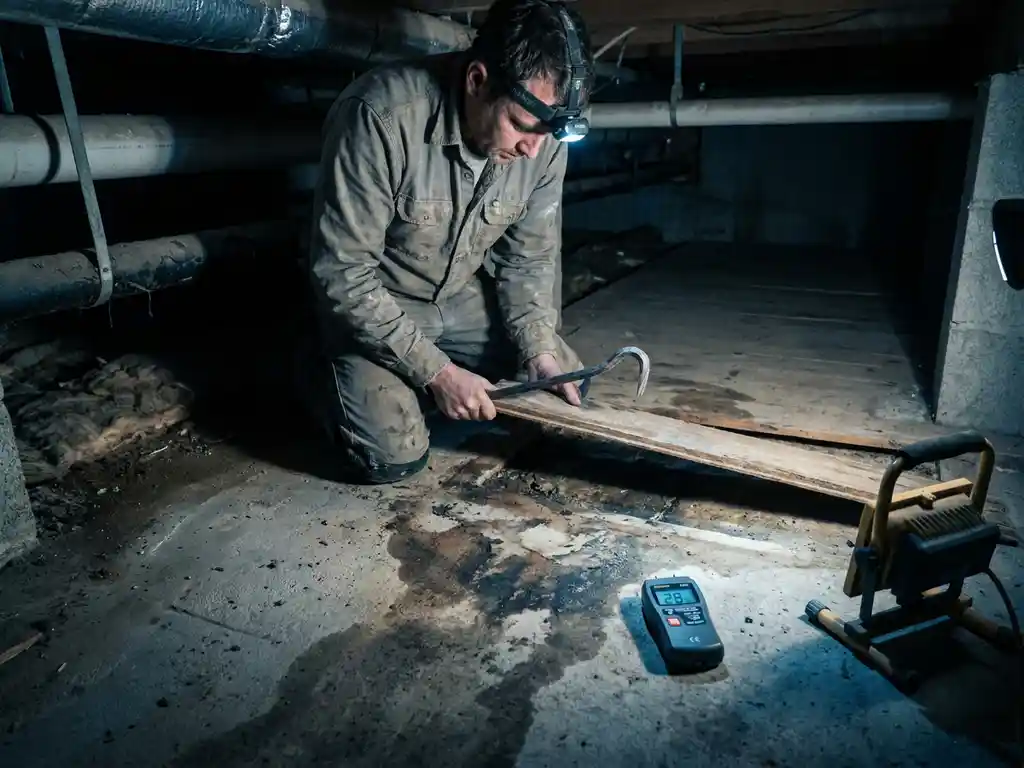
You can find the cause of moisture under your floor by systematically examining the most likely sources: condensation, leakage, rising groundwater, or inadequate ventilation in the crawl space. In most cases, a combination of visual signs and a simple moisture measurement will quickly point you in the right direction. This article covers the steps to take to identify the cause and what you can do next.
What are the most common causes of moisture under a floor?
Moisture under a floor is almost always caused by one of four factors: rising groundwater, condensation, a leaking water pipe, or poor crawl space ventilationIn homes with a crawl space, inadequate ventilation is by far the most common culprit, because stagnant, moist air has nowhere to go and condenses on cold surfaces.
Listed below are the four main causes:
- Rising groundwater: Groundwater rises through the foundation or the concrete floor slab by capillary action, especially in older homes without a proper moisture barrier.
- condensation: Warm, humid indoor air cools down on the cold underside of the floor and condenses as moisture. This is particularly a problem in poorly ventilated crawl spaces.
- Leaking pipes: A damaged water pipe or sewer under the floor can leak unnoticed for years and soak the surrounding structure.
- Rainwater or groundwater level: During heavy rainfall or a raised groundwater level, water can penetrate through cracks or insufficient sealing.
The cause completely determines which solution is needed. Therefore, it is important not to start repairing immediately, but to first thoroughly investigate where the moisture is coming from.
How do you recognize the signs of moisture under your floor?
Moisture under a floor betrays itself through visible and palpable signs: discolored or lumpy carpeting, a musty odor, white efflorescence on tiles or concrete, and wood rot in wooden floorboards. The sooner you recognize these signs, the less damage will occur.
Pay attention to the following concrete signs:
- Laminate or parquet that bulges, creaks, or comes loose from the subfloor
- Dark spots or mold growth at the edges of the floor or on the baseboards
- A persistent musty or earthy smell in the house, even after ventilating
- White deposits (efflorescence) on concrete or tiled floors, caused by salts carried along with the moisture.
- Rust spots on metal floor components or pipes
- Cold spots in the floor that do not match the rest of the room
A musty smell is often the first thing residents notice, but it is too quickly dismissed as a temporary problem. If the smell returns after airing, there is almost always a structural source of moisture present that requires further investigation.
How do you measure the moisture content in a concrete floor?
The moisture content in a concrete floor is measured with a moisture meter, also known as a hygrometer or humidity detector. There are two common methods: a surface measurement with a contact meter and a depth measurement using the CM method, in which a core sample is taken from the floor and chemically analyzed.
Surface measurement with a contact meter
A contact moisture meter measures the electrical resistance between two pins that you press into the surface. The wetter the concrete, the lower the resistance. This is a quick and inexpensive method, but it only provides information about the top layer. Deeper-lying moisture is not reliably measured with this method.
Depth measurement using the CM method
The CM method (calcium carbide method) is the most reliable way to measure the actual moisture content in the core of a concrete floor. This involves taking a core sample or drill core, mixing it with calcium carbide in a closed vessel, and measuring the amount of gas released. The result provides an accurate percentage of the moisture content. For laying floor coverings, a maximum permissible moisture content of 2,0 CM percent generally applies.
When is drilling a hole in the floor necessary for a moisture inspection?
Drilling into the floor is necessary when surface measurements do not provide a definitive answer regarding the cause of the moisture, or when you want to determine whether the moisture is coming from above (condensation) or from below (groundwater, leakage). By drilling a hole, you can take a sample for the CM method or look directly into the crawl space.
Specifically, drilling is necessary in the following situations:
- You want to take a reliable moisture sample for laboratory analysis or CM measurement.
- You suspect a leaking pipe under the floor and want to determine the exact location.
- There is no inspection hatch present and you want to visually inspect the crawl space or the underside of the floor.
- A contractor or installer needs access to pipes or structural elements under the floor.
Drilling into concrete requires the right equipment and knowledge. Incorrect drilling can hit reinforcing bars or damage the structure. Therefore, always have this type of work performed by a professional using diamond drilling techniques, ensuring the hole is drilled accurately and without collateral damage.
What do you do after you have found the cause of the damp floor?
After you have determined the cause of the floor moisture, you tackle the problem at the source. The approach differs depending on the cause: for condensation, improve ventilation; for rising damp, install a moisture barrier; for a leak, repair the pipe; and for groundwater intrusion, a drainage solution is necessary.
A practical step-by-step plan:
- Confirm the cause: If necessary, have the diagnosis confirmed by a structural engineer or moisture specialist before undertaking major interventions.
- Improve ventilation: For condensation and musty air, improving air circulation in the crawl space is often the most effective first step. A ventilation grille ensures a constant flow of dry outside air.
- Repair pipes or sealing: Have leaking pipes repaired immediately by a certified installer. Cracks in the floor or foundation are sealed with suitable injection materials or epoxy.
- Apply a moisture barrier: In the event of rising groundwater, a horizontal moisture barrier (injection or foil) is often installed in the wall or floor.
- Dry the structure: Allow the floor to dry completely before laying new flooring. This can take weeks to months, depending on the thickness of the concrete and the conditions.
- Check the result: Measure the moisture level again after the procedure to confirm that the problem has been resolved.
Do not wait too long to take action. Moisture under a floor not only affects the finish but can also damage the structure, insulation, and air quality in the home.
How De Betonboorder helps with moisture testing and crawl space ventilation
Once the cause of the floor moisture has been determined and intervention is required, De Betonboorder is ready to assist you. We help you in the following ways:
- Drilling inspection and sample openings: We drill precise holes in concrete floors for moisture sampling, pipe inspection, or direct inspection, without damaging the surrounding structure.
- Installing crawl space ventilation: We install ventilation grilles in the crawl space, allowing damp air to be removed and musty odors to disappear. Furthermore, good crawl space ventilation improves the insulation value of your home.
- National network of professionals: We work with a nationwide network of experienced specialists and in most cases are at your location within two working days.
- Neat delivery: Afterwards, we leave the workplace clean and tidy.
Have you discovered moisture under your floor and do you want to know what the next step is? Contact us and we will help you on your way quickly.
Related Articles
- How do I know if my wooden floor joists are damp?
- How do I tell if the musty smell in the house is coming from the crawl space?
- What is rising damp and how do I recognize it?
- Does crawl space ventilation also work in the winter?
- How big does an air conditioner need to be for my room?
- Can an air conditioner purify the air?
- When should you have an air conditioner installed so you are ready for summer?
- Which air conditioner is the quietest?
- How do I know if a contractor is allowed to just drill a hole in my wall?
- How do you drill multiple holes at exactly the same height?
- What is core drilling and when do you need it?
- Why is my drill slipping on a tile?