
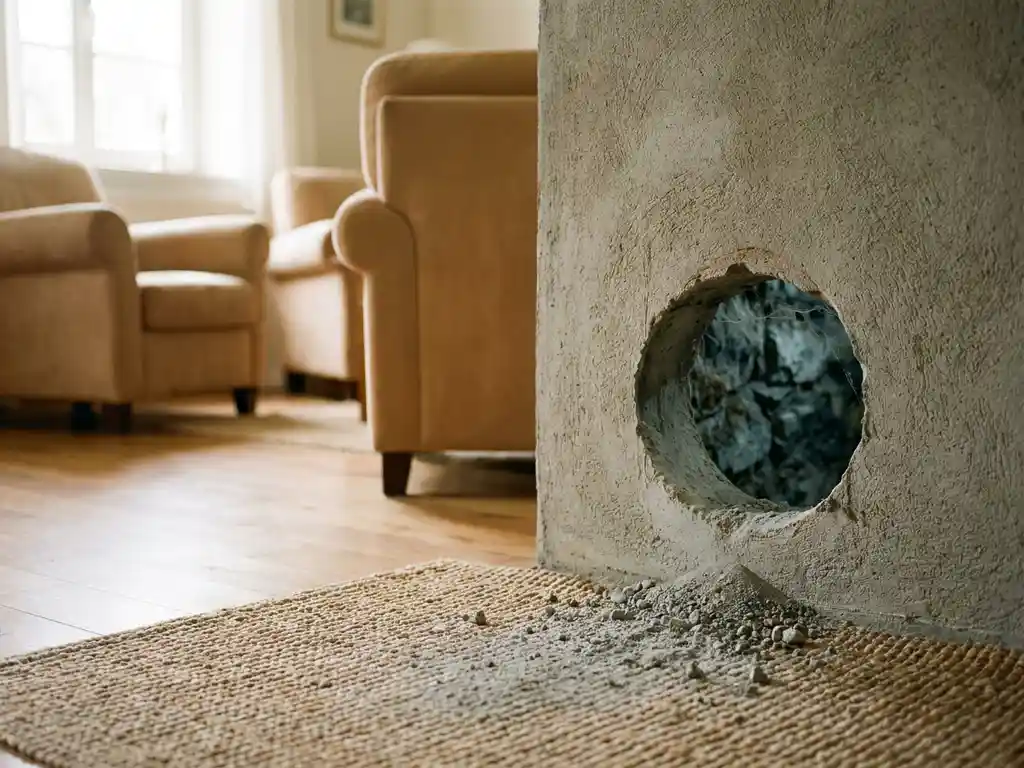
The musty basement smell in your living room almost always comes from the crawl space under your house. Moisture that accumulates there rises through cracks in the floor and spreads that typical moldy smell throughout your home. The solution lies in improving the crawl space ventilation, so that humid air can escape instead of ending up in your home. In this article, we answer the most frequently asked questions about this problem, from cause to solution.
Where does that musty cellar smell actually come from?
Musty air in the house is caused by damp, stagnant air creeping up from the crawl space through cracks, seams, and openings in the floor structure. Moisture from the ground collects in the crawl space through condensation and sometimes leaks. Without sufficient air circulation, that moisture has nowhere to go, and the odor it brings permeates your home.
The crawl space is naturally a dark, cool space with little air movement. Ground moisture evaporates constantly, but if there is no ventilation, that water vapor lingers. Over time, this can lead to mold formation on beams and insulation material. That mold is a major source of the musty smell you notice in your living room, even if the floor itself looks neat.
Houses built before the 1980s often have no or hardly any ventilation openings in the foundation. However, newer homes can also suffer from this problem, for example if ventilation grilles have become clogged by dirt, leaves, or a layer of insulation material installed too close to the ground.
How do you know if the crawl space is the source of the problem?
You can quite easily check if the crawl space is the cause of the musty smell in your living room. Open a hatch or access hatch to the crawl space and consciously smell the air coming out. If that air has the same musty odor as in your living room, you have found the source. Other signs further confirm this suspicion.
Pay attention to the following instructions:
- Condensation on the inside of floorboards or tiles that feel cold
- Visible damp patches or discoloration on the underside of the floor
- Mold formation on wooden beams or insulation material in the crawl space
- The scent is strongest in the early morning or after a period of rain.
- Ventilation openings in the exterior wall are plugged or completely missing.
If several of these signs apply, it is likely that poor air circulation in the crawl space is the root cause. The good news: this is a solvable problem, and you don't have to break open the entire floor to address it.
What really helps against musty air from the crawl space?
The most effective approach to musty odors from the crawl space is to improve ventilation, ensuring that moist air is continuously removed and replaced by drier outside air. Good crawl space ventilation addresses the root cause rather than merely masking the odor. Additional measures can further enhance the result.
These are the most proven solutions:
- Ventilation openings in the foundation: Holes in the concrete foundation or wall ensure a constant flow of air. This is the most sustainable solution.
- Mechanical crawl space ventilation: A small fan that actively extracts air is ideal if natural air circulation is insufficient.
- Installing ground foil: A vapor barrier on the floor of the crawl space prevents ground moisture from evaporating and making the air humid.
- Free up existing schedules: Check that ventilation openings are not blocked by dirt, insulation, or vegetation along the facade.
Of all these measures, installing or improving ventilation openings in combination with a ground foil is the most effective combination. Simply placing an air freshener or dehumidifier in the living room does not solve the problem structurally, because the source remains untouched.
How are ventilation holes drilled in concrete?
Ventilation openings in a concrete foundation are drilled using a diamond core drill, a tool that cuts a tight, round hole without damaging the surrounding concrete. The core drill is mounted on a water-cooled drilling machine, preventing the concrete from overheating and limiting dust. The result is a precise hole of exactly the desired diameter.
Drilling ventilation openings in concrete differs significantly from drilling with a standard hammer drill. A diamond core drill works by rotating and cutting, not by hammering. As a result, the surrounding structure remains intact, which is important in a foundation that supports the load-bearing capacity of the home. Reinforced concrete, aerated concrete, and even natural stone pose no problem for this technique.
The diameter of the holes is matched to the type of ventilation grille or duct to be placed inside. Common sizes range between 100 and 150 millimeters for standard grilles. After drilling, a grille or sleeve is fitted to keep insects and vermin out, while allowing air circulation to continue unimpeded.
When should you hire a professional for crawl space ventilation?
You hire a professional for crawl space ventilation as soon as the solution requires drilling holes in concrete or masonry. This is not a job for a standard hammer drill, as incorrect drilling can damage the foundation or result in a sloppy finish that does not seal properly. Professional advice is also wise if you are unsure of the cause of the moisture problem.
Situations where you definitely need a professional:
- There are no ventilation openings present and new holes need to be drilled in the concrete.
- The foundation is made of reinforced concrete, which requires special diamond equipment.
- You want to connect mechanical ventilation, and the duct must be tight and watertight.
- The moisture problem is serious, and you want to be sure that the cause is correctly determined.
For minor interventions, such as clearing existing grates or installing ground foil, you can do the work yourself. However, as soon as drilling into the foundation is required, professional work is the safest and most sustainable choice.
How De Betonboorder helps with crawl space ventilation
We take care of drilling ventilation openings in concrete foundations from start to finish, so you don't have to worry about the technical work. Via The Concrete Driller You can quickly and easily arrange for a professional who knows exactly how ventilation openings are installed correctly.
What we do for you:
- Drilling precision holes in concrete, reinforced concrete, or masonry with high-quality diamond core drills
- Minimal nuisance and damage to the surrounding structure
- The workspace is left neat and tidy.
- In many cases, schedule a professional within two days
- Nationwide network of experienced specialists, also in your region
Good crawl space ventilation reduces moisture problems, limits musty odors, and contributes to better insulation of your home. Would you like to know what we can do for your situation? Contact us and we respond within 24 hours.
Related Articles
- Can I turn my attic into a bedroom without a fixed staircase?
- How do I prevent wood rot on the floor joists under my house?
- Air conditioning installation costs: what does the price consist of?
- How much does an air conditioner in the attic cost, including installation?
- How much does a monoblock air conditioner cost? Complete price overview
- How many decibels does an air conditioner produce and when is that disturbing when sleeping?
- Can an air conditioner cause a headache?
- What is the difference between cooling capacity and electrical power in an air conditioner?
- Which air conditioner fits in a small space?
- How much does air conditioning cost, including installation?
- How do I request a quote for concrete drilling?
- What is a chemical anchor and when do you need it?