
The best air conditioner for an upstairs apartment is a split-unit air conditioner, because it is powerful enough to handle the excess heat that residents of an upstairs apartment experience structurally. A portable air conditioner can offer temporary relief, but lacks the capacity and efficiency that an upstairs apartment truly needs. In this article, we answer the most frequently asked questions about air conditioners for upstairs apartments, from type and capacity to costs and permits.
Why does an upstairs apartment heat up faster than other homes?
An upper-floor apartment heats up faster than other homes because the roof is directly exposed to solar radiation and there is no floor above to act as a buffer. The sun heats the roof throughout the day, after which that heat slowly penetrates the space below. This effect is noticeably stronger than in a mezzanine or ground-floor dwelling.
Adding to this is the fact that warm air naturally rises. All the heat present in the building collects at the top. Residents of an upstairs apartment therefore experience a double effect: heat from outside via the roof and heat from below rising. Without proper ventilation or cooling, the temperature in an upstairs apartment can quickly rise to several degrees above the outside temperature in the summer. A good air conditioning for your situation Choosing is therefore especially important if you live on the top floor.
Which types of air conditioning are suitable for an upstairs apartment?
For an upstairs apartment, there are two main types of air conditioning suitable: the Mobiele Airco and the split-unit air conditionerWhich type suits you best depends on your situation, budget, and whether you are willing to have an installation carried out. Both options have clear advantages and disadvantages that you must weigh carefully.
Mobile air conditioning
A portable air conditioner requires no permanent installation and is ready for immediate use. You place an exhaust hose through a window or door to the outside, and the unit cools the room. The disadvantage is that a portable unit operates less efficiently and makes more noise. Furthermore, the exhaust hose draws warm outside air inside if the seal is not perfect, which further reduces efficiency.
Split-unit air conditioner
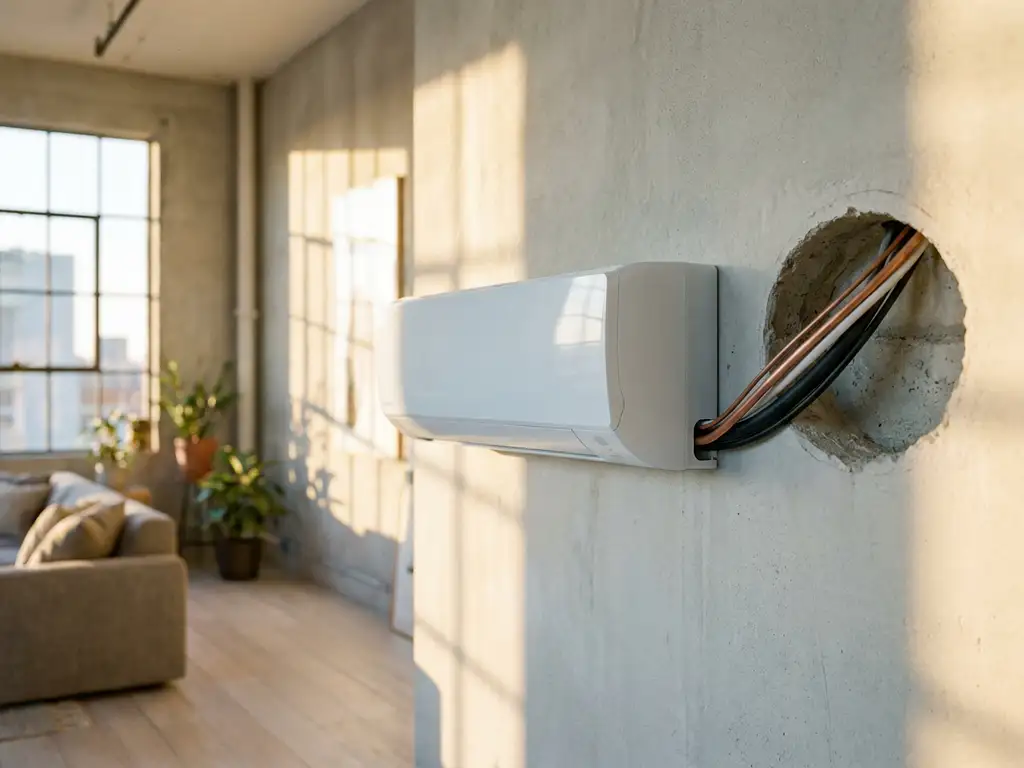
A split-unit consists of an indoor unit and an outdoor unit connected by pipes. This system is quieter, more efficient, and more powerful than a portable air conditioner. For an upstairs apartment, this is generally the best choice, especially if you want to cool multiple rooms or use the air conditioner for heating in the winter as well. However, installation does require a hole in the wall for the pipes.
What is the difference between a portable air conditioner and a split-unit?
The main difference between a portable air conditioner and a split-unit is the installation method and energy efficiency. A portable air conditioner is a standalone device without fixed mounting, whereas a split-unit consists of two separate units that are professionally installed. The split-unit is quieter, more energy-efficient, and cools more effectively, but requires a one-time installation.
- Mobile air conditioner: no installation required, ready to use immediately, less efficient, noisier, suitable for temporary use
- Split unit: professional installation required, quieter, more energy-efficient, higher cooling capacity, suitable for permanent use
- Cost: A portable air conditioner is cheaper to purchase, but more expensive to use due to lower efficiency.
- Comfort: A split-unit offers consistent cooling comfort without the inconvenience of a hose running through the window.
For an upstairs apartment, where the heat load is higher, a split-unit is almost always the better investment in the long term.
How much power does an air conditioner need for an upstairs apartment?
For an upstairs apartment, you typically have more power needed than for a comparable space on a lower floor. As a rule of thumb, you need approximately 80 to 100 watts of cooling capacity per square meter of living space, but for an upstairs apartment, it is better to increase this to 100 to 120 watts per square meter due to the extra heat load via the roof.
A 30-square-meter living room in an upstairs apartment therefore quickly requires an air conditioner with a cooling capacity of at least 3.000 watts, also referred to as 3 kW or approximately 10.000 BTU. Also take into account the following factors that influence the required power:
- The degree of roof insulation: a poorly insulated roof significantly increases the heat load.
- The orientation of the house: a south-facing roof captures more solar radiation.
- The number of windows and the presence of sun protection
- Ceiling height: higher ceilings mean more air volume to cool.
If in doubt, seek advice from a specialist who can perform a calculation based on your specific situation. This will prevent you from purchasing a device that is too weak and will never cool the room properly.
How much does it cost to install an air conditioner in an upstairs apartment?
The installation costs of an air conditioner in an upstairs apartment vary depending on the type of system, the complexity of the installation, and the accessibility of the outdoor unit. A split-unit installation involves not only mounting the units but also drilling a hole through the wall for the pipe run-through. Use the price tool for an indication of what your specific situation costs.
For an upstairs apartment, the installation can be slightly more complex than for a ground-floor home, as the outdoor unit sometimes needs to be placed on a roof or high facade. This may require extra equipment or scaffolding. Always request multiple quotes and ensure that the installer is certified to work with refrigerants, which is legally required in the Netherlands.
Do you need permission to install an air conditioner in an upstairs apartment?
In many cases, you have permission required to install an air conditioner in an upstairs apartment, especially if you rent or live in an apartment complex. The outdoor unit is visible on the outside of the building and falls under the common areas, for which the Homeowners Association (VvE) or your landlord must give permission.
These are the situations where you need permission or must take into account:
- Rental property: Always ask your landlord for written permission before having a split unit installed.
- HOA: If you are an owner in an apartment complex, you generally need approval from the Owners' Association to install an outdoor unit.
- Monumental buildings: For properties with monument status, additional rules apply, and an environmental permit may be required.
- Aesthetics Committee: Some municipalities have rules regarding the visibility of outdoor units on the street side.
A portable air conditioner does not require permission, as no permanent modifications are made to the building. Always check the regulations in your specific situation before hiring an installer.
How De Betonboorder helps with the installation of your air conditioner
Installing a split-unit air conditioner in an upstairs apartment requires more than just mounting the units. A precise hole must be drilled through the wall for the pipework, and that is exactly where we make the difference. We ensure a sleek, clean result without unnecessary damage to your home.
- We drill custom-sized holes for the pipe penetration of your split unit.
- We work with high-quality diamond core drills for clean, damage-free throughput.
- We leave the workplace neat and tidy.
- We work throughout the Netherlands and are available within two days in many cases.
- We help both private individuals and contractors and installers.
Would you like to know what we can do for your air conditioning installation? Contact us and we respond within 24 hours.
Related Articles
- Wall-mounted or floor-standing model: which air conditioner fits better in your interior?
- Air conditioner payback period: when do you recoup the investment?
- What temperature should you set on an air conditioner?
- How do you prevent an air conditioner from freezing?
- What is a monoblock air conditioner?
- Can an air conditioner make the air too dry?
- How does a Wi-Fi controlled air conditioner work?
- Can an air conditioner cause condensation problems?
- What is a recess and when do you need one?
- Can an oversized drill hole weaken a wall?
- What is the difference between a concrete driller and a handyman?
- What do you need to arrange with the neighbors when removing a load-bearing wall?