
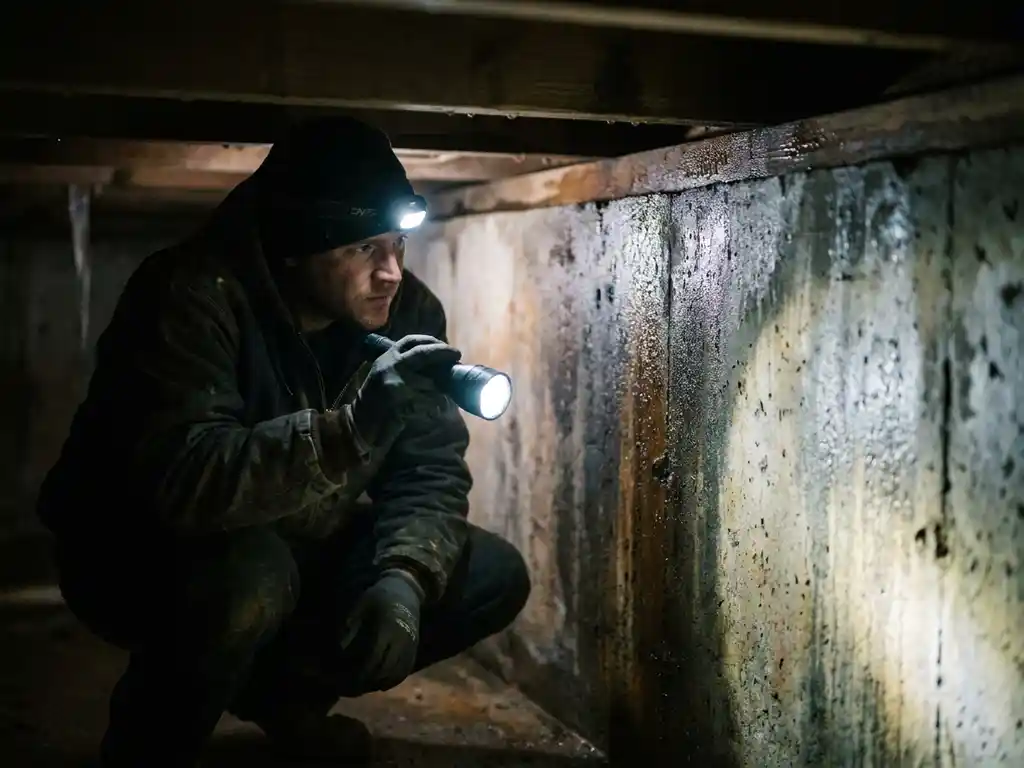
You inspect your crawl space for moisture damage yourself by systematically looking for visible mold, condensation, rust spots on metal parts, and wet or moldy insulation. A thorough self-inspection quickly gives you insight into the situation, so you know whether you can take measures yourself or need a professional. In this article, we answer the most frequently asked questions about inspecting your crawl space, step by step.
What signs of moisture damage are visible in a crawl space?
The most common visible signs of moisture damage in a crawl space are mold growth on wooden beams, white efflorescence on concrete walls, rust on steel pipes, wet or sagging insulation, and a musty odor that is also noticeable inside the home. If you recognize one or more of these signs, there is almost certainly a moisture problem.
Mold on woodwork is perhaps the clearest warning sign. Wooden floor joists that remain damp for extended periods compromise the load-bearing capacity of your floor. Efflorescence, also known as lime deposits, occurs when water seeps through concrete walls and carries minerals to the surface. This tells you that moisture is actively moving through the structure.
Also note:
- Condensation droplets on the inside of the crawl space walls or on pipes
- Sand or soil that feels damp or muddy
- Insulation material that is sagging or has turned black
- Woodworm infestation, which occurs more frequently in damp wood
- Musty or earthy smell that permeates into the living space above
Even if you don't see an immediate puddle of water, these signs can indicate structurally high humidity in the crawl space. A good crawl space ventilation is in that case one of the first solutions to consider.
How do you safely prepare for a crawl space inspection?
Safe preparation for a crawl space inspection consists of purchasing the appropriate personal protective equipment, checking the ventilation in the space, and ensuring adequate lighting. Never enter a crawl space without preparation, as the conditions can be dangerous.
What is the minimum you need before entering the crawl space?
- Overalls or old clothes with which you can cover yourself completely
- Knee pads to be able to crawl on hard surfaces
- A dust mask or FFP2 mask against mold spores and dust
- Gloves to avoid contact with mold and dirt
- A powerful flashlight or headlamp so that you have both hands free
- A mobile phone for emergencies
Check beforehand whether the crawl space is easily accessible. Ensure that the access hatch can open fully and do not block it during the inspection. Inform someone in the house that you are entering the crawl space. Do you immediately smell a strong chemical or gaseous odor upon opening the hatch? If so, do not enter and contact a professional.
Also check whether there are electrical or gas lines running through the crawl space that could be damaged. If you have any doubts about the safety, it is wise to call in a professional for the inspection.
How do you perform a crawl space inspection step by step?
You carry out a crawl space inspection step by step by first assessing the surroundings and soil, then checking structural elements such as beams and pipes, and finally examining the insulation and ventilation openings. A structured approach prevents you from overlooking anything.
Follow this sequence for a thorough inspection:
- Open the hatch and let the room ventilate first. by leaving the hatch open for five to ten minutes before entering.
- Check the bottom immediately after entering. Is the ground dry, damp, or even wet? Feel with your hand if the earth feels clammy.
- View the crawl space walls on limescale, cracks, or dark damp spots.
- Inspect the wooden floor joists From below. Gently press your thumb into the wood. If it feels soft or spongy, there is wood rot.
- Check pipes and installations on rust formation, condensation droplets, or leaks.
- View the insulation which is attached to the underside of the floor. Is it hanging loose, is it discolored, or does it feel damp?
- Locate the vents and check if they are free of dirt, cobwebs, or other blockages.
Take photos of everything you notice during the inspection. This way, you can properly assess the situation later and compare it when you inspect the space again after a few months.
What are the most common causes of moisture in a crawl space?
The most common causes of moisture in a crawl space are rising groundwater, condensation due to temperature differences, insufficient or blocked ventilation, and leaking pipes or foundation problems. In most cases, a combination of factors is involved.
Rising damp and groundwater
In the Netherlands, the groundwater level is relatively high in many regions. After a wet period or during heavy rainfall, groundwater can enter the crawl space, especially if there is no proper vapor barrier foil on the floor. Rising damp travels up through the foundation and the soil, increasing the humidity throughout the entire space.
Poor or absent ventilation
A crawl space requires fresh air circulation to remove moist air. If ventilation openings are blocked or completely missing, moist air remains trapped and condenses on cold surfaces such as pipes and concrete walls. This is one of the most underestimated causes of structural moisture problems.
When should you call in a professional for crawl space problems?
You must call in a professional when you find severe wood rot in the joists, see structural cracks in the foundation, detect active water intrusion that does not stop, or when the mold growth is so extensive that you cannot safely deal with it yourself. In all these cases, self-intervention is insufficient or even dangerous.
Some situations are clear: a centimeter of water on the floor of your crawl space calls for immediate action by a specialist. But more subtle situations also justify professional advice, such as when:
- The musty smell in the house persists even though you have cleared the ventilation openings.
- You feel soft spots in your wooden floor above the crawl space
- There is condensation on the inside of exterior walls
- You are not sure how serious the damage is
A professional can not only assess the damage but also take targeted measures, such as installing crawl space membranes, fitting a ventilation system, or repairing damaged structural components. Delaying professional intervention leads to higher costs in the long run in most cases.
How De Betonboorder helps with crawl space ventilation
Good crawl space ventilation is often the most effective and sustainable solution for moisture problems in the crawl space. We at De Betonboorder help you with this in a concrete way:
- Installation of ventilation grille(s) in the crawl space for optimal air circulation
- Drilling ventilation openings in concrete or masonry, accurately and without unnecessary damage to the surroundings
- Improvement of insulation of your home as an additional benefit of good ventilation
- Tackling musty odors that enter the home from the crawl space
- Rapid deploymentIn many cases, we arrange a professional for you within two days.
Our professionals handle the job from start to finish and ensure that the workplace is left tidy. Would you like to know what we can do for your situation? Then contact us and we respond within 24 hours.
Related Articles
- Which parts of my upper floor are load-bearing?
- Can I install crawl space ventilation myself, or does a professional need to do it?
- Hidden costs when purchasing an air conditioner: what should you look out for?
- Can an air conditioner increase the value of your home?
- How does a Wi-Fi controlled air conditioner work?
- How thick is an average concrete floor?
- How do I know if a job is too big to do myself?
- How do I know if my wall contains asbestos?
- What is core drilling and when do you need it?
- How do you create a wall penetration for an air conditioner?
- What are the best renovations to create a greater sense of space in a terraced house?
- How does load-bearing wall removal work in a 70s home?