
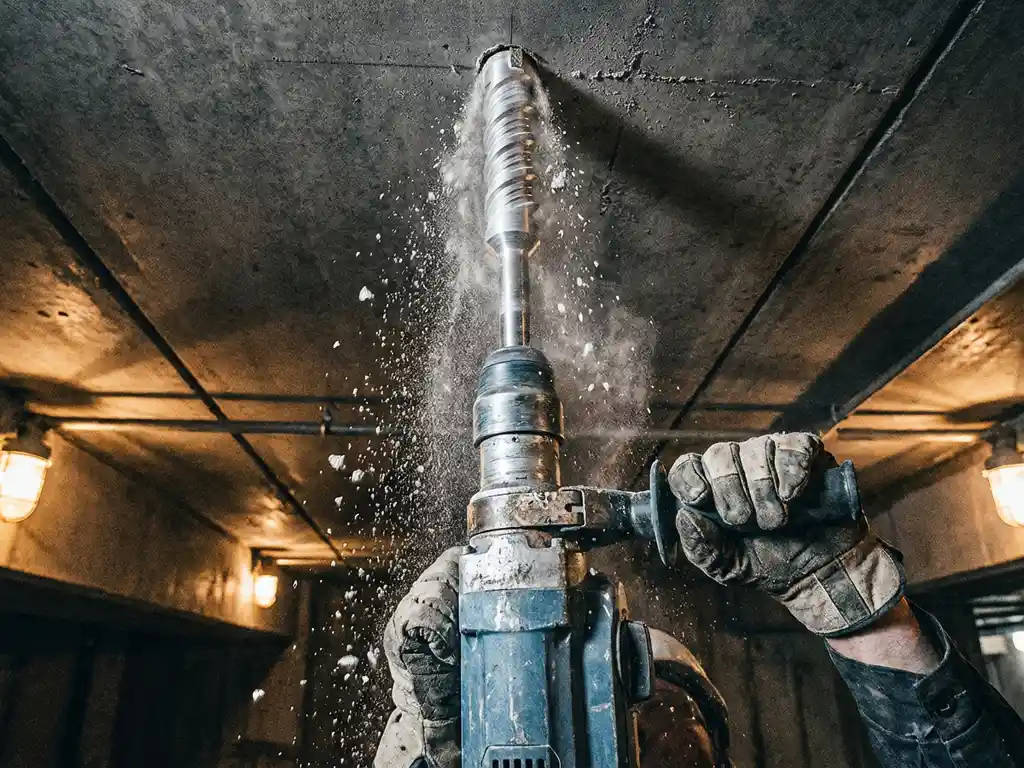
Installing spotlights in a concrete ceiling requires the right preparation, the right tools, and the right technique. Concrete is a hard material that requires specific drilling methods to create neat, precise holes without damaging the ceiling. With the right approach, you can achieve professional results and install your spotlighting safely.
In this article, we discuss step-by-step how to successfully drill holes for spotlights in concrete ceilings: from choosing the right tools to professional techniques that prevent damage.
What tools do you need to drill a hole in a concrete ceiling?
To drill into a concrete ceiling, you need a powerful hammer drill or SDS drill, diamond core drills of the correct diameter, a vacuum cleaner for dust extraction, and safety equipment such as a dust mask and safety glasses.
The drill must have a power output of at least 800 watts to drill through concrete effectively. SDS drills are ideal because they are specifically designed for drilling into hard materials. Choose diamond core drills instead of standard concrete drills, as these work much more efficiently and produce less vibration.
Additional necessities include a spirit level for drilling straight holes, a pencil for marking, and possibly a ladder or scaffolding for working safely at height. Good dust extraction is essential to keep your workspace clean and minimize health risks.
How do you determine the correct position for spotlights in a concrete ceiling?
First, measure the space and distribute the spotlights evenly, with a distance of 1,5 to 2 meters between them. Mark the positions with a pencil and use a detector to check that there is no reinforcement, pipes, or cables in the concrete at the marked spots.
Start by determining the lighting plan. Spotlights must provide sufficient light without creating dark corners. Take into account the brightness of the spotlights and the desired atmosphere in the room. Different requirements apply to a living room than to a kitchen or bathroom.
Always use a pipe detector before you start with concrete drillingThese devices can detect metal and cables hidden in the concrete. Pay particular attention to reinforced concrete, where reinforcing bars can affect the position of your spotlights.
Which drilling technique do you use for spot holes in reinforced concrete?
Start with a small pilot hole of 6-8 mm and drill it completely through the concrete. Then gradually increase to the desired diameter using diamond core drills, continuously using water for cooling and dust suppression.
Reinforced concrete contains steel reinforcing bars that require extra attention. When you encounter reinforcement, switch to a metal drill bit to cut through the steel. Then continue with the diamond core drill bit for the remaining concrete.
Apply even pressure without forcing it. Let the crown drill do the work and prevent overheating by pausing regularly. For thicker ceilings, it may be necessary to drill from both sides to obtain a perfectly round hole.
How do you prevent damage to the concrete ceiling while drilling?
Always use water cooling while drilling to prevent overheating, drill with even pressure without forcing it, and ensure proper support for the drill to minimize vibrations that can cause cracks.
Always start at a low speed and increase it gradually. This prevents the drill bit from slipping and scratching the concrete. Place a piece of tape over the drilling spot to prevent chipping on the surface.
Watch out for signs of problems, such as excessive vibration, smoke, or unusual noises. Stop immediately if you feel resistance indicating rebar or a pipe. Regularly check that the hole remains straight by checking the angle of the drill.
When should you hire a professional for concrete drilling?
Hire a professional for ceilings thicker than 20 cm, if you have doubts about reinforcement or pipes, if you have no experience with concrete drilling, or if you need multiple large holes that require precision and speed.
Professional concrete drillers have specialized equipment at their disposal, such as diamond drilling rigs with water connections and powerful dust extraction systems. They can also use X-ray detection to precisely determine the location of reinforcement and pipes.
In complex situations, such as stretch ceilings, hollow slab floors, or ceilings with many installations, professional expertise is indispensable. A specialist is also the right choice if you want a guarantee on the result or do not have time for a time-consuming job.
How De Betonboorder helps with spot holes in concrete ceilings
We specialize in the professional drilling of recessed holes in concrete ceilings and ensure perfect results without damage. Our experienced craftsmen have high-quality diamond core drills and modern equipment to work dust-free.
Our services include:
- Precision drills for holes with a diameter of 4 to 350 millimeters
- Work dust-free with professional extraction systems
- Pre-detection of reinforcement and pipes
- Tidy up the workspace neatly afterwards
- Fast service within two days
Whether you want to install a single spotlight or are planning a complete lighting installation, we ensure professional work without the hassle. Contact us for a no-obligation quote and leave the drilling work to the professionals.
Related Articles
- Does more ventilation help against moisture under the floor?
- How do I inspect my crawl space for moisture damage myself?
- Innova 9HP Mini vs Innova 12HP Vertical: the best choice for a bedroom
- How much does professional air conditioning installation by a professional cost?
- Having air conditioning installed: how does the installation proceed step by step?
- Qlima vs Olimpia Splendid: which brand is the better choice?
- Can you drill into concrete when it is freezing outside?
- How do you install an air conditioner yourself?
- Which air conditioner is suitable for an attic room?
- How thick is an average concrete floor?
- What are the pitfalls of hiring a cheap concrete driller?
- What are the consequences of incorrect load-bearing wall removal?