
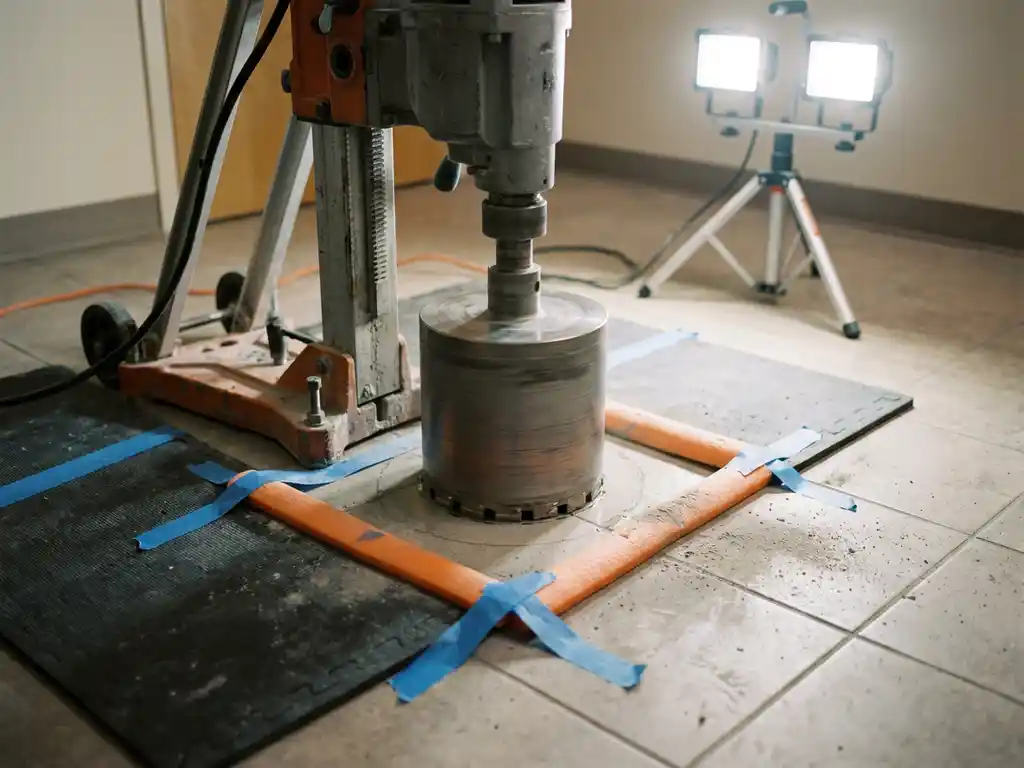
In the event of a floor breakthrough, such as the create stairwell For a fixed staircase, protect the surrounding finish by properly covering the subfloor, installing dust protection, and choosing the correct drilling technique. Good preparation prevents damage to tiles, parquet, plaster, and other vulnerable surfaces. In this article, we answer the most frequently asked questions about protecting your finish during a floor breakthrough.
Which finishes are most at risk during a floor breakthrough?
When a floor is broken through, hard, brittle floor coverings such as tiles and natural stone are particularly at risk of damage, followed by parquet and laminate. Plasterwork on nearby walls and ceilings is also vulnerable to vibrations and dust settling. The closer the finish is to the drill point, the greater the risk.
Tiles are particularly sensitive because they can crack or come loose due to vibrations, even at some distance from the actual drilling point. Parquet and laminate are less brittle, but can sustain permanent stains or scratches from coarse debris, drilling water, or heavy equipment driven over them. Plasterwork on walls close to the breakthrough may show hairline cracks if the vibration load is too high.
The structure itself also plays a role. With a reinforced concrete floor, the vibrations during drilling are more intense than with aerated concrete or a wooden floor with a concrete layer. The more reinforcement in the floor, the more force is required and the greater the risk of collateral damage to adjacent surfaces.
How is the work floor protected before drilling begins?
The work floor is protected by a combination of covering material, edge protection, and a well-thought-out work route. Sturdy protective cardboard or rubber mats are laid on the floor around the drilling point so that tools, debris, and drilling water do not cause direct damage to the underlying finish.
Good preparation consists of the following steps:
- Covering the floor surround the work zone with sturdy protective cardboard or plywood sheets, at least one meter around the drill point.
- Installing edge strips or tape along tile or parquet edges to prevent the edge from chipping when starting the saw or drill.
- Clearing the work route so that there are no furniture, thresholds, or other objects that heavy equipment can bump into.
- Sealing adjacent spaces with dust walls or foil, so that dust does not get into the rest of the house.
In occupied situations, preparation is especially important. In the case of a floor opening in a home Where people live or work, protecting furniture, floors, and walls in adjacent rooms is at least as important as the protection directly around the drill point itself.
What is the difference between concrete sawing and concrete drilling when breaking through a floor?
When breaking through a floor for a stairwell, concrete saws are used to cut out the contours of the opening straight and accurately, while concrete drills are used for round openings or as a starting point for the saw. Concrete sawing is the most commonly used method for stairwells because it provides a straight, clean cut with minimal overhang onto the surrounding floor.
Concrete sawing uses a diamond saw blade that cuts through the floor along a straight line. This provides a clean, predictable cut and limits vibration transfer to the rest of the floor. The saw operates precisely along a pre-marked line, which means the finish around the opening remains intact if the preparation is done properly.
Concrete drilling with a diamond core drill bit is sometimes used to pre-drill the corners of a rectangular opening, so that the saw has a starting point without the blade getting stuck in the corner. This prevents slippage and protects the corners of the new floor edge. Together, both techniques provide the most controlled result for a stairwell or other floor opening.
How is dust and vibration damage to surrounding finishes limited?
Dust damage is limited by using dust extraction directly on the tool and by installing dust walls around the work zone. Vibration damage is limited by choosing diamond techniques, which operate more accurately and quietly than hammer drills or demolition hammers.
Dust control during a floor breakthrough
Concrete drills and saws produce fine dust that spreads rapidly. An industrial vacuum cleaner connected directly to the drill or saw captures the majority of the dust at the source. Additionally, dust walls made of foil or fabric are installed to shield the work zone from the rest of the room. In occupied situations, ventilation openings and doors are also taped shut to prevent fine dust from entering bedrooms or closets.
Controlling vibrations during drilling
Vibrations are inevitable when breaking through a floor, but they can be controlled. Diamond core drills and diamond saw blades cut the concrete rather than crushing it, resulting in significantly less vibration energy than traditional hammer drilling. Additionally, it helps to perform the breakthrough in stages rather than sawing through the full thickness at once. This keeps the load on the surrounding structure and finish manageable.
How much does it cost to protect the finish when breaking through a floor?
The costs for protecting the finish are typically included in the work of a skilled concrete driller. A professional company typically includes protective equipment, dust extraction, and protective sheeting as part of the job. As the client, you usually do not have to pay separately for this or purchase materials yourself.
What you can do yourself to save costs is clear the work zone beforehand. Remove furniture, rugs, and decorations from the immediate vicinity of the workspace. The less time a professional spends moving and protecting your belongings, the more efficiently the job will proceed. This saves time and keeps total costs manageable.
When requesting a quote, always explicitly ask whether surrounding area protection is included and exactly what is being covered. This prevents surprises afterwards and ensures that your finish is properly protected during the floor breakthrough.
How De Betonboorder helps protect your finish
At De Betonboorder, we understand that breaking through a floor in an occupied situation requires care. We work with experienced craftsmen who not only master the technical aspects of creating the stairwell, but also know how to leave your home neat and undamaged. This is what we arrange for you:
- Professional dust extraction directly on the tool, so that dust dispersion is kept to a minimum.
- Covering the work floor and surroundings with protective equipment, included as standard in the work.
- Use of diamond techniques for a precise, low-vibration breakthrough that spares the surrounding finish.
- Structural advice regarding the position and execution of the stairwell, including a steel structure for safety.
- Neat delivery: the workplace is left clean and tidy after completion of the job.
Would you like to know what we can do for your situation? Contact us and we will respond within 24 hours with a suitable proposal.
Related Articles
- Can a stairwell be closed up again?
- Are mold spores under the floor bad for the respiratory system?
- Innova 12HP vs Innova 15HP: how much power do you really need?
- How much does a monoblock air conditioner cost? Complete price overview
- What temperature should you set on an air conditioner?
- Why is my air conditioner dripping water?
- What is an inverter air conditioner?
- What temperature in the house is unhealthy?
- How do you check if an air conditioner is working properly?
- For which jobs do you need a concrete drill?
- What are the risks of removing a load-bearing wall yourself?
- How long does it take to remove a load-bearing wall?