
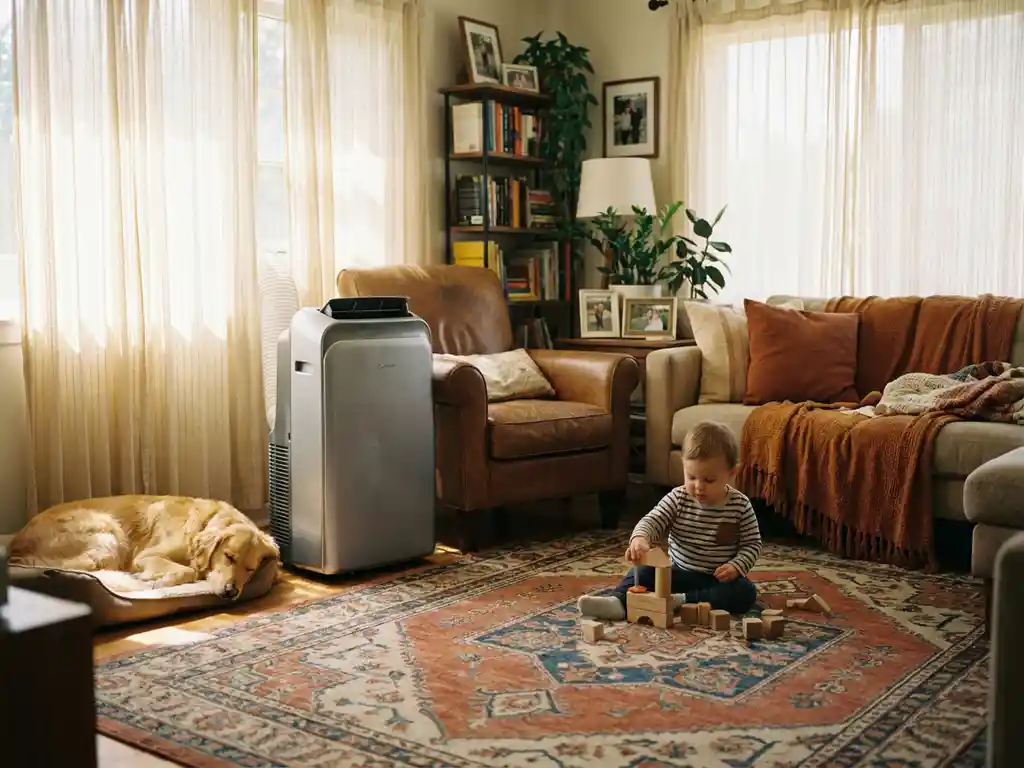
An air conditioner is safe for children and pets, provided you set it sensibly and observe a few basic rules. The temperature, airflow, and air quality determine whether the system contributes to a pleasant indoor climate or causes discomfort. In this article, we answer the most frequently asked questions about using an air conditioner in a busy living room with children and pets.
Is an air conditioner safe for children and pets?
Yes, an air conditioner is safe for children and pets as long as you use it correctly. Most risks do not arise from the device itself, but from incorrect settings: air that is too cold, direct airflow on people or animals, or a neglected filter. With the right approach, an air conditioner actually offers more comfort and a healthier indoor climate.
Children and pets are more sensitive to temperature fluctuations than adults. A too abrupt transition from warm to cold can lead to cold symptoms or stress in animals. Therefore, never direct the air outlet directly at a high chair, play area, or pet bed. Also ensure that pets always have the option to move to a warmer room.
Check your air conditioner filters regularly. Dirty filters spread dust, mold spores, and other particles that can be particularly harmful to children and pets. Clean filters are therefore not only good for the efficiency of the device, but also for the health of everyone in the house.
What temperature is ideal when using air conditioning with children?
When using air conditioning with children, an indoor temperature of 22 to 24 degrees Celsius is ideal. This is cool enough to prevent heat stress, but warm enough to avoid signs of overcooling such as shivering or muscle cramps. Avoid settings below 20 degrees, especially if children are playing or sleeping in the room.
Babies and toddlers are less able to regulate their body temperature than older children. For a room where a baby sleeps, 22 degrees is a safe upper limit. Check regularly whether the child is lying comfortably and does not feel too cold, even if the room seems pleasantly cool.
Do not set the air conditioning to the lowest setting when children have just come in from outside. Let them acclimatize for a few minutes before the room reaches the desired temperature. This prevents abrupt temperature shocks that can strain the immune system.
How do you set up an air conditioner for a busy living room?
For a busy living room with children and pets, it is best to set the air conditioner to a moderate cooling setting, with a timer and a targeted airflow that does not hit anyone directly. Use the fan mode to circulate the air without additional cooling, and switch on the cooling function when the temperature really rises.
Practical settings for a family living room:
- Temperature: 22 to 24 degrees Celsius as a target value
- Air direction: towards the ceiling or sideways, never directly on people or animals
- Fan speed: low to medium for a quiet sound level
- Timer: Start the air conditioning 30 minutes before arrival so that the room is already cool.
- Sleep mode: Use night mode when using in the evening for less noise and a stable temperature.
Modern air conditioning systems also offer a smart air conditioning configuration with which you can adjust the settings remotely via an app. Handy if you want to make sure the living room is already cool before the children come home.
What does air conditioning do to air quality for pets?
An air conditioner affects the air quality in your home in two ways: it filters particles from the air and lowers humidity. This is positive for most pets, but if humidity is too low, animals may suffer from dry mucous membranes, itchy skin, or respiratory problems. A humidity level between 40 and 60 percent is most comfortable for both people and animals.
Dogs and cats generally tolerate cooled air well, provided they are not lying in the direct airflow. Rodents, birds, and reptiles are more sensitive. Reptiles need warmth for their metabolism and should never be kept in a room that is too cold. Birds are sensitive to drafts and can quickly become ill in direct cold air.
Check your air conditioner filters at least once a month if you have pets. Pet hair and dander clog filters faster than average, which degrades air quality and reduces the efficiency of the unit.
Which type of air conditioner is best suited for a family home?
For a family home with a busy living room, a split-unit air conditioner is the most suitable choice. This system consists of an indoor and an outdoor unit, operates quietly, cools efficiently, and offers precise temperature control. Compared to portable air conditioning systems, a split-unit is quieter, more powerful, and more energy-efficient in the long run.
Split unit air conditioning
A split-unit is ideal for families because the indoor unit operates quietly and dissipates heat via an outdoor unit. There is no need for a hose running through a window or door, which makes the installation neater and lets in less heat. Most models also have a heating function, allowing you to use the system all year round.
Mobile air conditioning
A portable air conditioner is easy to move and requires no permanent installation, but it has lower efficiency and produces more noise. For a family home, this is a temporary solution, not a permanent one. The exhaust hose, which must go through a window, also lets warm air in, partially negating the cooling effect.
When is air conditioning better than a fan?
Air conditioning is better than a fan as soon as the outside temperature rises above 28 degrees. A fan moves air but does not lower the temperature. At high temperatures, a fan simply blows warm air around, which offers hardly any cooling. An air conditioner lowers the actual air temperature and is therefore more effective during real heatwaves.
For families with young children or pets, this distinction is important. Heat stress in children and animals can occur quickly during prolonged heat. In such cases, a fan offers insufficient protection. An air conditioner provides a reliable, adjustable temperature that you can adapt to the needs of everyone in the house.
A fan remains useful as a supplement: use it to better distribute cooled air throughout the room, not as a replacement for the air conditioner. Combine both for an efficient and comfortable indoor climate on hot days.
How De Betonboorder helps with the installation of your air conditioner
Installing an air conditioner in an existing home often requires more than just hanging the indoor unit. For a split-unit air conditioner, a hole must be drilled through the wall so that the pipes can run between the indoor and outdoor units. That is exactly what we at De Betonboorder take care of.
What we arrange for you:
- Professional drilling of the through-hole through concrete, brick, or other materials
- Work precisely with diamond core drills for a sleek and clean result.
- Minimal collateral damage to the surrounding wall or finish
- Work is possible in occupied properties, including family homes.
- Tidy handover: the workplace is left clean
Do you want to know what your situation requires or schedule a professional immediately? Contact us and we ensure that the drill hole for your air conditioning installation is made quickly and professionally.
Related Articles
- Is crawl space ventilation a permanent solution or does it require maintenance?
- How does mechanical crawl space ventilation work?
- Can a damp crawl space become a problem when selling my house?
- Olimpia Splendid vs Innova: which brand has the lowest electricity costs?
- Innova vs. the competition: why choose an Innova monoblock air conditioner?
- Innova vs Qlima: which brand offers the best monoblock air conditioner?
- What is a portable air conditioner?
- Can an air conditioner cause noise nuisance for neighbors?
- What happens if you accidentally drill through a pipe?
- Can an oversized drill hole weaken a wall?
- What preparation is needed for load-bearing wall removal?
- When is load-bearing wall removal the best solution?